Calculations references
VO
2
and VCO
2
"Energy Expenditure and Fuel Selection in Biological Systems: The Theory and Practice of Calculations Based on Indirect Calorimetry and Tracer
Methods": M. Elia, G. Livesey, World Rev. Nutr. Diet. Basel, Karger, 1992, vol 70, pp 68-131.
"Nutritional Assessment in Critical Care, A Training Handbook": Donald C. Zavala
Anaerobic Threshold (modified V-Slope)
The intercept of the two slopes is defined as the VO2 above which VCO2 increases faster than VO2 without hyperventilation and can be selected
automatically or manually by the software.
During incremental exercise above the Lactate Threshold, a net increase in lactic acid production results in an accelerated rate in VCO2 relative to
VO2. When plotting these variables against each other a linear relationship is displayed. The slope of the lower component is slightly less than 1.0,
whereas the upper component has a slope greater than 1.0. The intercept of these two slopes is the LT or AT point as measured by gas exchange.
The increase in VCO2 in excess of that derived from aerobic metabolism must be generated from the buffering of lactic acid. This is seen in all
subjects exercising at work levels above their LT.
References
OVS, Original V-Slope method: "A new method for detecting anaerobic threshold by gas exchange", Beaver, Wasserman, Whipp, JAP 1986,
60:2020-2027.
MVS, Modified V-Slope method: "Metabolic acidosis during exercise in patients with chronic obstructive pulmonary disease", Sue, Wasserman,
CHEST 1988, 94:931-938.
Oxygen Kinetics
“Delayed Kinetics of VO2 in the Transition from prior Exercise. Evidence for O2 Transport Limitation of VO2 Kinetics: A Review”; R.L. Hughson and
M.A. Morrissey, Int. J. Sports Med. 4 (1983) 31-39
ISO 8996: Ergonomics – Determination of metabolic heat production, 1990
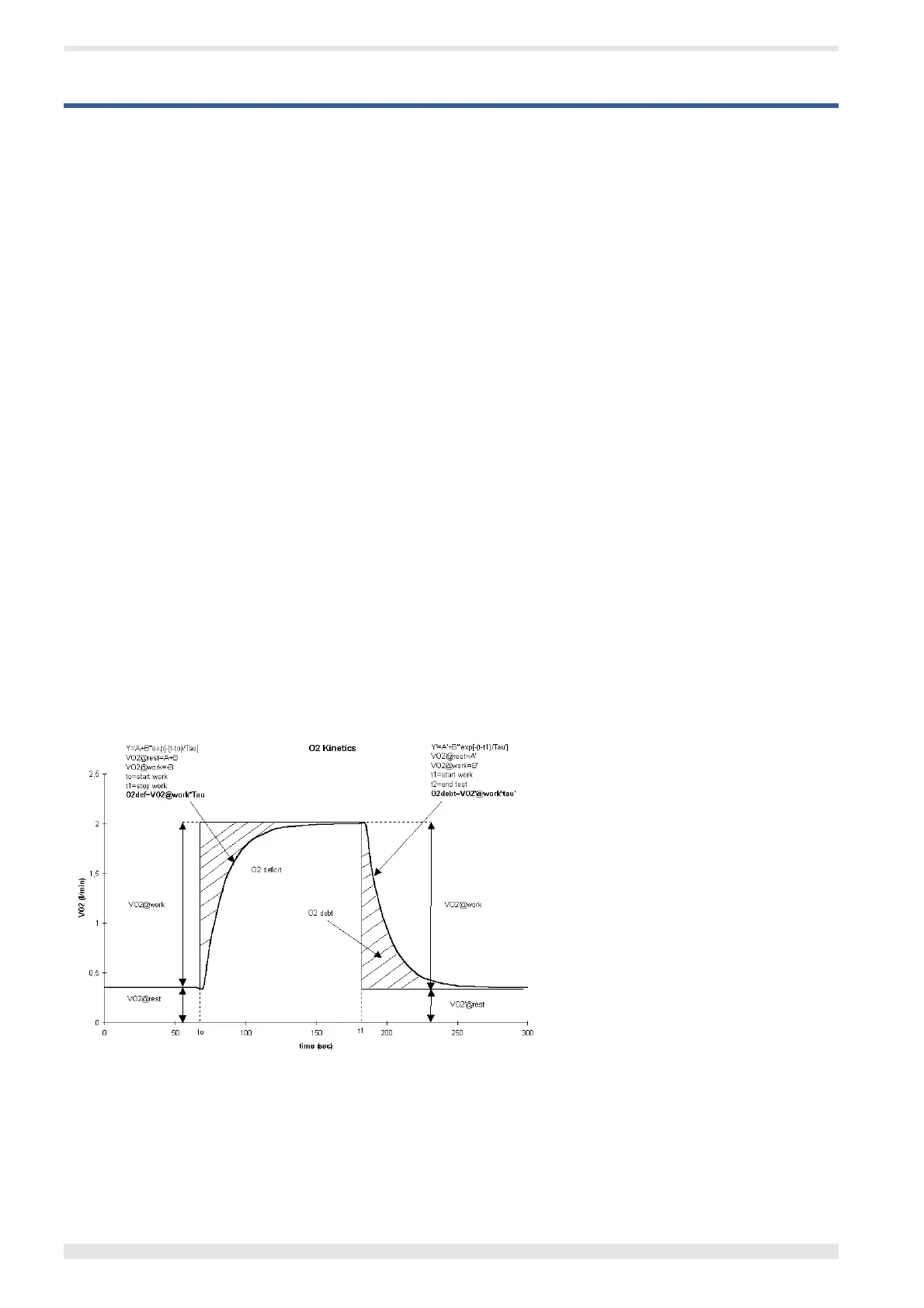
The following picture displays how O
2
debt and O
2
deficit values are calculated.
72 - Appendix - Calculations references


 To Next Page