E/LE-series User Manual 7
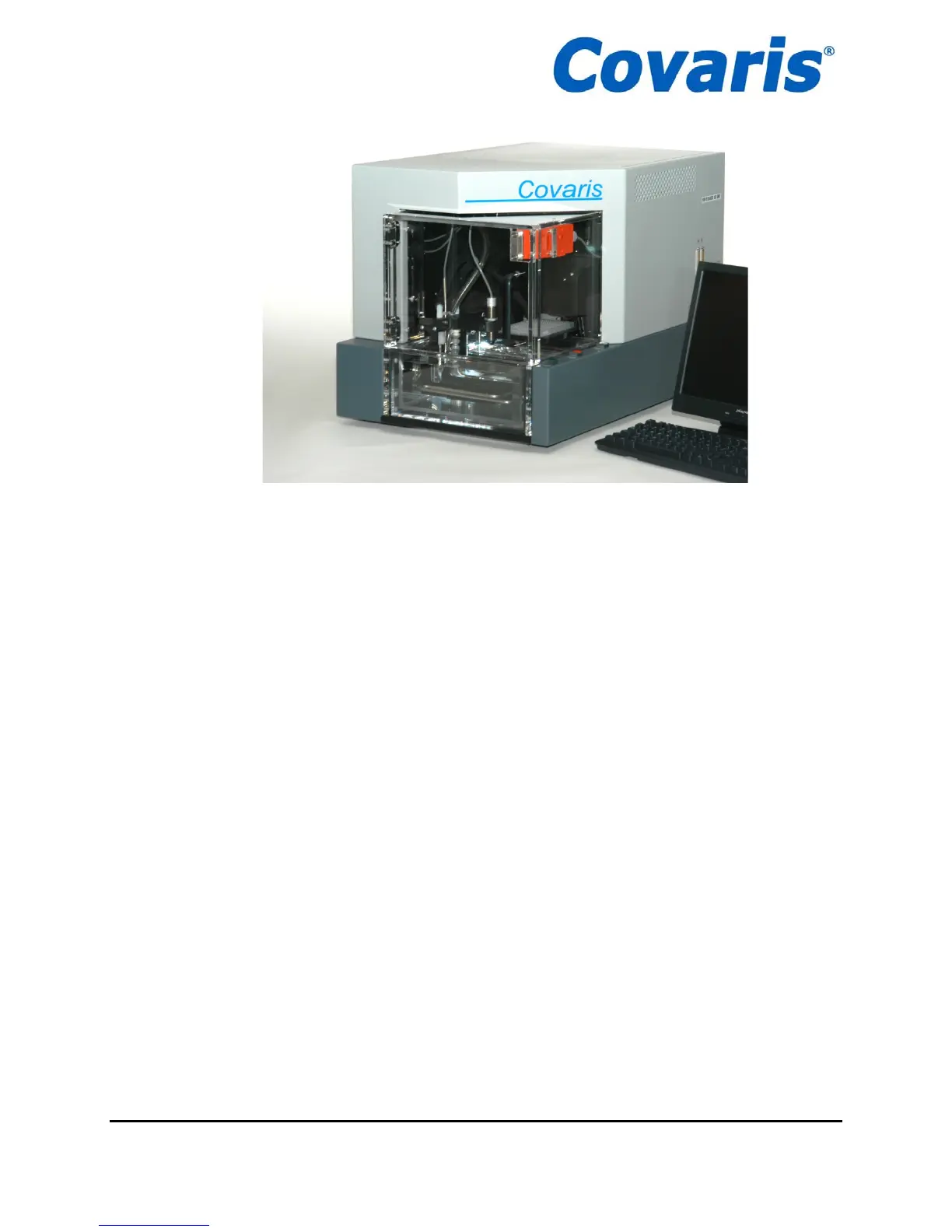
Figure 1
1.4 Principle of Operation
The Covaris Process generates acoustic shock waves to cause controlled cavitation and
acoustic streaming at the focal point within the sample treatment vessel. Acoustic energy has
been utilized for many years for a variety of diagnostic, therapeutic and research purposes. Well-
known uses of sonic or acoustic energy in materials processing include "sonication", an
uncontrolled process of mechanical disruption involving the direct immersion of an unfocused kHz
range (e.g., 15,000 cycles per second) ultrasound source into a fluid suspension of the material
being treated. There are also specific clinical examples of the utilization of therapeutic ultrasound
(e.g. lithotripsy) and of diagnostic ultrasound (e.g., fetal imaging).
Typically, when ultrasound is applied to a bulk biological sample solution (as for the extraction of
intracellular constituents from tissue), the treatment causes a complex, heterogeneous, mixture of
sub-events that vary during the course of a treatment dose. In other words, the ultrasonic energy
may be partitioned between various states. For example, the energy may directly treat a sample;
the energy may displace the target and shift the target out of the optimal energy zone; the energy
may result in interference, (i.e., a “bubble shield”), that reflects the acoustic energy; or the large
particles may move to low energy nodes thereby leaving the smaller particles with more dwell-
time in the high energy nodes. In addition, the sample viscosity, temperature, and uniformity will
vary during the ultrasonic process, resulting in gradients during the process. The current low
frequency, unfocused sonicator-type processes are random and non-uniform. This limits the use
of ultrasound in high throughput applications where treatment standardization is required.
In contrast, focused, nonlinear acoustic waves are computer generated and delivered to
individually-addressable samples with the E and LE series systems. The mechanical energy
imparted on the sample results in a controlled series of compression, rarefaction events. The E
and LE-series instruments were designed to provide the researcher with methods and systems to
control the delivery of mechanical energy into a biological sample for high-throughput sample
preparation applications.



 To Next Page