SANDING
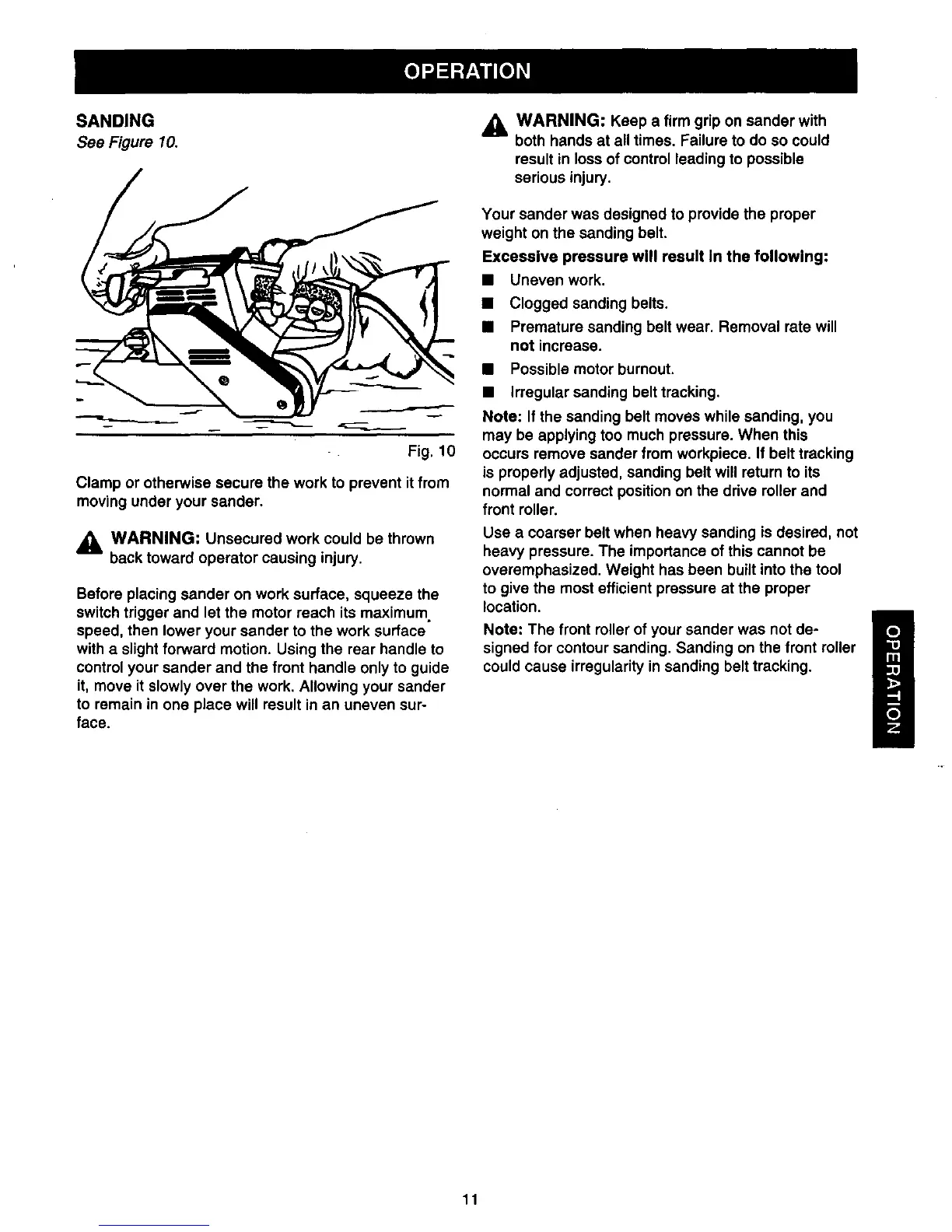
See Figure 10.
___._..._.,,,-------
Fig, 10
Clamp or otherwise secure the work to prevent itfrom
moving under your sander.
,_ WARNING: Unsecured work could be thrown
back toward operator causing injury.
Before placing sander on work surface, squeeze the
switch trigger and let the motor reach its maximum
speed, then lower your sander to the work surface
with a slight forward motion. Using the rear handle to
control your sander and the front handle only to guide
it, move it slowly over the work. Allowing your sander
to remain in one place will result in an uneven sur-
face.
,_ WARNING: Keep a firm grip on sander with
both hands at all times. Failure to do so could
result in loss of control leading to possible
serious injury.
Your sander was designed to provide the proper
weight on the sanding belt.
Excessive pressure will result In the following:
• Uneven work.
• Clogged sanding belts.
• Premature sanding belt wear. Removal rate will
not increase.
• Possible motor burnout.
• Irregular sanding belt tracking.
Note: Ifthe sanding belt moves while sanding, you
may be applying too much pressure. When this
occurs remove sander from workpiece. If belt tracking
is properly adjusted, sanding belt will return to its
normal and correct position on the drive roller and
front roller.
Use a coarser belt when heavy sanding is desired, not
heavy pressure. The importance of this cannot be
overemphasized. Weight has been built into the tool
to give the most efficient pressure at the proper
location.
Note: The front roller of your sander was not de-
signed for contour sanding. Sanding on the front roller
could cause irregularity in sanding belt tracking.
H
11



 To Next Page