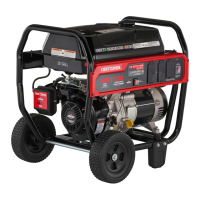
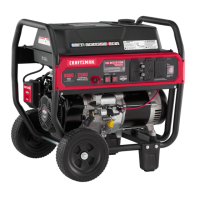
This document describes the Craftsman Outdoor Portable Generator, a versatile engine-driven, revolving field, alternating current (AC) generator designed to provide electrical power for various outdoor applications and home power restoration. It is equipped with a voltage regulator that automatically maintains the output voltage level.
Function Description:
The generator is designed to supply electrical power for operating compatible electrical lighting, appliances, tools, and motor loads. It can be used to power outdoor items via extension cords or to restore home power using a transfer switch. A transfer switch, installed by a licensed electrician, allows the generator to be directly connected to a home's electrical system via a locking receptacle, ensuring isolation from utility power and compliance with electrical codes.
Important Technical Specifications:
The manual covers three models: CMXGGAS030733, CMXGGAS030734, and CMXGGAS030791.
For models CMXGGAS030733 & CMXGGAS030734:
- Rated Wattage: 7,000 Watts
- Starting Wattage: 10,500 Watts
- AC Current at 240 Volts: 29.1 Amps
- AC Current at 120 Volts: 58.3 Amps
For model CMXGGAS030791:
- Rated Wattage: 8,000 Watts
- Starting Wattage: 11,500 Watts
- AC Current at 240 Volts: 33.3 Amps
- AC Current at 120 Volts: 66.6 Amps
Common Specifications for all models:
- Frequency: 60 Hz at 3600 rpm
- Phase: Single Phase
- Displacement: 25.63 cu. in. (420 cc)
- Spark Plug Gap: 0.030 in. (0.76 mm)
- Fuel Capacity: 8.5 U.S. Gallons (32.2 Liters)
- Oil Capacity: 36 Ounces (1.0 Liters)
The generator has a system ground that connects the generator frame components to the ground terminals on the AC output receptacles. The system ground is connected to the AC neutral wire (the neutral is bonded to the generator frame).
Usage Features:
- Automatic Shutoff (CO Detection™): The generator is equipped with a Carbon Monoxide (CO) Shutdown Indicator Light. This system automatically shuts down the engine if harmful levels of carbon monoxide accumulate around the generator or if a CO Detection system fault occurs. After shutdown, the CO Detection indicator light will blink red for at least five minutes. A blue light will blink for five seconds at startup to confirm CO Detection is functioning.
- Safe Location Requirements: For safe operation, the generator must be used outdoors in an open area, at least 20 ft. (6.1 m) from occupied spaces, with the exhaust pointed away to reduce the risk of carbon monoxide accumulation. It should not be run in enclosed areas like homes, garages, basements, or sheds, even with open doors or windows. Additionally, it must be at least 5 ft. (1.5 m) from any structure, overhang, trees, shrubs, or vegetation over 12 in. (30.5 cm) in height to prevent fire hazards from hot exhaust gases.
- Fuel Requirements: The generator uses clean, fresh, unleaded fuel with a minimum of 87 octane. Gasoline with up to 10% ethanol content (E10) is acceptable. For altitudes over 5,000 ft. (1524 m), a minimum 85 octane fuel is acceptable, and high-altitude adjustment is required for emissions compliance.
- Oil Requirements: The engine is shipped with 10W30 oil. The recommended oil viscosity varies with outdoor temperature, with SAE 30 for temperatures above 4°C (40°F) and Synthetic 5W30 for colder temperatures.
- Starting Procedure:
- Ensure the unit is outdoors on a level surface.
- Turn the fuel valve to the ON (I) position.
- Set the On/Off switch to the ON (I) position.
- Pull the choke handle out to the CHOKE (||) position.
- For electric starting, push and hold the Start switch for a maximum of 5 seconds until the engine starts. If the battery is discharged, manual starting or battery charging (for AGM batteries) is required.
- For manual starting, grasp the recoil handle and pull slowly until slight resistance is felt, then pull rapidly to start the engine.
- Gradually push the choke handle to the RUN (||) position.
- Electrical Receptacles:
- 120 Volt AC, 20 Amp, GFCI Duplex Receptacles: These supply 120 Volt AC, single-phase, 60 Hz power for electrical lighting, appliances, tools, and motor loads, up to 2,400 Watts (2.4 kW) at 20 Amps. They are protected by "push to reset" 20 Amp circuit breakers against electrical overload and feature Ground Fault Circuit Interrupter (GFCI) protection to prevent electrical shock.
- 120/240 Volt AC, 30 Amp Locking Receptacle (NEMA L14-30): This supplies 120/240 Volt AC, single-phase, 60 Hz power for loads up to 7,200 Watts (7.2 kW) at 30 Amps for 240 Volts or two independent 120 Volt loads at 30 Amps each. This receptacle is not GFCI protected.
- Power Management: To manage generator power, loads should be added sequentially. Start the engine with no loads, then plug in and turn on the largest load first, allowing the generator output to stabilize before adding subsequent loads. The total load should never exceed the generator's capacity, considering both running and starting watts.
- Shutdown Procedure:
- Turn off and unplug all electrical loads from the generator panel receptacles.
- Let the engine run at no-load for one minute to stabilize internal temperatures.
- Push the On/Off switch to the OFF (O) position.
- Move the fuel valve to the OFF (O) position.
Maintenance Features:
The manual provides a detailed maintenance schedule:
- First 5 Hours: Change engine oil.
- Every 8 Hours or Daily: Clean debris, check engine oil level.
- Every 25 Hours or Yearly: Clean engine air filter.
- Every 100 Hours or Yearly: Change engine oil.
- Yearly: Replace engine air filter, service fuel valve, service spark plug, inspect muffler and spark arrester, clean cooling system. (More frequent service is required under dirty or dusty conditions).
Specific maintenance tasks include:
- Cleaning: Daily inspection for oil or fuel leaks and cleaning accumulated debris around the generator and muffler. Use a soft bristle brush and a damp cloth.
- Fuel Valve Maintenance: The fuel valve has a sediment cup, screen, and o-ring that need periodic cleaning. This involves turning off the fuel, removing and cleaning these components with a nonflammable solvent, then reassembling and checking for leaks.
- Engine Oil Maintenance:
- Checking/Adding Oil: Check oil level before each use or every 8 hours. Ensure the generator is on a level surface. Clean around the oil fill, remove and wipe the dipstick, then reinsert (without screwing in) to check the level. Fill to the full mark if needed, being careful not to overfill.
- Changing Oil: Change oil when the engine is warm. Remove the oil drain plug to drain oil completely. Reinstall the plug, then slowly pour recommended oil (approx. 36 oz. / 1.0 L) into the oil fill opening, pausing to allow it to settle, until it reaches the full mark on the dipstick.
- Service Air Cleaner: Loosen screws, remove the air cleaner cover, carefully remove the cartridge from the base, install a clean (or new) air cleaner assembly, and reassemble.
- Inspect Muffler and Spark Arrester: Inspect for cracks, corrosion, or damage. Check the spark arrester screen for damage or carbon blockage and clean with a brush and commercial solvent if needed, or replace.
- Service Spark Plug: Clean the area around the spark plug, remove and inspect it. Replace if electrodes are pitted, burned, or porcelain is cracked. Check and reset the electrode gap to the recommended specification (0.030 in. / 0.76 mm). Install and tighten firmly.
The manual also includes information on long-term storage, emphasizing fuel treatment or draining, cleaning, and proper covering. It also provides an FCC/IC Compliance Statement regarding potential interference and user responsibilities.

 Need help?
 General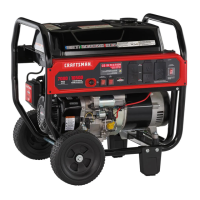


 To Next Page