r
fTh _'_
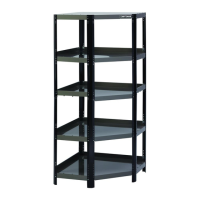
is shelving unit was designed to be flexible for the consumer
to assemble in different configurations. The only shelves that
have specific placements are the middle shelf (where the legs
connect) and the top shelf. The other shelves can be varied in
their placement to suit the customer's storage requirements.
NOTE: While unpacking the shelving unit, save the packaging
materials to use as a scratch free surface.
The customer must first decide if they want an "Open" or
"Closed" shelf design. (See examples)
OPEN CLOSED
NOTE: For ease of assembly,finger tighten all fasteners until
instructed to wrench tighten.
The following directions describe how to assemble both
methods. The exact shelf placement is left up to the customer.
STEP (1): Bottom Section
_ AA (32)
BB (12)
cc (20)
NOTE: The lower legs need to be in the correct orientation to
assemble correctly. The end that has NO holes is the bottom,
and the end with one hole is the top.
The support rail MUST always rest underneath the shelf for
proper support.
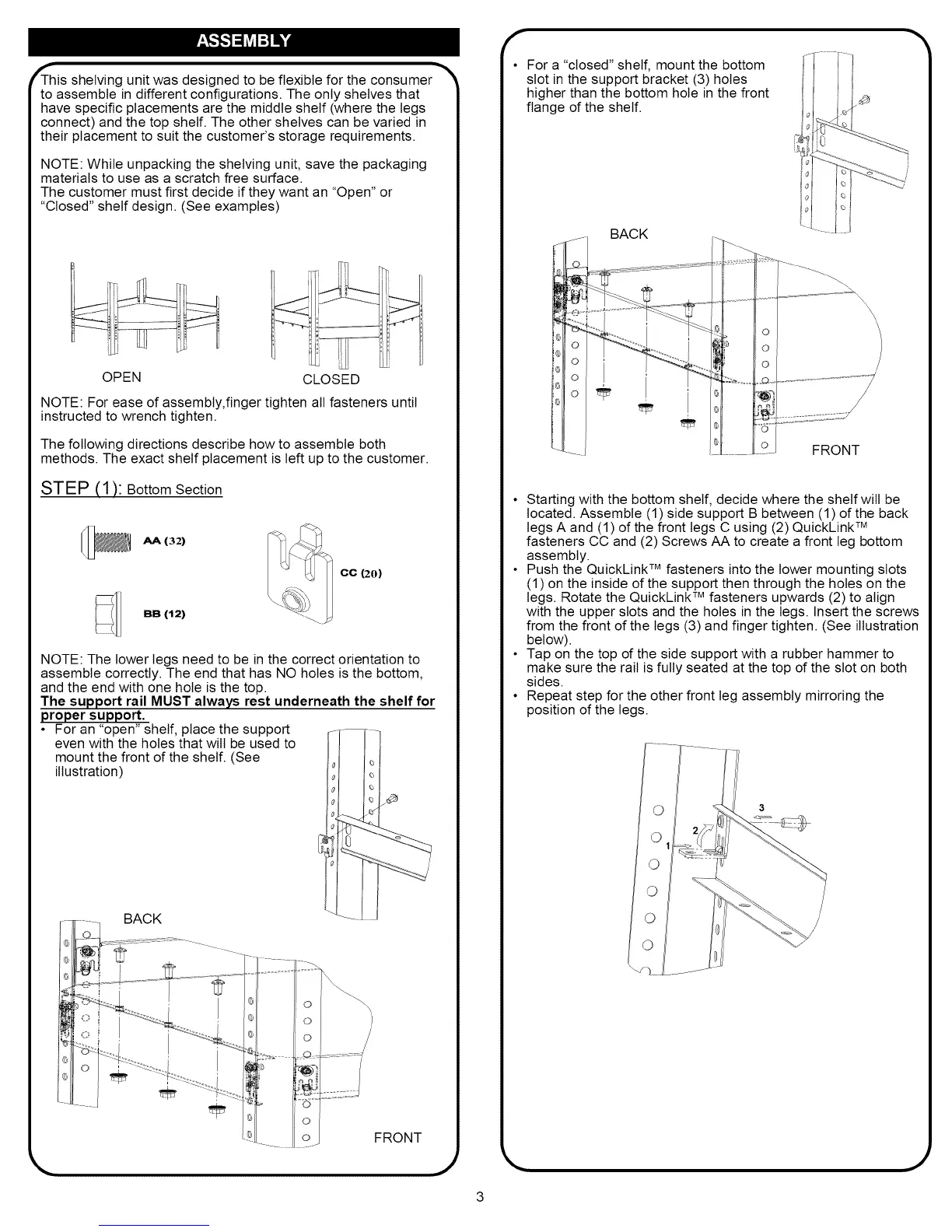
• For an "open" shelf, place the support
even with the holes that wilt be used to
mount the front of the shelf. (See
illustration
BACK
FRONT
For a "closed" shelf, mount the bottom
slot in the support bracket (3) holes
higher than the bottom hole in the front
flange of the shelf.
BACK
FRONT
• Starting with the bottom shelf, decide where the shelf wilt be
located. Assemble (1) side support B between (1) of the back
legs A and (1) of the front legs C using (2) QuickLink TM
fasteners CC and (2) Screws AA to create a front leg bottom
assembly.
• Push the QuickLink TM fasteners into the lower mounting slots
(1) on the inside of the support then through the holes on the
legs. Rotate the QuickLink TM fasteners upwards (2) to align
with the upper slots and the holes in the legs. Insert the screws
from the front of the legs (3) and finger tighten. (See illustration
below).
• Tap on the top of the side support with a rubber hammer to
make sure the rail is fully seated at the top of the slot on both
sides.
• Repeat step for the other front leg assembly mirroring the
position of the legs.
k,,.. .j





 To Next Page