6
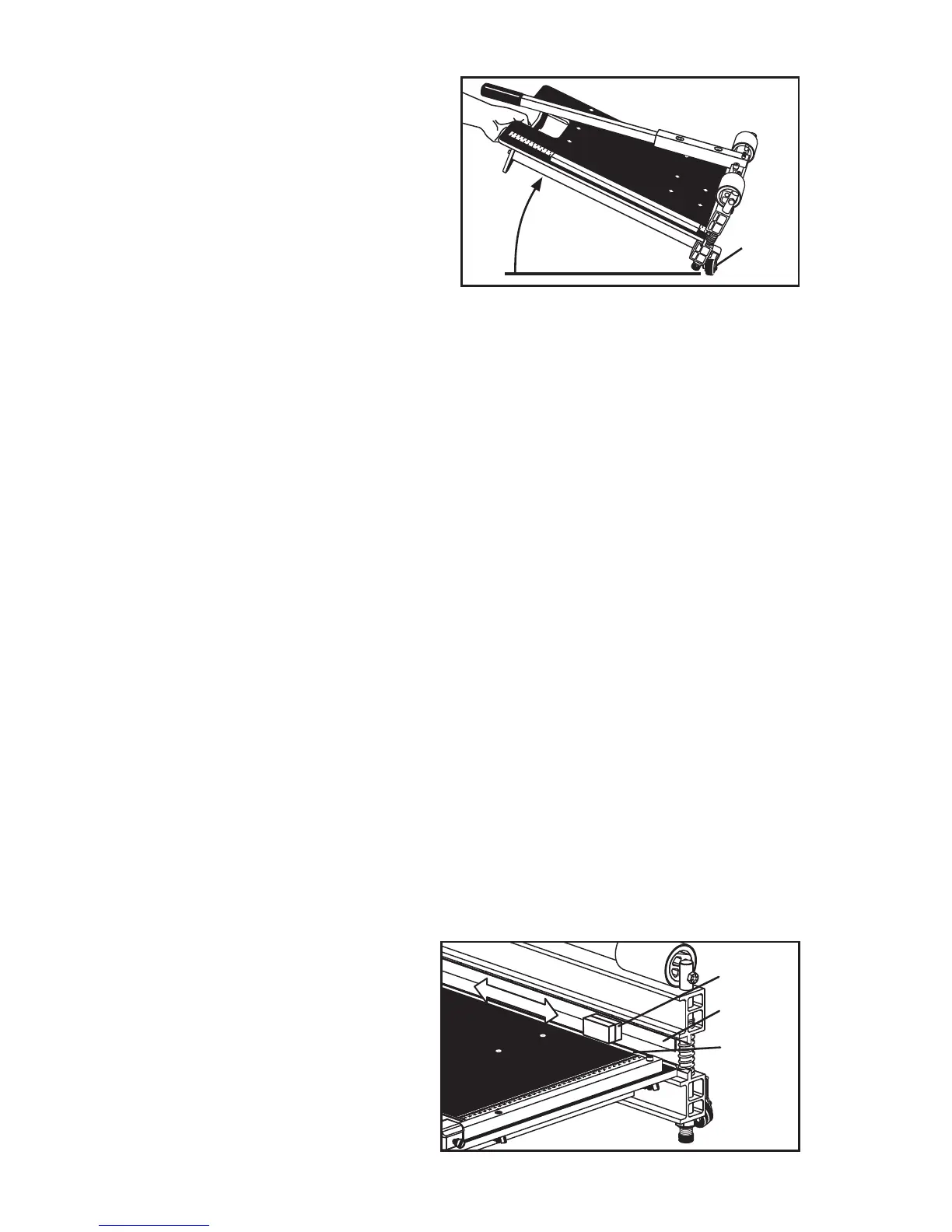
The cutter includes wheels for
moving the cutter easily from a
kneeling position (Figure 8). Sim-
ply lift the back of the bed off the
oor to about a 30° angle, and the
wheels will contact the oor for
wheeling the cutter from place to
place without having to get up and
carry it by the carrying handle.
TRANSPORTATION AND STORAGE:
Whenever the tool is left unattended, or during transportation or storage, the
safety lock should be locked (Figure 3). The safety lock lowers the blade
to shield it from contact, and prevents unexpected motion of the leverage
handle. To lock the safety lock, lower the leverage handle to its bottom posi-
tion and slide the safety lock all the way to the right. The safety lock includes
a lock nut that should be tightened down to prevent accidental unlocking.
For transportation or storage, the leverage handle should also be positioned
with its button in the lower hole of the connector tube.
Carry the cutter by its carrying handle (Figure 1). Do not carry the cutter using
its leverage handle, blade carrier, or bottom bar. Keep hands away from the
blade, blade carrier, and pressure rollers at all times.
When transporting or storing the cutter, use caution to prevent the cutter from
being dropped or falling. Damage to the cutter or injury may result.
In transportation or storage, do not pile heavy materials on top of the tool
such as by putting it in the bottom of the van and piling up ooring and other
materials on top of it. Damage to the cutter’s bed and mechanism may result.
MAINTENANCE:
BURRS OR NICKS ON BLADE: Burrs or nicks may develop on the inner
(bed facing) side of the blade that can cause the blade to seem dull and
cut less efciently. The cutter
includes a sharpening stone
that can be used for restoring
the edge as much as possible
(Figure 9). There is no need to
remove the blade from the blade
carrier. Simply raise the lever-
age handle to raise the blade
enough distance for adequate
clearance of the stone, then lay
LIFT BACK
OF BED 30º
WHEELS
STONE
BLADE
ANVIL
Figure 8
Figure 9



 To Next Page
 Loading...