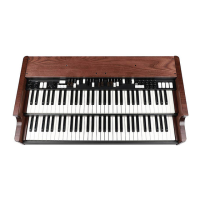
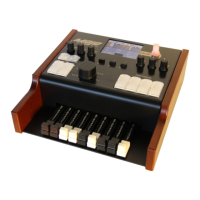
Crumar Seventeen and Seventeen "Parsifal" User's Manual
CHAPTER 3. SOUNDS: TINE ELECTRIC PIANO.
This is a simulation of the famous
Rhodes Electric Piano
. It's not specific to a Mark I, Mark II or Mark V model because it can do them all.
This is the only sound present on your instrument that is totally physically modeled.
The parameters (showed in the screen as "EP") that you can modify are:
TYPE: This lets you select one of the 9 different variations.
WOOD LEVEL: Adjusts the volume of the wooden noises.
FELT LEVEL : Adjust the volume/action of the felt of the hammers.
RELEASE LEVEL: Adjusts the volume of the damper noises you can hear every time a key is released.
HAMMER TIPS : Adjusts the hardness of the hammer tips; a higher value
produces a snappier attack, a lower value produces a softer attack. This
also affects the amount of metallic component you hear at the attack of
each note.
BITE AND BARK: Adjusts the aggressiveness of the virtual tines. This aspect
also varies according the selected variation.
METALLIC: Adjusts the metallic component of the tine sound.
RESONANCES: Adjusts the level of the sympathetic resonances. When the
sustain pedal is held down, the whole harp is free to vibrate so each key
stroke puts the harp into self-resonance.
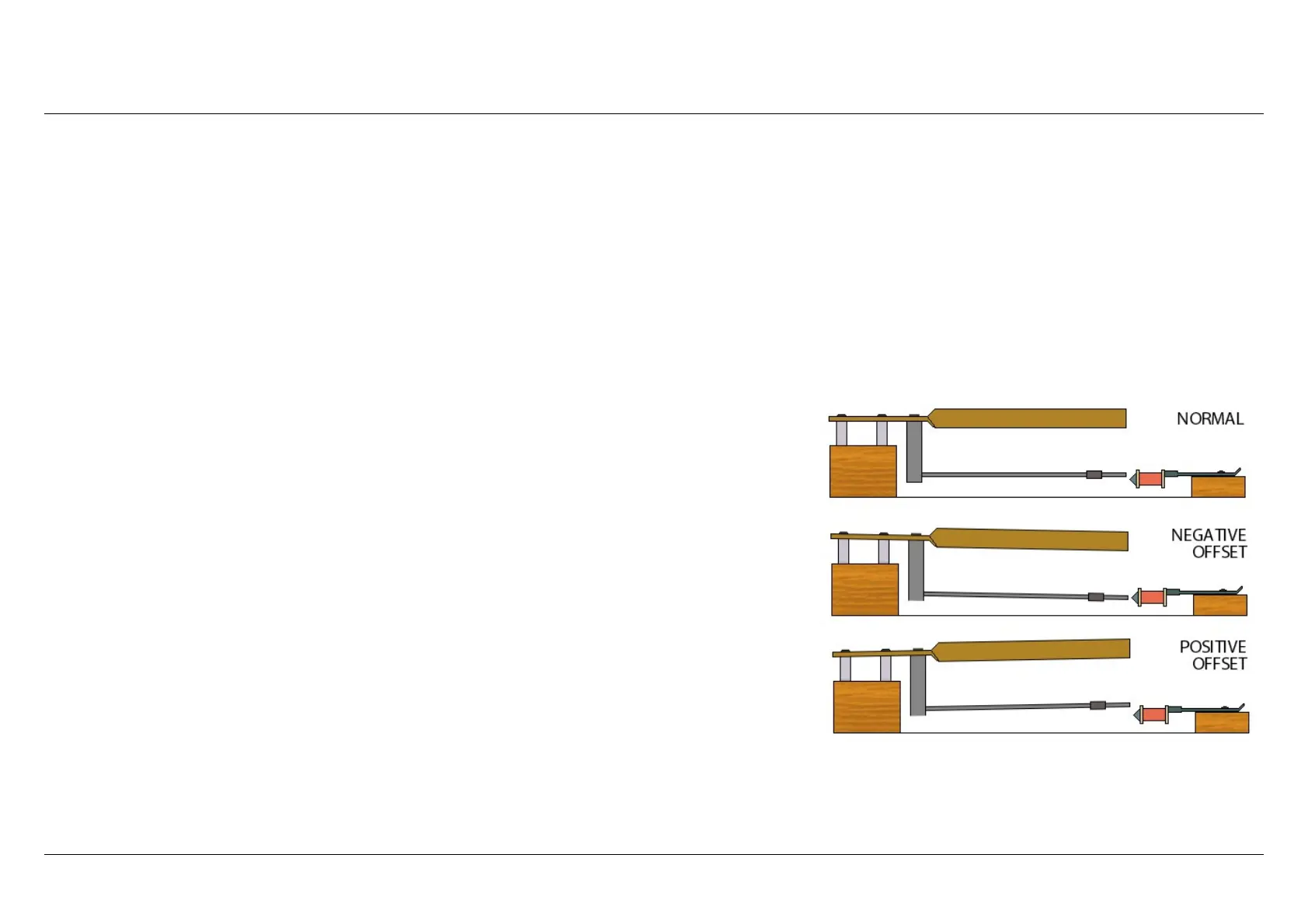
PICKUP OFFSET: Adjusts the average offset of the pickups in front of the
tines. This parameter affects the balance between the fundamental and its
overtones. The picture at the right shows the correlation between the tine,
the tonebar and the pickup in a real
Rhodes
piano.
HI-PASS FILTER: Adjusts the hi-pass filtering, similar to the original “BASS BOOST” knob, which is indeed a passive high-pass filter.
PEDAL NOISE LEVEL: Adjusts the volume of the noise produced by the
Crumar Seventeen User's Manual - Page 7


 To Next Page