Need help?
Do you have a question about the CUAV X7 Plus and is the answer not in the manual?
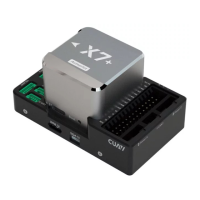
This product is a continuation version of CUAV X7 flight controller, compatible with all expansion hardware.
Access detailed tutorials and firmware downloads for the X7+ AutoPilot via the CUAV docs website.
Links to download QGroundControl and Mission Planner software for drone control.
Steps for downloading and writing firmware for the X7+ autopilot.
Links to ArduPilot and PX4 Github repositories for source code.
Commands for compiling firmware for ArduPilot and PX4.
PWM signal output ports for ESC and servo connections.
Connects to PPM, DSM, or SBUS remote control receivers.
Connects to HV_PM or analog ammeters for power monitoring.
Connects to CAN protocol power management modules like CAN PMU Lite.
Connects GPS modules and safety switches for drone operation.
Connects P9 or other data transmission devices for telemetry.
Connects LTE LINK series or other data transmission devices.
Connects IST8310 compass or other I2C devices.
Connects to CAN GPS or other CAN devices.
Used for digital transmission or GPS2.
Telemetry signal strength input, receiver with RSSI output.
Product has passed CE certification requirements.
Product has passed CE certification (FC mark).
CUAV has passed ISO 9001 quality management system certification.
Visit www.cuav.net for product information.
Refer to doc.cuav.net for detailed usage and assembly instructions.
The CUAV X7+ AutoPilot is a sophisticated flight controller designed for experimental unmanned systems, serving as a core hardware component for various aerial and marine vehicles. This product is a continuation of the CUAV X7 flight controller, ensuring compatibility with its existing expansion hardware, allowing for seamless replacement and integration into established setups. It is primarily intended for use with ArduPilot and PX4 firmware, which are provided by a third party, highlighting its role as a versatile hardware platform within the broader ecosystem of unmanned system development.
The X7+ AutoPilot acts as the central processing unit for unmanned vehicles, managing flight control, navigation, and communication. It processes sensor data, executes control algorithms, and interfaces with various peripherals to enable autonomous operation. The device supports a wide range of unmanned systems, including planes, copters, helicopters, VTOL (Vertical Take-Off and Landing) aircraft, unmanned vehicles, and unmanned boats, making it a highly adaptable solution for diverse applications.
Its primary function is to provide a reliable and robust platform for executing complex flight and navigation tasks. This includes managing motor outputs (M1-M14) for ESCs and servos, receiving remote control signals (RCIN) from PPM, DSM, or SBUS receivers, and handling power management through dedicated interfaces (Power A for analog ammeters and Power C for CAN protocol power management modules like CAN PMU Lite or CAN PMU). The device integrates multiple UART, I2C, and CAN bus interfaces, facilitating communication with GPS modules, safety switches, data transmission systems (TELEM1, TELEM2), compasses (IST8310), and other CAN devices (such as NEO V2 PRO/NEO 3 PRO GPS units). It also features an RSSI input for telemetry signal strength, allowing for monitoring of receiver performance.
The X7+ AutoPilot is designed to be a pure hardware component, relying on third-party firmware and software for its operational intelligence. This modular approach allows users to leverage the extensive capabilities and community support of ArduPilot and PX4, tailoring the flight controller's behavior to specific project requirements. The device's robust design and comprehensive interface options ensure that it can be integrated into highly customized and complex unmanned systems.
The X7+ AutoPilot is designed for ease of integration and operation within the Pixhawk standard pinout framework. Users are strongly advised to adhere to the provided interface definitions and original wiring to prevent damage to the equipment. The product manual emphasizes the importance of careful installation and usage in accordance with instructions to ensure correct and safe operation.
For firmware management, the X7+ supports ArduPilot 4.10/PX4 V1.12.3 and above. Users can download and write firmware following tutorials available on the CUAV documentation website. For developers interested in modifying the code, source code for both ArduPilot and PX4 is accessible via their respective GitHub repositories. The manual provides specific compile commands for both ArduPilot (e.g., ./waf configure --board CUAV-x7 and ./waf copter --upload) and PX4 (e.g., make cuav_x7pro_default), guiding users through the process of compiling and writing custom firmware. This flexibility allows advanced users to adapt the flight controller to unique research or application needs.
The device's extensive connectivity options facilitate its use in diverse configurations. The M1-M14 ports serve as PWM signal outputs, directly connecting to ESCs and servos for motor control. The RCIN port supports various remote control signal protocols, ensuring compatibility with a wide range of RC receivers. Dedicated power input ports (Power A and Power C) allow for flexible power management setups, accommodating both analog and CAN-based power modules. Multiple UART, I2C, and CAN interfaces enable the connection of essential peripherals such as GPS modules, compasses, safety switches, and data transmission systems. The inclusion of a safety switch interface is a critical feature for safe operation, allowing users to arm and disarm the system securely.
The X7+ AutoPilot is suitable for a broad spectrum of applications, from hobbyist projects to professional experimental setups. Its compatibility with widely adopted open-source flight control software like ArduPilot and PX4 means that users can benefit from a large community, extensive documentation, and continuous development, enhancing the usability and longevity of the product. The product's design, with its focus on standard pinouts and comprehensive interface support, aims to simplify the integration process for system builders.
Maintenance of the X7+ AutoPilot primarily revolves around software updates and careful handling of the hardware. As a pure hardware component, its physical maintenance is minimal, focusing on ensuring proper connections and protecting it from environmental factors. The product is designed to operate within a specified temperature range of -20 to 85°C and a non-condensing humidity range of 5% to 95%, indicating a degree of environmental robustness. However, users are cautioned against flying in adverse weather conditions such as rain, strong wind, or fog, which could impact the device's performance and longevity.
The most significant aspect of maintenance involves keeping the firmware updated. CUAV provides after-sales service within the product warranty period, but the reliability of the system for any specific purpose is not guaranteed by the company, as the firmware and software are provided by a third party. Therefore, users are responsible for regularly checking for and applying the latest firmware versions from ArduPilot or PX4 to ensure optimal performance, security, and access to new features. The online documentation and download links provided by CUAV are crucial resources for this purpose.
Proper installation and wiring are paramount for the device's long-term reliability. The manual explicitly states that the company will not compensate for damage to equipment if the wiring is not used according to the standard defined by the interface. This underscores the importance of meticulous attention to detail during the initial setup and any subsequent modifications. Regular inspection of cable connections, ensuring they are secure and free from damage, is a simple yet effective maintenance practice.
Environmental protection is also a key maintenance consideration. While the device has a specified operating environment, protecting it from physical shock, excessive moisture, and extreme temperatures beyond its rated limits will extend its lifespan. Storing the device in a dry, stable environment when not in use is recommended.
In summary, maintenance for the X7+ AutoPilot is largely preventive, focusing on correct installation, adherence to wiring standards, regular firmware updates, and protection from environmental hazards. Given its role as a critical component in unmanned systems, ensuring its proper functioning through these practices is essential for the safety and success of any operation. The product's design, while robust, relies heavily on user diligence in these areas to maintain optimal performance.
 General
| Processor | STM32H743 |
|---|---|
| Barometer | MS5611 |
| Operating Voltage | 5V |
| SD Card Slot | Yes |
| Operating System | ArduPilot or PX4 |
| IMU | BMI088 |
| GPS | M8N |
| Interfaces | UART, I2C, CAN |
| Voltage Input | 4.5V - 5.5V |
| Current Sensor | Yes |
| CAN Bus | 2 |
| Operating Temperature | -20°C to 60°C |
| Connectivity | WiFi, Bluetooth |

 To Next Page