EasyManua.ls Logo

Cub Cadet 340 - Operation

Cub Cadet 340
12 pages
Print Icon
To Next Page IconTo Next Page
To Previous Page IconTo Previous Page
Loading...
OPERATION
GAS
AND
OIL
FILL-UP
Service
the
engine
with
gasoline
and
oil
as
instructed
in
the
separate
engine
manual
packed
with
your
tiller.
Read
instructions
carefully.
NOTE:
Your
tiller
is
shipped
without
oil;
however,
a
small
amount
of
oil
may
be
present
from
the
factory.
TO
START
ENGINE
WARNING:
BE
SURE
NO
ONE
IS
STAND¬
ING
IN
FRONT
OF
THE
TILLER
WHILE
THE
ENGINE
IS
RUNNING
OR
BEING
STARTED.
1.
Attach
spark
plug
wire
and
cover
to
spark
plug.
2.
Make
certain
the
clutch
handle
is
in
the
neutral
position
(released).
See
figure
4.
3.
Place
the
throttle
control
lever
in
FAST
position.
See
figure
5.
4.
Move
choke
lever
to
CHOKE
position.
(A
warm
engine
requires
little
or
no
choking.)
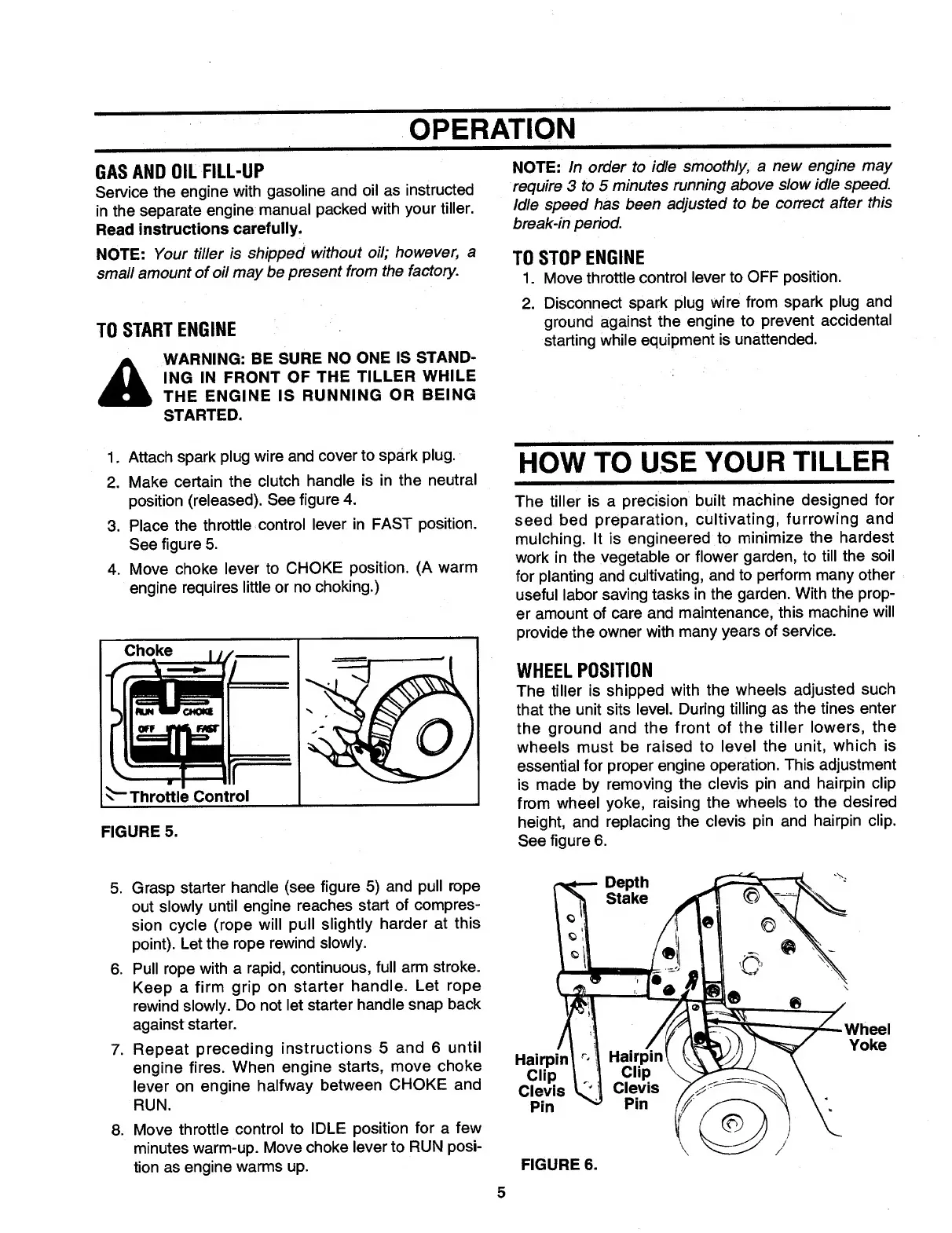
^
Throttle
Control
FIGURE
5.
5.
Grasp
starter
handle
(see
figure
5)
and
pull
rope
out
slowly
until
engine
reaches
start
of
compres¬
sion
cycle
(rope
will
pull
slightly
harder
at
this
point).
Let
the
rope
rewind
slowly.
6
.
Pull
rope
with
a
rapid,
continuous,
full
arm
stroke.
Keep
a
firm
grip
on
starter
handle.
Let
rope
rewind
slowly.
Do
not
let
starter
handle
snap
back
against
starter.
7.
Repeat
preceding
instructions
5
and
6
until
engine
fires.
When
engine
starts,
move
choke
lever
on
engine
halfway
between
CHOKE
and
RUN.
8
.
Move
throttle
control
to
IDLE
position
for
a
few
minutes
warm-up.
Move
choke
lever
to
RUN
posi¬
tion
as
engine
warms
up.
NOTE:
In
order
to
idle
smoothly,
a
new
engine
may
require
3
to
5
minutes
running
above
slow
idle
speed.
Idle
speed
has
been
adjusted
to
be
correct
after
this
break-in
period.
TO
STOP
ENGINE
1.
Move
throttle
control
lever
to
OFF
position.
2.
Disconnect
spark
plug
wire
from
spark
plug
and
ground
against
the
engine
to
prevent
accidental
starting
while
equipment
is
unattended.
HOW
TO
USE
YOUR
TILLER
The
tiller
is
a
precision
built
machine
designed
for
seed
bed
preparation,
cultivating,
furrowing
and
mulching.
It
is
engineered
to
minimize
the
hardest
work
in
the
vegetable
or
flower
garden,
to
till
the
soil
for
planting
and
cultivating,
and
to
perform
many
other
useful
labor
saving
tasks
in
the
garden.
With
the
prop¬
er
amount
of
care
and
maintenance,
this
machine
will
provide
the
owner
with
many
years
of
service.
WHEEL
POSITION
The
tiller
is
shipped
with
the
wheels
adjusted
such
that
the
unit
sits
level.
During
tilling
as
the
tines
enter
the
ground
and
the
front
of
the
tiller
lowers,
the
wheels
must
be
raised
to
level
the
unit,
which
is
essential
for
proper
engine
operation.
This
adjustment
is
made
by
removing
the
clevis
pin
and
hairpin
clip
from
wheel
yoke,
raising
the
wheels
to
the
desired
height,
and
replacing
the
clevis
pin
and
hairpin
clip.
See
figure
6.
5

Related product manuals