EasyManua.ls Logo

Cub Cadet 340 - Page 7

Cub Cadet 340
12 pages
Print Icon
To Next Page IconTo Next Page
To Previous Page IconTo Previous Page
Loading...
4.
Throttle
Control:
The
throttle
control
lever
adjusts
the
engine
speed
and
stops
the
engine.
With
the
throttle
control
lever
pushed
completely
forward,
the
carburetor
is
in
START
position.
Pulling
the
throttle
control
back
slightly
adjusts
the
engine
speed
to
FAST.
Pulling
the
throttle
back
further
reduces
the
engine
speed
to
SLOW.
Puil
the
throttle
completely
back
to
stop
the
engine.
Use
maximum
engine
speed
for
deep
tiiling.
Move
the
throttie
controi
to
SLOW
when
transporting
the
tiller.
TRANSPORTING
THE
TILLER
To
transport
the
tiller
to
or
from
the
garden,
pivot
the
depth
stake
forward,
out
of
the
way.
See
figure
9.
With
the
throttle
control
in
SLOW
position,
the
unit
will
“walk”
freely
on
top
of
the
lawn.
If
the
operator
does
not
allow
the
tiller
to
move
freely,
the
unit
wilt
start
to
till
the
surface.
CULTIVATING
For
cultivating,
a
two
to
three
inch
depth
is
desirable.
Setting
the
wheels
and
depth
stake
so
that
the
wheels
are
about
two
inches
above
the
ground
while
the
tiller
is
resting
on
the
tines
and
depth
stake
will
allow
the
machine
to
work
at
cultivating
depth.
The
throttle
should
be
set
to
control
forward
movement
to
a
slow
walking
speed.
With
the
outer
tines
installed,
the
working
width
of
the
machine
is
22
or
24
inches.
For
cultivation,
this
may
be
reduced
to
13
inches
by
removing
the
outer
tines.
Refer
to
“Tine
Width
Adjustment”
in
Adjustment
section.
When
laying
out
plant
rows,
be
sure
to
allow
enough
width
to
permit
cultivation
between
the
rows.
In
grow¬
ing
corn
or
similar
crops,
check-row
planting
will
per¬
mit
cross
cultivation
and
practically
eliminate
hand
hoeing.
See
figure
10.
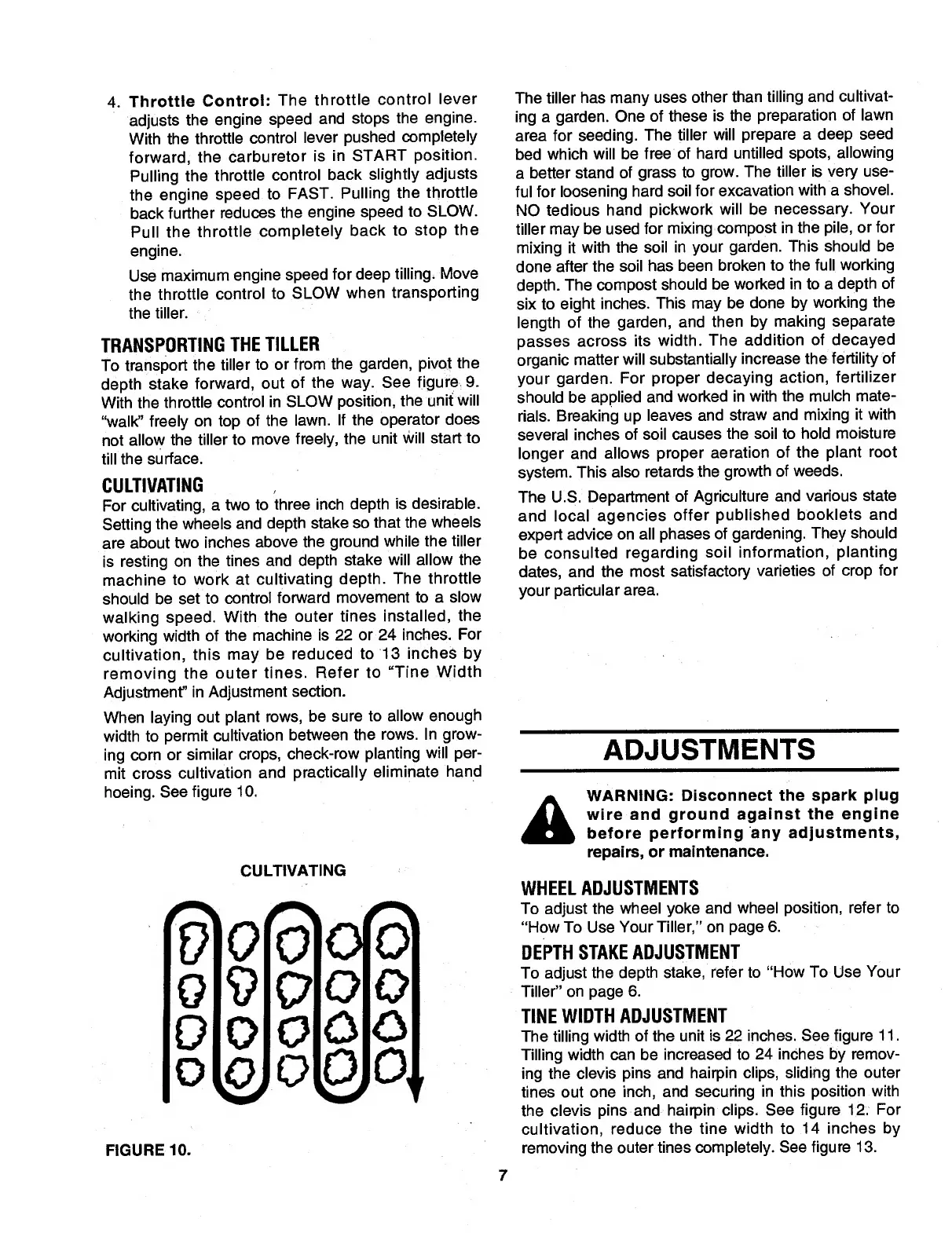
CULTIVATING
FIGURE
10.
The
tiller
has
many
uses
other
than
tilling
and
cultivat¬
ing
a
garden.
One
of
these
is
the
preparation
of
lawn
area
for
seeding.
The
tiller
will
prepare
a
deep
seed
bed
which
will
be
free
of
hard
unfilled
spots,
allowing
a
better
stand
of
grass
to
grow.
The
tiller
is
very
use¬
ful
for
loosening
hard
soil
for
excavation
with
a
shovel.
NO
tedious
hand
pickwork
will
be
necessary.
Your
tiller
may
be
used
for
mixing
compost
in
the
pile,
or
for
mixing
it
with
the
soil
in
your
garden.
This
should
be
done
after
the
soil
has
been
broken
to
the
full
working
depth.
The
compost
should
be
worked
in
to
a
depth
of
six
to
eight
inches.
This
may
be
done
by
working
the
length
of
the
garden,
and
then
by
making
separate
passes
across
its
width.
The
addition
of
decayed
organic
matter
will
substantially
increase
the
fertility
of
your
garden.
For
proper
decaying
action,
fertilizer
should
be
applied
and
worked
in
with
the
mulch
mate¬
rials.
Breaking
up
leaves
and
straw
and
mixing
it
with
several
inches
of
soil
causes
the
soil
to
hold
moisture
longer
and
allows
proper
aeration
of
the
plant
root
system.
This
also
retards
the
growth
of
weeds.
The
U.S.
Department
of
Agriculture
and
various
state
and
local
agencies
offer
published
booklets
and
expert
advice
on
all
phases
of
gardening.
They
should
be
consulted
regarding
soil
information,
planting
dates,
and
the
most
satisfactory
varieties
of
crop
for
your
particular
area.
ADJUSTMENTS
A
WARNING:
Disconnect
the
spark
plug
wire
and
ground
against
the
engine
before
performing
any
adjustments,
repairs,
or
maintenance.
WHEEL
ADJUSTMENTS
To
adjust
the
wheel
yoke
and
wheel
position,
refer
to
“How
To
Use
Your
Tiller,”
on
page
6.
DEPTH
STAKE
ADJUSTMENT
To
adjust
the
depth
stake,
refer
to
“How
To
Use
Your
Tiller”
on
page
6.
TINE
WIDTH
ADJUSTMENT
The
tilling
width
of
the
unit
is
22
inches.
See
figure
11.
Tilling
width
can
be
increased
to
24
inches
by
remov¬
ing
the
clevis
pins
and
hairpin
clips,
sliding
the
outer
tines
out
one
inch,
and
securing
in
this
position
with
the
clevis
pins
and
hairpin
clips.
See
figure
12.
For
cultivation,
reduce
the
tine
width
to
14
inches
by
removing
the
outer
tines
completely.
See
figure
13.
7

Related product manuals