Need help?
Do you have a question about the curt 13236 and is the answer not in the manual?
Identifies compatible Dodge/Chrysler Challenger, Charger, 300S/300C sedan models.
Specifies maximum trailer and tongue weight limits for safe towing.
Provides guidance on preparation, difficulty, and safety precautions.
Instructions for removing exhaust isolators from muffler and pipe.
Guidance on fascia removal for specific exhaust configurations.
Details removing the driver side muffler and preparing hardware.
Guides on using fishwire for bolts and positioning the hitch.
Instructions on tightening bolts and nuts to specified torque values.
Steps for reattaching the driver side muffler and exhaust system.
Guidance on reattaching exhaust hangers and isolators.
Explains Gross Trailer Weight (GTW) and Tongue Weight (TW).
Defines Weight Carrying (WC) and Weight Distribution (WD).
Discusses sway control devices and ball mount installation.
Details trailer ball selection, coupler use, and safety chain requirements.
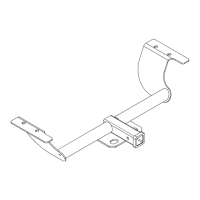
This document provides comprehensive instructions for installing a CURT receiver hitch, designed for specific Dodge and Chrysler models, including the Challenger, Charger, and 300S/300C, manufactured between 2011 and the present (for Dodge) and 2015 and the present (for Dodge/Chrysler). The hitch is a sedan style, intended for weight-carrying applications.
The primary function of this device is to provide a secure towing point for trailers, enabling the vehicle to tow loads up to 3500 lbs trailer weight and support a tongue weight of 350 lbs. It is crucial to adhere to these weight limits and never exceed the vehicle manufacturer's recommended towing capacity to ensure safety and prevent damage. The installation process is categorized as "Moderate" in difficulty, suggesting it might require some mechanical aptitude, though it is achievable for a novice with an estimated installation time of 45 minutes, or 20 minutes for a professional.
Before beginning the installation, it is strongly advised to read all instructions thoroughly. The document emphasizes that two people may be required to ease the installation process, particularly when maneuvering the hitch into position. Using proper tools, as listed in the "Installation Requires" section, will significantly improve the quality of the installation and reduce the time needed. Safety glasses are mandatory throughout the entire installation process to protect against potential hazards.
The installation process involves several key steps, starting with the preparation of the vehicle's exhaust system. For both V6 and V8 models, this includes locating and removing exhaust isolators and, in some cases, temporarily removing the driver-side muffler or tube. This step is critical for providing adequate clearance to install the hitch. The document provides detailed instructions for removing these components, including saving bolts and nuts for reinstallation. For vehicles with welded exhaust, fascia removal may ease installation, with specific instructions provided for removing plastic push pins and screws to access hidden components and temporarily remove the bumper fascia.
A crucial technique highlighted in the instructions is "Fishwiring Hardware." This method is used to guide carriage bolts and spacers through the vehicle's frame rails and out through existing mounting holes. The fishwire tool helps in pulling the hardware through the frame, preventing loss of components inside the frame rail and guiding the hitch during mounting. This technique is applied to install 1/2" carriage bolts and CM-SP40 spacers through access holes on both the driver and passenger side frame rails, pulling them through existing holes (two on the passenger side and one on the driver side).
Once the vehicle is prepared and the hardware is fishwired, the hitch is raised into position. This involves first placing the passenger side of the hitch over the passenger side muffler, then raising the driver side. The hitch is secured to existing weldnuts using supplied M12 hardware and conical toothed washers, and 1/2" hex flange nuts are attached onto the carriage bolts. Proper torqueing of all hardware is essential for a secure installation: 1/2" hardware should be torqued to 110 lb-ft, and M12 hardware to 79 lb-ft. The document includes images illustrating each step, from removing exhaust components to fishwiring and securing the hitch.
After the hitch is securely installed, the exhaust system components that were temporarily removed are reinstalled. For V6 models, this involves sliding the driver-side muffler/tube back into position against the stud on the exhaust system and securing the clamp with the nut saved from Step 3. For V8 models, the driver-side muffler is reattached onto studs with nuts and springs from Step 3. Finally, the exhaust is raised back into its original position, and all exhaust isolators and hangers removed in Step 1 are reattached.
Maintenance features for this device are straightforward but critical for long-term safety and performance. The document explicitly states, "PERIODICALLY CHECK THIS RECEIVER HITCH TO ENSURE ALL FASTENERS ARE TIGHT AND ALL STRUCTURAL COMPONENTS ARE SOUND." This ongoing maintenance ensures that the hitch remains securely attached and structurally sound, preventing potential failures during towing.
The manual also includes a comprehensive "Towing Safety Information" section, which is vital for safe operation. This section defines key terms such as Gross Trailer Weight (GTW), Tongue Weight (TW), Weight Carrying (WC), Weight Distribution (WD), and Sway Control. It provides guidance on how to measure tongue weight, the importance of matching coupler size to hitch ball size, and the proper use of safety chains. Safety chains are a legal requirement and must be crossed under the trailer tongue to prevent it from dropping to the road if it separates from the hitch. The document also details trailer classification based on safety chain breaking force, emphasizing that the strength rating of safety chains and their attachments must meet or exceed the GVWR (Gross Vehicle Weight Rating) of the trailer.
Furthermore, the safety information covers electrical connections, reminding users to check that all components (trailer lights, electric brakes, break-away systems) are working properly every time they tow. A wiring identification by color chart is provided for 4-way, 5-way, 6-way, and 7-way systems, which is helpful for troubleshooting electrical connections. The document also includes a "How Much Can You Safely Tow?" chart, which helps users understand their towing capabilities based on trailer type and weight, although it directs users to refer to their owner's manual for specific towing capabilities and limitations.
In summary, this CURT receiver hitch is a robust towing solution designed for specific Dodge and Chrysler models. Its function is to provide a secure attachment point for trailers, with clear instructions for installation and critical safety guidelines for operation and maintenance. The emphasis on reading instructions, using proper tools, adhering to weight limits, and performing regular checks underscores the importance of safety in all towing activities.
 General
| Material | Steel |
|---|---|
| Finish | Black Powder Coat |
| Installation | Bolt-On |
| Brand | CURT |
| Part Number | 13236 |
| Category | Automobile Accessories |
| Hitch Class | Class III |
| Receiver Tube Size | 2 inches |
| Weight Capacity | 6000 lbs |
| Towing Capacity | 6000 lbs |

 To Next Page