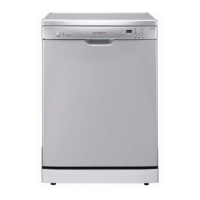
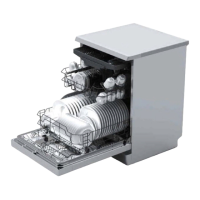
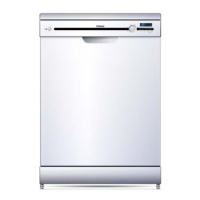
This document is a service manual for a domestic dishwasher, model DDW-G1213E. It provides comprehensive information regarding the appliance's features, safety precautions, wash cycles, maintenance, troubleshooting, and diagnostic procedures.
The dishwasher is designed for household use, specifically for washing dishes and cooking utensils. It incorporates several features aimed at efficiency and convenience. It boasts A-grade ratings for energy consumption, washing efficiency, and drying efficiency according to European standards, indicating a focus on environmental performance and effective cleaning. The appliance is equipped with electronic controls, allowing for precise operation and the inclusion of a delay wash function, which enables users to schedule wash cycles at a more convenient time. A water softening function is integrated to prevent the formation of incrustation, which can prolong the life of the appliance and improve washing results. Furthermore, it features a concealed heater to prevent heater turf burning, enhancing safety and durability. The dishwasher offers a super-capacity design, accommodating up to 12 place settings, making it suitable for families or those who frequently entertain.
The manual outlines various wash cycle programs tailored to different levels of soiling and types of dishes. These include:
- Intensive: For the heaviest soiled loads, such as pots, pans, casserole dishes, and dishes with dried food. This cycle involves pre-wash, main wash at 60°C, rinse, and drying.
- Normal: For normally soiled loads, including pots, plates, glasses, and lightly soiled pans, serving as a standard daily cycle. It includes pre-wash, main wash at 50°C, rinse, and drying.
- Economy: A faster wash cycle for more delicate items sensitive to high temperatures. This cycle should be run immediately after use and includes pre-wash, main wash at 45°C, rinse, and drying.
- Crystal: Designed for lightly soiled loads such as plates, glasses, bowls, and lightly soiled pans. It features pre-wash, main wash at 40°C, rinse, and drying.
- Rapid: A shorter wash for lightly soiled loads that do not require drying. This cycle includes a wash at 40°C and a rinse.
- Pre-Rinse: Used to rinse dishes that are planned to be washed later in the day. This is a pre-wash cycle only.
Safety is a paramount concern, and the manual details numerous precautions. During delivery, users are advised to check for transport damage and dispose of packaging materials properly. For installation, it's crucial that the dishwasher is not connected to the electricity supply while installation is carried out, that domestic wiring is properly earthed, and that the mains electricity supply conforms to the dishwasher's nameplate details. The appliance should not be connected via an extension cable. Built-under and built-in appliances must be installed under a continuous work surface and attached to adjacent cupboards for stability. The mains plug should remain easily accessible after installation. Specific models may have an electrically operated valve in the water inlet's plastic housing, and users are warned not to cut the hose or immerse the housing in water. The power supply cord must not be excessively bent or flattened during installation.
During normal use, the dishwasher is intended only for washing household dishes and cooking utensils by adults. It should not be installed outdoors or exposed to rain. Heavy objects should not be placed on the open door, nor should anyone stand on it, as this could cause the appliance to tip forward. The water inside the dishwasher is not potable. Solvents should never be used inside the dishwasher due to explosion risk. The door should be opened carefully during operation to avoid water squirting out. The heating element should not be touched during or after a wash cycle. Users are reminded not to touch the dishwasher barefoot or with wet hands, and the use of extension cords and multiple sockets is discouraged. If the appliance malfunctions or requires maintenance, it should be disconnected from the power supply.
Maintenance features are crucial for the longevity and performance of the dishwasher. After every wash, it's recommended to turn off the water supply and leave the door slightly ajar to prevent moisture and odors from being trapped. Before cleaning or maintenance, the plug should always be removed from the socket. For cleaning the exterior and rubber parts, only a cloth with warm soapy water should be used; solvents or abrasive cleaning products are prohibited. Spots or stains inside the dishwasher can be removed with a cloth dampened with water and a little white vinegar, or a specialized dishwasher cleaning product. If the appliance needs to be moved, it should ideally be kept in a vertical position, or on its back if absolutely necessary. Periodic cleaning of the seals with a damp sponge is advised to prevent food remnants from causing odors. The door should not be left open to avoid tripping hazards. When going on holiday, it's recommended to run an empty wash cycle, then remove the plug and turn off the water supply, leaving the door slightly ajar to preserve the seals and prevent odors.
The manual also provides extensive troubleshooting guidance for common issues. For problems when the appliance is switched on, remedies include checking the fuse, plug insertion, door closure, program button, water tap, and strainer in the water intake hose. A service diagnostics cycle can be initiated by pressing "ON/OFF" and "Delay" buttons, which lights all LED indicators and displays "888" to enter the diagnostic mode. This mode allows for checking various components like the inlet valve, dispenser, washing pump, heater, drain pump, and softener. If issues persist after these checks, users are advised to contact an authorized service center with details of the problem, model type, and serial number.
Other troubleshooting tips cover:
- Lower spray arm rotation difficulty: Check for blockages by small items or food.
- Lid in detergent compartment cannot be closed: Check for overfilling or clogged mechanism.
- Indicator lamps not extinguishing: Ensure the main switch is OFF.
- Remnants of detergent stuck: Ensure the compartment is dry before adding detergent.
- Water remains inside after program: Check for drainage hose blockages, jammed pump, or blocked filters.
- Unusual foam: Avoid using normal washing-up liquid in the rinse-aid container and wipe up spills.
- Appliance stops suddenly: Check electricity and water supply.
- Knocking sound: Adjust dishes to prevent contact with spray arm or check for loose crockery. Inlet valve knocking is normal and not a functional issue.
- Food remnants on dishes: Ensure proper loading, avoid overloading, use sufficient detergent, select an intensive program, ensure spray arm rotation is unobstructed, check for blocked nozzles or filters, and ensure filters are correctly fitted.
- Plastic items discolored: Use enough detergent with sufficient bleaching properties.
- White stains on crockery/glasses: Use enough detergent, adjust rinse-aid amount, add salt if water is hard, check water softener setting, ensure salt container lid is tight, and consider phosphate-containing detergent.
- Dishes not dried: Select a program with drying, adjust rinse-aid, and avoid removing items too soon.
- Dull glasses: Adjust rinse-aid amount.
- Tea stains/lipstick not removed: Use detergent with sufficient bleaching effect and ensure washing temperature is high enough.
- Rust on cutlery: Use rustproof cutlery, reduce salt content if too high, ensure salt container lid is tight, and avoid spilling salt.
- Clouded/discolored glasses: Use suitable detergent; some glasses may not be dishwasher-proof.
- Smears on glasses/cutlery: Adjust rinse-aid amount.
- Suds in the tub: Use only special dishwasher detergent. If suds occur, open the dishwasher, let them evaporate, add cold water, and run a "soak" cycle.
- Stained tub interior: Use detergent without colorant.
- Dishes/flatware not clean: Select a stronger program, ensure detergent dispenser and spray arms are not blocked.
- Spots/filming on glasses/flatware: Address hard water, low inlet temperature, overloading, improper loading, old/damp detergent, empty rinse aid dispenser, or incorrect detergent dosage. For removal, take out metal utensils, add no detergent, choose the longest cycle, run for 18-22 minutes, then add white vinegar or citric acid crystals.
- Cloudiness on glassware: Use less detergent with soft water and select a shorter cycle.
- Yellow/brown film on inside: Use a solution of bleach and warm water to remove stains by hand.
- Film on surfaces (iron deposits): Call a water softener company for a special filter.
- White film on inside surface (hard water minerals): Clean with a damp sponge and dishwasher detergent; avoid other cleaners.
- Detergent cup lid won't latch: Turn the dial to OFF and slide the door latch to the left.
- Detergent left in dispenser cups: Reload dishes properly.
- Steam: Normal phenomenon during drying and water draining.
- Black/gray marks on dishes: Use a mild abrasive cleaner to remove marks from aluminum utensil rubbing.
- Water standing on tub bottom: Normal, keeps water seal lubricated.
- Dishwasher leaks: Avoid overfilling rinse aid dispenser; wipe spills. Ensure dishwasher is level.
The manual also includes a section on error codes (E1-E7) with their meanings and possible causes, such as door open, water inlet malfunction, water drainage malfunction, temperature sensor malfunction, overflow, water leakage, and abnormal heating element operation. Each error code has a corresponding troubleshooting flowchart to guide technicians through diagnostic steps, including checking components, wiring, and replacing parts like pressure switches, flow meters, control wires, and PCBs.


 To Next Page
 General