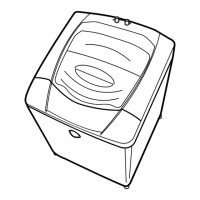
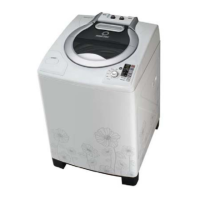
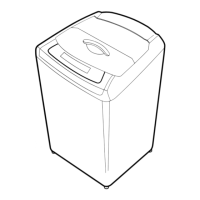
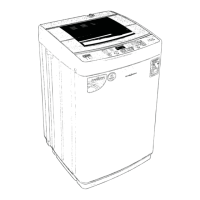
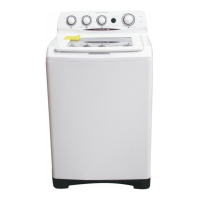
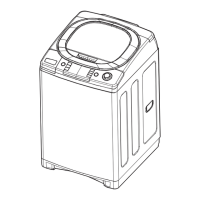
This document is a service manual for the DAEWOO Auto Washer, specifically models DWF-201M, DWF-200M(V), and DWF-240M(V). It provides detailed information on the washer's structure, installation, features, maintenance, and troubleshooting.
Function Description
The DAEWOO Auto Washer is a fully automatic washing machine designed to provide efficient and quiet washing. It incorporates advanced technologies to enhance cleaning performance, sterilize clothes, and deodorize bad smells. The washer features an air bubble washing system, which is the first of its kind, and a water current system to adjust unbalanced loads during spinning, thereby reducing vibration and noise. It also includes an automatic water supply system for blanket wash, which adjusts water levels based on absorption. The machine is equipped with a functional principle of bubble washing, where a bubble motor supplies air to the pulsator, creating air-bubbles through centrifugal force. The automatic draining time adjustment system optimizes draining time based on conditions, and an automatic unbalance adjustment system prevents abnormal vibration during spin cycles. The circulating-water course and lint filter system improve washing and rinsing effects by circulating water in a designed pattern and filtering lint.
Important Technical Specifications
The manual provides specifications for three models: DWF-201M, DWF-200M(V), and DWF-240M(V).
- Power Source: Available in all local AC voltage and cycle.
- Power Consumption:
- 50Hz: 480W (DWF-201M, DWF-200M(V)), 550W (DWF-240M(V))
- 60Hz: 550W (DWF-201M, DWF-200M(V)), 600W (DWF-240M(V))
- Machine Weight:
- Non-Pump: 47Kg (DWF-201M, DWF-200M(V)), 49Kg (DWF-240M(V))
- Pump: 48Kg (DWF-201M, DWF-200M(V)), 50Kg (DWF-240M(V))
- Dimension (WXHXD):
- 630 X 1040 X 670 (DWF-201M, DWF-200M(V))
- 630 X 1060 X 670 (DWF-240M(V))
- Washing Course:
- DWF-201M: Full Automatic 4 Course (Fuzzy, Blanket, Wool, Economy)
- DWF-200M(V)/240M(V): Full Automatic 6 Course (Fuzzy, Blanket, Wool, Light, Heavy, Economy)
- Water Consumption:
- DWF-201M, DWF-200M(V): 250 L
- DWF-240M(V): 270 L
- Water Level Selector (High, Medium, Low, E.Low) with varying liters per level.
- Operating Water Pressure: 0.3kgf/cm²~8kgf/cm² (2.94 N/cm²~78.4N/cm²)
- Revolution Per Minute:
- 50Hz: Wash: 125-140 RPM, Spin: 640-675 RPM
- 60Hz: Wash: 130-150 RPM, Spin: 710-740 RPM
- Pulsator: 6 Wings (Ø406mm)
- Water Level Control: Electronical Sensor
- Gear Mechanism Ass'y: Helical Gear
- Features: Lint Filter, Softener Inlet, Function for Soak Wash, Alarm Signal, Residual Time Display, Auto. Water Supply, Function for Bubble and Radical, Auto Re-feed Water, Auto Power Off.
- (V): Denotes Inverter Function.
Usage Features
The washer is designed for ease of use and optimal performance.
- Installation: Requires installation on a horizontal solid floor, at least 25cm from the wall to prevent noise and vibration. It should not be installed in direct sunlight, near heat appliances, in places prone to freezing, or in damp areas like bathrooms. An optional under base cover can be installed to reduce noise. Proper horizon setting is crucial, adjusted by turning the adjustable leg.
- Water Inlet Hose Connection: Detailed instructions are provided for connecting the inlet hose to both ordinary and screw-shaped taps, emphasizing careful tightening and checking for rubber packing.
- One-touch operation system: Simplifies the washing process.
- Water Current to Adjust Unbalanced Load: Prevents eccentricity of clothes during spinning by rotating the pulsator clockwise and counter-clockwise for 35 seconds, reducing vibration and noise.
- Automatic Water Supply System for Blanket Wash: Automatically checks and supplies water after 2 minutes of operation to compensate for water absorption by blankets.
- Automatic Draining Time Adjustment: The micom (microcomputer) remembers previous draining times and adjusts accordingly. If draining takes longer than 15 minutes, the program stops and an alarm is given.
- Automatic Unbalance Adjustment: Interrupts the spin process and initiates a rinse process if the tub becomes unbalanced, giving an alarm if the safety switch is activated.
- Residual Time Display: Shows the remaining time for the washing cycle, counting down during the process.
Maintenance Features
Regular maintenance is essential for the longevity and performance of the washer.
- Lint Filter Cleaning: The lint filter, located at the upper part of the tub, should be regularly cleaned by pulling out the filter frame, turning it inside out, washing off lint with water, and reinserting it.
- Water Inlet Filter Cleaning: The water inlet filter should be cleaned when water leaks from the inlet. This involves pulling out the power plug, turning off the water supply, separating the inlet hose, pulling out the inlet filter, and removing dirt with a brush.
- Drain Filter Cleaning: For "U" shape drain hoses, the drain filter at the back of the washer screens foreign materials. It should be cleaned regularly (every 10 uses) to prevent drain problems. This involves draining residual water, turning the cap counter-clockwise, pulling out the filter assembly, cleaning it, and reassembling it correctly.
- Gear Mechanism Ass'y Replacement: Detailed steps are provided for disassembling and replacing the gear mechanism, including removing the top plate, outer tub cover, pulsator, special nut, and special washer, then laying the washer on its front to access and remove the gear protect, V-belt, and gear mechanism. Reassembly is the reverse process.
- Motor Synchronous and Valve Replacement (Non-Pump Model): Instructions include laying the washer on its front, loosening screws, taking out wires, separating the motor synchronous from the base, turning the valve, and removing the valve lid.
- Clutch Spring Problem Repair: If the laundry is unevenly distributed during spin, causing noise, vibration, or poor spin performance, the clutch spring may be defective. The manual provides a checking method (observing spin tub and pulsator revolution) and instructions for replacing the clutch boss assembly, which includes the clutch spring.
- Case Filter Ass'y Replacement: Steps involve separating the back cover, removing screws, turning and separating the case filter assembly from the drain motor and cavitation hose, and then assembling the new case filter assembly.
- "Panel R" Disassembly: Instructions for disassembling the "Panel R" involve removing screws from the rear and using a driver to push the panel upward from the back or from the gap between "Panel R" and "DOOR B".
- New Components Information: The manual highlights differences in new components such as the motor condensor, pressure switch, radical and air generator, and synchronous motor, primarily focusing on lead wire length and connection types.

 Need help?

 To Next Page
 General