
 Need help?
Do you have a question about the Daikin DM AHU and is the answer not in the manual?
Highlights important notes and warnings for safe and correct operation, disclaiming liability for unqualified personnel.
Outlines safety practices for unit connection, start-up, repair, and maintenance, emphasizing qualified personnel.
Guides installation following industrial practices, emphasizing indoor use and proper support when ceiling hung.
Details requirements for adequate space around the unit for maintenance and proper installation height for condensate drainage.
Explains how to assemble units shipped in sections using pre-installed joint brackets for cabinets and base frames.
Discusses vibration isolators, including spring and restrained types, and their installation.
Details the removal of temporary transport brackets and adjustment of spring isolators for proper leveling.
Explains the application of restrained spring isolators and the insertion of U-shaped plates.
Describes the arrangement of control box and expansion valve kit for VRV AHU, referencing other manuals.
Covers the installation and connection procedures for unit coils, including general guidelines and specific types.
Emphasizes uniform airflow across the coil for performance and preventing moisture carry-over.
Advises on preventing freeze-up in water coils by draining and using anti-freeze solutions.
Covers expansion devices for DX coils, suction piping, thermostatic expansion valve, and pressure drop.
Specifies requirements for drain pipes and traps, emphasizing level installation for proper condensation drainage.
Details electric supply, connection details, grounding, and protection for motors, including VFD control.
Specifies downward motor wiring from the terminal box to prevent condensation water entry and potential failure.
Describes filter types and installation, instructing to insert according to the airflow arrow.
Details modification of pulley diameter by moving the adjustable flange and locking it securely.
Covers power supply and electrical connection for electric heaters, noting the 240V, single-phase rating and safety interlock.
Details the process for removing and replacing the fan/motor assembly, including drive belts and mounting.
Describes how to remove and replace coils, including disconnecting piping and handling stacked coils or DX coils.
Lists essential preparation steps before initial unit operation, including cleaning and securing components.
Covers thorough cleaning, removal of transport brackets, securing fasteners, and sealing air leaks.
Details checks for fan rotation, belt tension, motor connections, voltage, and VFD settings.
Advises checking airflow through the heater and warns about potential damage from unbalanced voltage.
Specifies operating limits for forward curve and airfoil fans, including maximum RPM and kW for different sizes.
Outlines checks for soiling, corrosion, damage, vibration, and securing of bolts and connections.
Checks for dirt accumulation, cleans the unit, and verifies safety controls, cables, and connections.
Details checking and cleaning moisture eliminator blades, ensuring correct positioning.
Step-by-step instructions for assembling the heat wheel unit, including baffle and cabinet sections.
Specifies water quality requirements to prevent scaling and corrosion in heat exchangers and piping.
Provides a checklist for pre-start up and start-up checks for the AHU's fan, coil, and other sections.
This document serves as an installation, operation, and maintenance manual for Double Skin Modular Air Handling Units (AHUs), including DM AHU, DS AHU, and AHUR VRV AHU models. It provides comprehensive guidance for users to ensure the continuous and successful operation of the equipment.
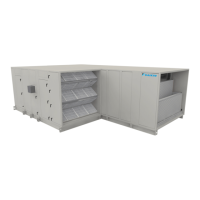
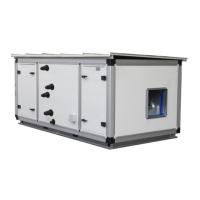
Air Handling Units are designed to regulate and circulate air as part of a heating, ventilating, and air conditioning (HVAC) system. These modular units can be delivered as separate sections or fully assembled, offering flexibility for various installation scenarios. They are equipped with components such as fans, coils (water, direct expansion, or heat pipe), filters, and dampers to condition and distribute air. The units are not designed to be weatherproof unless specifically equipped with a canopy, indicating their primary use in indoor or protected environments. For VRV AHU models, control boxes and expansion valve kits are integrated, working in conjunction with outdoor units and remote controllers to manage the air conditioning process. Electric heaters can also be incorporated to provide heating, with safety interlocks to prevent operation without airflow.
The AHUs offer several features to facilitate their use and integration into HVAC systems. For installation, specific lifting methods are recommended to prevent damage, emphasizing the use of spreader bars and forklift trucks with appropriate extensions. Adequate space around the unit is crucial for maintenance, filter replacement, and coil servicing. Section joints are pre-installed for modular units, allowing for careful assembly and alignment of multiple sections. Vibration isolators, including spring and restrained spring types, are supplied to minimize noise and vibration, with temporary transport brackets that must be removed before commissioning.
Piping connections for coils require careful attention, with specific instructions for water coils, direct expansion (DX) coils, and drain pan traps. For DX coils, individual expansion devices are necessary, and proper placement of sensing bulbs is critical for optimal performance. Electrical installation must comply with local codes and regulations, with detailed diagrams provided for motor connections (star, delta, multi-speed, dual winding) and electric heaters. Motor cabling is designed to prevent condensation ingress. Drive belts and sheaves require precise alignment and tensioning, with recommended deflection forces provided to prevent premature wear and damage. Filters are easily inserted into sliding frames or universal clips, and mixing boxes can be linked to actuators for coordinated damper operation. Variable pitch pulleys allow for adjustments to fan speed, and heat wheels or heat pipes can be integrated for energy recovery. Ductwork connections should ensure smooth airflow and minimize pressure loss, with specific guidelines for elbows, dampers, and sealing to prevent leakage, especially for outdoor installations.
The manual outlines a detailed maintenance plan to ensure the longevity and efficient operation of the AHUs. Regular pre-run checks are essential, including thorough cleaning, securing all fasteners, and verifying the removal of transport brackets. Fan and motor maintenance involves checking for free rotation, belt tension and alignment, correct electrical connections, and sealing of motor conduits. For fan arrays, ensuring simultaneous operation of all fans is critical, and blank-off plates should be used for non-functional fans. Vibration isolator mounts and flexible connections must be checked for free movement. Coil maintenance includes inspecting for foreign matter, damage, and proper condensate drainage, with specific instructions for cleaning dirty coils (dry or wet methods) and checking frost protection systems. DX coils should not be cleaned with hot water or steam, and the refrigeration system should be checked if frost builds up. Filters, whether disposable or washable, need regular inspection and replacement or cleaning based on pressure drop. Dampers should be checked for dirt, corrosion, and smooth operation. Electric heaters require checks for dirt accumulation, safety controls, cables, and connections, with a critical airflow velocity requirement. Heat wheels and heat pipes should be maintained according to manufacturer recommendations. Moisture eliminators require periodic cleaning of blades to ensure correct positioning and prevent distortion.
A comprehensive maintenance interval table is provided, suggesting weekly, monthly, 3-monthly, 6-monthly, and yearly checks for various components such as fans, motors, bearings, belts, coils, filters, and dampers. This includes actions like cleaning, greasing, replacing, re-tensioning, and tightening. The manual also includes a troubleshooting guide to assist in diagnosing and resolving common malfunctions, covering issues like motor failure to start, motor stall, motor overheats, low air volume, excessive noise, excessive vibration, bearing overheating, water in drain pan, premature drive belt failure, belt swelling, and filter collapsing.
 General
| Construction | Modular |
|---|---|
| Casing | Galvanized steel |
| Coil Options | Chilled water, hot water, DX |
| Filter Options | HEPA |
| Airflow Rate | 1, 000 - 60, 000 m³/h |
| Dimensions (HxWxD) | Varies by model |
| Weight | Varies by model |


 To Next Page