10
T
O
AVOID
BODILY
INJURY
,
FIRE
OR
EXPLOSION
,
SOLVENT
CEMENTS
MUST
BE
KEPT
AWAY
FROM
ALL
IGNITION
SOURCES
(
I
.
E
.,
SPARKS
,
OPEN
FLAMES
,
AND
EXCESSIVE
HEAT
)
AS
THEY
ARE
COMBUSTIBLE
LIQUIDS
.
A
VOID
BREATHING
CEMENT
VAPORS
OR
CONTACT
WITH
SKIN
AND
/
OR
EYES
.
WARNING
PREFERRED
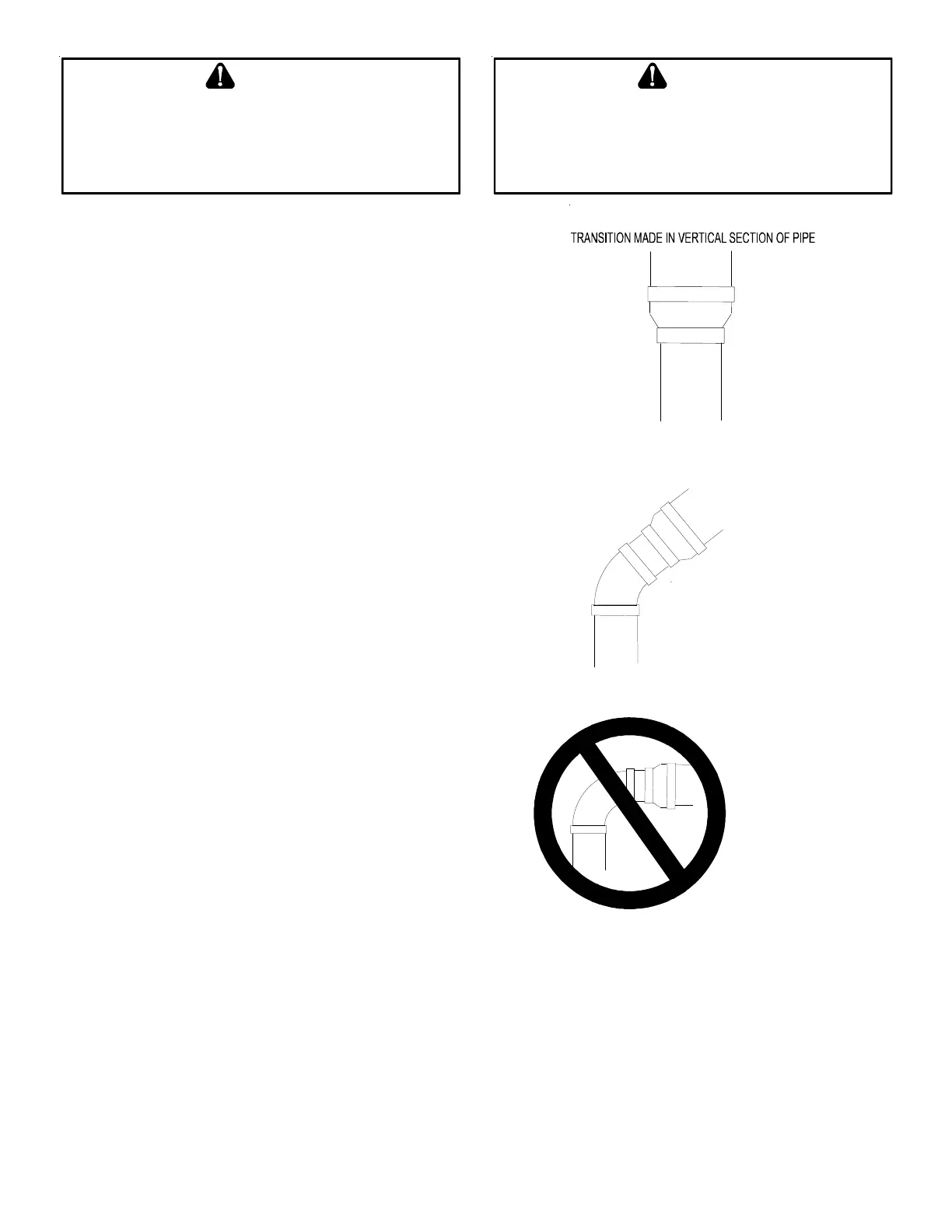
Figure 4
TRANSITION NO LESS
THAN 45 DEGREES TO
HORIZONTAL PLANE TO
AVOID CREATING A WATER
TRAP IN VENT PIPING.
ACCEPTABLE
Figure 5
NO TRANSITION ON
HORIZONTAL PLANE,
THIS CREATES A
WATER TRAP AND
RESTRICTS FLUE
GASES
Figure 6
Some models require the use of 3” pipe. Do not transition
from a 2” to 3” pipe in a horizontal section of pipe as this
may create a water trap.
Piping must be adequately secured and supported to prohibit
sagging, joint separation, and/or detachment from the furnace.
Horizontal runs of vent/flue piping must be supported every three
to five feet and must maintain a 1/4 inch per foot downward
slope, back towards the furnace, to properly return condensate
to the furnace’s drain system. Allowances should be made for
minor expansion and contraction due to temperature variations.
T
O
AVOID
BODILY
INJURY
,
FIRE
OR
EXPLOSION
,
SOLVENT
CEMENTS
MUST
BE
KEPT
AWAY
FROM
ALL
IGNITION
SOURCES
(
I
.
E
.,
SPARKS
,
OPEN
FLAMES
,
AND
EXCESSIVE
HEAT
)
AS
THEY
ARE
COMBUSTIBLE
LIQUIDS
.
A
VOID
BREATHING
CEMENT
VAPORS
OR
CONTACT
WITH
SKIN
AND
/
OR
EYES
.
WARNING
MATERIALS AND JOINING METHODS
Two-three-inch nominal diameter PVC Schedule 40 pipe
meeting ASTM D1785, PVC primer meeting ASTM F656,
and PVC solvent cement meeting ASTM D2564 specifica-
tions must be used. Fittings must be DWV type fittings
meeting ASTM D2665 and ASTM D3311. Carefully follow
the manufacturer’s instructions for cutting, cleaning, and
solvent cementing of PVC.
The use of Schedule 40 PVC cellular core DWV meeting
ASTM F891-1 or ABS cellular core (Foam Core) plastic
pipe is also acceptable as a flue/vent and intake pipe
material. PVC primer meeting ASTM F656 and PVC sol-
vent cement meeting ASTM D2564 specifications must be
used. Fittings must be DWV type fittings meeting ASTM
D2665 and ASTM D3311. Carefully follow the manufactures
instructions for cutting, cleaning and solvent cementing
of PVC.
NOTE: Requirement does not apply to the combustion air
pipe.
As an alternative to PVC pipe, primer, solvent cement, and
fittings, ABS materials which are in compliance with the fol-
lowing specifications may be used. Two-or-three-inch ABS
Schedule 40 pipe must meet ASTM D1527. Solvent cement
for ABS to ABS joints must meet ASTM D2235. The solvent
cement for the PVC to ABS transition joint must meet ASTM
D3138. Fittings must be DWV type fittings meeting ASTM
D2661 and ASTM D3311. Carefully follow the manufacturers’
instructions for cutting, cleaning, and solvent cementing PVC
and/or ABS.
All 90° elbows must be medium radius (1/4 bend DWV) or
long radius (Long sweep 1/4 bend DWV) types conforming to
ASTM D3311. A medium radius (1/4 bend DWV) elbow mea-
sures 3 1/16” minimum from the plane of one opening to the
center line of the other opening for 2” diameter pipe, and 4
9/16” minimum for 3” pipe.
PROPER VENT/FLUE AND COMBUSTION AIR PIPING PRACTICES
Adhere to these instructions to ensure safe and proper fur-
nace performance. The length, diameter, and number of el-
bows of the vent/flue pipe and combustion air pipe (when
applicable) affects the performance of the furnace and must
be carefully sized. All piping must be installed in accordance
with local codes and these instructions.



 To Next Page