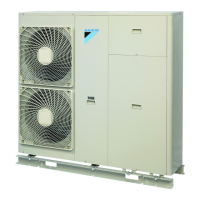
This document is an installation manual for Daikin packaged air-cooled water chillers and packaged reversible air-to-water heat pumps, specifically covering models EWAQ-ACV3 (009, 010, 011), EWYQ-ACV3 (009, 010, 011), EWAQ-ACW1 (009, 011, 013), and EWYQ-ACW1 (009, 011, 013), which use R410A refrigerant. It provides comprehensive instructions for unpacking, installing, connecting, maintaining, and troubleshooting these units.
Function Description
The Daikin inverter chiller is designed for outdoor installation and serves both heating and cooling applications. It is intended for use with fan coil units or air handling units for air conditioning purposes. The range includes two main versions: a heat pump (EWYQ) for both heating and cooling, and a cooling-only (EWAQ) version. These units are available in six standard sizes: V3 (single phase) with capacities of 9, 10, and 11 kW, and W1 (three phase) with capacities of 9, 11, and 13 kW.
The unit's hydraulic compartment includes essential components for water circulation and temperature regulation. An air purge valve automatically removes air from the water circuit. Three temperature sensors (R11T, R13T, R14T) monitor water and refrigerant temperatures at various points. An expansion vessel (10 L) accommodates changes in water volume due to temperature fluctuations, with a default pre-pressure of 1 bar. A manometer allows for water pressure readout, and a flow switch checks water flow, protecting the heat exchanger and pump from damage. The pump circulates water, and a pressure relief valve opens at 3 bar to prevent excessive pressure. Shut-off valves allow isolation of the unit's water circuit from the residential water circuit for maintenance. A water filter removes dirt to prevent damage to the pump or blockage of the evaporator.
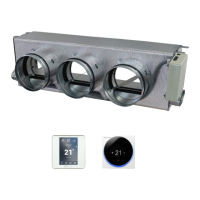
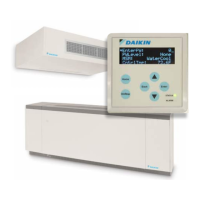
The digital controller, supplied as a kit for indoor mounting, provides a user-friendly interface for setting up, using, and maintaining the unit. It allows users to turn the unit ON/OFF, select between cooling and heating modes (for heat pump models), and set the water temperature. Certain user interface buttons can be made unavailable based on three permission levels (1, 2, or 3), with level 2/3 determined by field setting [0-00].
The unit supports connection to benefit kWh rate power supply delivery systems, allowing for potential power interruptions or limited electricity consumption during specific periods. This feature enables the unit to switch into a forced-off mode when a specific input signal is received, preventing compressor operation.
Important Technical Specifications
Nominal Capacity:
- EWAQ/EWYQ009-011ACV3 and EWAQ/EWYQ009-013ACW1 models have varying cooling and heating capacities. Specific values are detailed in the Technical Data (1418 x 1435 x 382 dimensions).
Dimensions (H x W x D):
- All models: 1418 x 1435 x 382 mm.
Weight:
- Machine weight: 180 kg.
- Operation weight: 185 kg.
Connections:
- Water inlet/outlet: G 5/4" FBSP (Female British Standard Pipe) hose nipple.
- Water drain: hose nipple.
- Refrigerant liquid side: Ø9.5 mm (3/8 inch).
- Refrigerant gas side: Ø15.9 mm (5/8 inch).
Expansion Vessel:
- Volume: 10 L.
- Maximum working pressure (MWP): 3 bar.
Pump:
- Type: Water cooled.
- Number of speeds: 2 (low and high speed, medium speed setting on dial is equal to low speed).
Sound Pressure Level (at 1m in front of the unit, free field condition):
- Heating: 51 dBA (V3), 51-52 dBA (W1).
- Cooling: 51 dBA (V3), 51-52 dBA (W1).
Internal Water Volume:
Pressure Relief Valve Water Circuit:
Operation Range - Water Side:
- Heating: +25°C to +50°C.
- Cooling: +5°C to +22°C.
Operation Range - Air Side (RH: 85%):
- Heating: -15°C to +35°C.
- Cooling: +10°C to +46°C.
Electrical Specifications:
- V3 models (1~):
- Power supply: 230 V 50 Hz 1P.
- Nominal running current: 5.8 A.
- Minimum circuit amps (MCA): 28.2 A.
- Recommended field fuse: 32 A.
- Wire type: H05VV-U3G.
- W1 models (3N~):
- Power supply: 400 V 50 Hz 3P.
- Minimum circuit amps (MCA): 13.5 A.
- Recommended field fuse: 20 A.
- Wire type: H05VV-U5G.
- Wire type of wiring between units: H05VV-U4G2.5.
- Earth leakage circuit breaker: high-speed type, 30 mA (<0.1 s).
- Thermostat requirements: Contact voltage 230 V.
Refrigerant:
- Type: R410A.
- GWP value: 1975.
Usage Features
Installation Site Selection:
- Requires a well-ventilated, level, and stable foundation capable of withstanding the unit's weight and vibration.
- Must be free from flammable gas or product leaks.
- Adequate servicing space must be ensured.
- Piping and wiring lengths must be within allowable ranges.
- Should avoid locations where water leakage could cause damage or where the unit is frequently exposed to strong winds or heavy snowfall.
- In cold climates, the unit should be installed with its suction side facing a wall or with a baffle plate on the air discharge side to prevent wind exposure. A large canopy and pedestal are recommended in heavy snowfall areas.
Water Circuit Management:
- Designed for use in a closed water system to prevent excessive corrosion.
- Maximum water pressure is 3 bar.
- Requires drain taps at low points and air vents at high points of the system.
- An automatic air purge valve is integrated.
- Water circuit protection against freezing is crucial in colder climates, either by installing the optional heater tape (OP10) or adding glycol to the water.
- Glycol concentration must be appropriate for the expected lowest outdoor temperature (e.g., 10% ethylene glycol for -5°C, 35% for -15°C). Uninhibited glycol should not be used, and the water treatment must be executed by a qualified specialist.
Digital Controller Operation:
- Allows users to turn the unit ON/OFF, select cooling/heating mode, and set water temperature.
- Supports weather-dependent set point settings, where water temperature is automatically adjusted based on outdoor temperature. Users can shift the target water temperature by a maximum of 5°C.
- Quiet mode settings (A or B) are available to prioritize quiet operation, potentially at the cost of reduced performance.
- Auto restart function reapplies user interface settings after a power supply failure.
- Remote alarm output logic can be configured via field settings.
Benefit kWh Rate Power Supply:
- Allows connection to systems that may interrupt power supply or limit consumption.
- When connected, the unit can be forced into off mode.
- Heater tape options require continuous power supply; if the benefit kWh rate system completely shuts off power, a separate power supply for heaters is needed.
Start-up and Configuration:
- Initial start-up at low outdoor ambient temperatures requires gradual water heating to prevent concrete floor cracking. The lowest leaving water set temperature can be adjusted.
- Pump speed can be selected (low or high) to optimize water flow and minimize noise.
Maintenance Features
Regular Checks:
- All checks and inspections must be performed at least once a year by qualified personnel.
- Before any maintenance or repair, the circuit breaker on the supply panel must be switched off, fuses removed, or protection devices opened.
- The service panel of the switch box should only be opened by a licensed electrician.
Chiller Unit Maintenance:
- Water Pressure: Check if water pressure is above 0.3 bar and add water if necessary.
- Water Filter: Clean regularly to prevent damage to the pump or evaporator.
- Water Pressure Relief Valve: Check for correct operation by turning the red knob counter-clockwise. If no clacking sound is heard, contact a local dealer. If water continuously runs out, close shut-off valves and contact a dealer.
- Pressure Relief Valve Hose: Ensure it is positioned appropriately to drain water.
- Air Heat Exchanger: Remove dust and contaminants from coil fins using a brush and blower, blowing from the inside out to avoid bending fins.
- Fan Motor: Clean cooling ribs and check for abnormal noises.
- Unit Switch Box: Visually inspect for loose connections or defective wiring.
Glycol System Maintenance:
- If glycol is used, document its concentration and pH-value at least once a year.
- A pH-value below 8.0 indicates inhibitor depletion, requiring more inhibitor.
- A pH-value below 7.0 indicates glycol oxidation, requiring system drainage and thorough flushing before severe damage occurs.
- Disposal of glycol solution must comply with local and national legislation.
Digital Controller Maintenance:
- The digital controller itself does not require maintenance beyond cleaning dirt with a soft damp cloth.
Troubleshooting:
- General guidelines include a thorough visual inspection for obvious defects or loose connections before contacting a dealer.
- Safety devices should never be bridged or changed.
- If the pressure relief valve is replaced, the flexible hose must be reconnected.
- The manual provides a detailed table of possible causes and corrective actions for common symptoms (e.g., unit not heating/cooling, compressor not starting, pump noise, water pressure relief valve leaks) and error codes.
- Error codes displayed on the user interface (e.g., E3, E4, L8, 12, L4, E7, 02) indicate specific malfunctions, such as closed stop valves, blocked air inlet/outlet, voltage imbalance, or missing phases.
- For W1 units, reversed phase protection works during initialization. If a phase reversal occurs, power must be shut off, and two of the three power supply cables (L1, L2, L3) must be switched.

 Need help?

 To Next Page
 General