IM 1287-6 • REBEL APPLIED ROOFTOP 112 www.DaikinApplied.com
Planned Maintenance
Planned maintenance is the best way to avoid unnecessary
expense and inconvenience. Have this system inspected at
regular intervals by a qualied service technician. The required
frequency of inspections depends upon the total operating time
and the indoor and outdoor environmental conditions. Routine
maintenance should cover the following items:
• Tighten all belts, wire connections, and setscrews.
• Clean the evaporator and condenser coils mechanically
or with cold water, if necessary. Usually any fouling is
only matted on the entering air face of the coil and can be
removed by brushing.
• Check each circuit’s refrigerant sightglass when
the circuit is operating under steady-state, full load
conditions. The sightglass should then be full and clear. If
it is not, check for refrigerant leaks.
NOTE: A partially full sight glass is not uncommon at part
load conditions.
• Check for proper superheat.
• Check for proper subcooling.
• Check for blockage of the condensate drain. Clean the
condensate pan as needed.
• Check the power and control voltages.
• Check the running amperage of all motors.
• Check all operating temperatures and pressures.
• Check and adjust all temperature and pressure controls
as needed.
• Check and adjust all damper linkages as needed.
• Check the operation of all safety controls.
• Check the condenser fans and tighten their setscrews.
• Lubricate the door latch mechanisms.
Unit Storage
Location
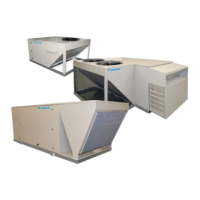
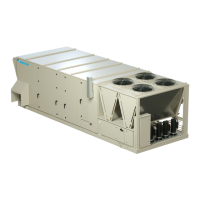
The Daikin Applied Rooftop Packaged System Unit is an
outdoor unit. However, the schedule may dictate storage either
on the ground or in its nal position at the site. If the unit is
stored on the ground, additional precautions should be taken
as follows:
• Make sure that the unit is well supported along the length
of the base rail.
• Make sure that the unit is level (no twists or uneven
ground surface).
• Provide proper drainage around the unit to prevent
ooding of the equipment.
• Provide adequate protection from vandalism, mechanical
contact, etc. The condenser ns are particularly
vulnerable to damage by even light contact with objects.
• Make sure all doors are securely closed.
• If isolation dampers are provided, verify that they are
properly installed and fully closed to prevent the entry
of animals and debris through the supply and return air
openings.
• Units without isolation dampers should be tted with
covers over the supply and return air openings.
Preparation
Supply (and Return) Fans
1. Turn the supply and return fan manual motor protectors
(MMP) to the OFF position.
2. Once every two weeks, rotate the fan and motor shafts.
Mark the shaft positions rst to make sure they stop in a
dierent position.
3. Depending on local climatic conditions, condensate
may collect on components inside the unit. To prevent
surface rust and discoloration, spray all bare metal parts
with a rust preventive compound, and consider adding
a desiccant inside of the cabinet and control panel.
Pay close attention to fan shafts, bearings, and bearing
supports.
Cabinet Sections
Once a month, open a door on each section and verify that no
moisture or debris is accumulating in the unit.
Cooling Circuits
The steps below are necessary only if the unit has been
started.
1. Turn the compressor manual motor protectors (MMP) to
the OFF position.
2. Close the discharge and liquid line refrigerant service
valves on each circuit.
3. Tag the valves as a warning for the technician who
restarts the units.
Restart
After extended storage, perform a complete start up. Inevitable
accumulations of dirt, insect nests, etc. can contribute to
problems if not cleaned out thoroughly prior to start up. In
addition, thermal cycling tends to loosen mechanical and
electrical connections. Following the start-up procedure helps
discover these and other issues that may have developed
during the storage interval.


 To Next Page
 Loading...