Need help?
Do you have a question about the Danfoss OMS and is the answer not in the manual?
Lists T-codes and max surface temps for OMS, OMT, OMV motors in gaseous environments based on operating conditions.
Classifies maximum surface temperatures for T3, T4, and T5 temperature classes for Group IIG equipment.
Presents maximum surface temperature data for motors in dusty environments (Group IID).
Outlines builder's responsibilities and essential checks for safe motor installation, including ATEX compliance.
Covers pre-start up checks, fluid filling, and recommended start-up procedures for safe motor operation.
Emphasizes regular maintenance, checks for leaks, oil level, temperature, and fluid condition for reliability.
Lists general safety precautions for servicing, including anti-sparking tools, personal safety, and fluid under pressure.
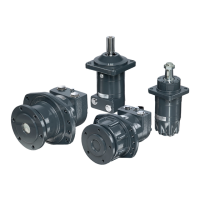
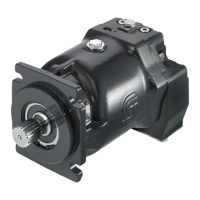
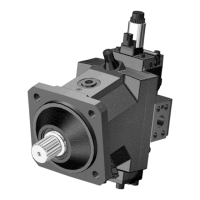
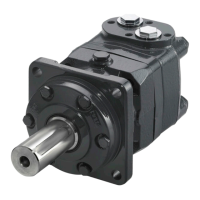
The Danfoss OMS, OMT, and OMV series are hydraulic orbital motors designed for converting hydraulic energy (pressure, oil flow) into mechanical energy (torque and speed). These motors are suitable for both mobile and stationary applications and are ATEX certified, meaning they fulfill the explosion requirements of Directive 2014/34/EU for Group II Category 2 systems. This allows them to operate in gaseous environments (Zone 1 and 2) and dusty environments (Zone 21 and 22).
The operating principle of these motors is based on an internal gear design, consisting of a fixed external gear reaching against an internal gear through which the output torque and speed are transmitted. The distributor valve in the OMS, OMT, and OMV motors is of the disc valve design, which is driven synchronously by the internal gear through a cardan shaft, ensuring that the individual chambers of the motor are filled and emptied precisely. The motor has two port connections on the end cover, which can serve as either inlet or outlet ports depending on the application. A drain line connection (Z) relieves pressure on the shaft seal to the tank, and the tank pressure must not exceed the maximum permissible seal pressure.
The motors are marked with an ATEX code: Ex II 2 GD ck TX.
II: Group II, for surface industries.2: Category 2, suitable for zones 1, 2, 21, and 22.G: May operate in a gaseous environment.D: May operate in a dusty environment.c: Ignition protection by "constructional safety."k: Ignition protection by "liquid immersion."TX: Maximum surface temperature depends on operating conditions (ambient and oil temperature).The T-codes and maximum surface temperatures vary depending on the specific motor type (OMS/OMSW, OMSS, OMT/OMTW, OMTS, OMV/OMVW, OMVS) and the ambient and oil temperatures. For gaseous environments (G), T-codes range from T3 to T5.
For dusty environments (D), maximum surface temperatures are provided in Celsius and Fahrenheit, considering different oil and ambient temperature combinations. For example, an OMS/OMSW motor with oil temperature ≤ 80 °C [176 °F] and ambient temperature ≤ 60 °C [140 °F] can reach a surface temperature of 185 °C [365 °F]. It is crucial to account for the insulation effect of dust layers; for up to 5 mm [1.97 in] layer thickness, a safety margin of 75 °C [167 °F] is recommended.
Mineral hydraulic oil with anti-wear additives (type HLP [DIN 51524] or HM [ISO 11158]) must be used. It is compulsory to use oils whose inflammable degree is at least 50K above the maximum surface temperature of the motor. Mixing oils of different brands or even different oils of the same brand can lead to sediment and sludge formation, causing rapid system deterioration.
The ambient temperature should generally be between -30 °C [-22 °F] and +90 °C [+210 °F] to ensure shaft seal integrity. Under normal operating conditions, oil temperature should be kept between 30 °C [86 °F] and 60 °C [140 °F]. High fluid temperatures can limit seal life and reduce oil lubricity, with oil life being halved for every 8 °C [46 °F] increase above 60 °C [140 °F].

 To Next Page
 General