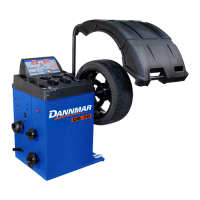
DB-70 Automatic Wheel Balancer 8 P/N 5900261 — Rev. A1 — January 2021
Frequently Asked Questions
What does a Wheel Balancing Machine do?
The Wheel Balancer detects wheel imbalances and indicates where and what value of
counterweights are to be placed to correct the Wheel imbalance. Wheel imbalance
creates vibration which creates excessive wear on the Tires and steering components.
Q
Is Wheel Balancing the same as Wheel Alignment?
A: No. When you balance a Wheel, you fix a weight distribution problem that can cause Wheel
wobble, uneven Tire wear, and vehicle vibration. This is done by putting weights on the Wheel in
appropriate locations.
When you align a Wheel, you are adjusting the angles of the wheels to the pavement through the
vehicle suspension.
Q: Where can I put my Wheel Balancer?
A: The ideal location has a flat concrete floor with room to move the wheels and Tires safely around
the machine. The Balancer’s position should allow the operator to work safely and keep everyone
away from the Balancer while it is in use. Most garages put their Wheel Balancers and Tire
Changers near each other.
Q: Why are there two types of Weights?
A: Clip-On Weights are more visible. Adhesive Weights are lower profile and come in two colors so
you can try to color match with the Rim, so they are less visible. Some Vehicle owners with
expensive Wheels prefer Adhesive Weights because they are less visible.
Q: What kind of plug comes with the Balancer?
A: The Balancer comes from the factory with a plug for 110 VAC power. However, it may be
converted to 220 VAC. Refer to Connecting to Power
for complete instructions for switching
between 110 and 220 VAC. Because 220 VAC plugs vary from location to location, no 220 VAC
plug comes with the Balancer. Have a
refer to this manual for instructions
on converting the Balancer to 220 VAC. The Electrician will also install an appropriate plug or have
the Power Cord attached directly to the facility’s power system protected by an appropriate circuit
breaker conforming to local electrical codes.
Q: What Balancing Modes does the Balancer have?
A: The Balancer has six dynamic balancing modes and one static mode. Dynamic modes are DYN,
ALU 1, ALU 2, ALU 3, ALU 4, ALU 5, ALUS and STA. Dynamic (DYN) mode is used with steel
Wheels, the Static mode is used for older, narrower Wheels or motorcycle Wheels, and the
Aluminum modes are for Aluminum Alloy (non-steel) Wheels.
Q: How accurate are the weight values the Balancer displays?
A: By default, the Balancer rounds off to .25 ounces (~7 grams); this is because most weights sold in
the U.S. come in .25 ounce increments. (Countries that use the metric system measure weight in
grams; their weights come in 5 gram increments.) If you do not want rounded-off weight values,
press and hold the F button on the Control Panel to see specific values.
Q: What do I do if I have a problem with the Balancer that I cannot solve?
A: Contact Dannmar; we are here to help. Using a web browser, visit the Dannmar Support
website.


 To Next Page
 Loading...