32 Low Frequency Oscillators
Dave Smith Instruments
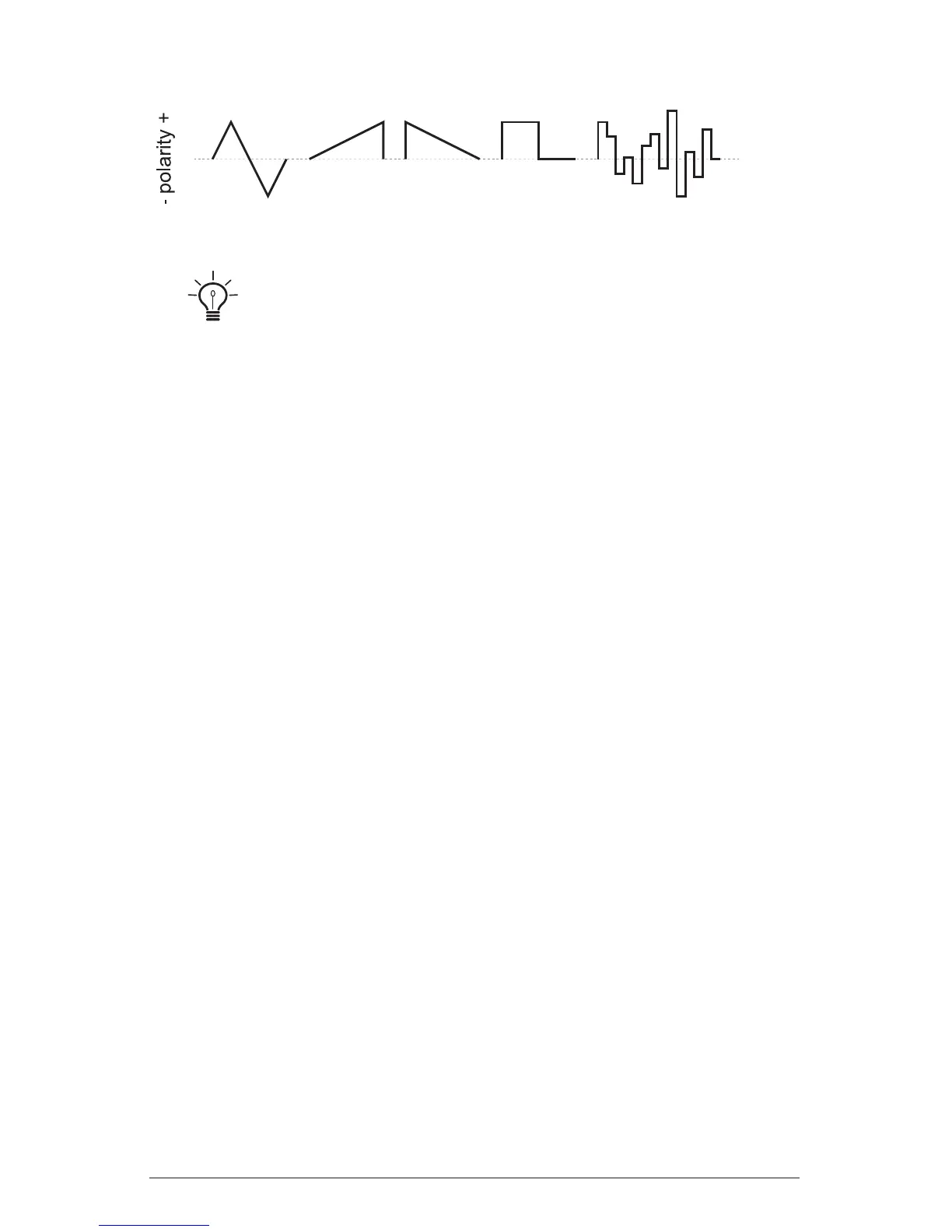
Square RandomSawtooth Reverse
Sawtooth
Triangle
0
LFO waveshapes
The Prophet-6 has a sixth “hidden” LFO waveshape that you can use as a
modulation source — noise. To access this, choose random then turn frequency all the
way clockwise. This generates a white noise waveform.
The LFO can be free-running or synced to the arpeggiator, sequencer, or
MIDI clock for tempo-synced effects such as lter sweeps, tremolo, and so on.
Frequency: Sets the frequency of the LFO waveshape routed to the
destination. See also “LFO Sync” below.
LFO Sync: When on, the LFO synchronizes with the arpeggiator,
sequencer, or MIDI clock. By default, the LFO wave cycle is reset when
you press a key (but is not reset if you press a key while other notes are
held).
Shape: Triangle, Sawtooth, Reverse Sawtooth, Square, Random—The
wave shape of the LFO. A sixth waveshape, noise, can be generated by
selecting random and turning the frequency knob all the way to the right.
Initial Amount: Sets the amount of LFO modulation routed to the
selected destinations. Setting an amount here applies the selected modu-
lation continuously. If you set this parameter to zero but still select a
modulation destination, modulation is only applied when you use the
Mod Wheel.
Freq 1: Selects the frequency of Oscillator 1 as a modulation destination.
Use a triangle wave as a source to create vibrato. Use a square wave to
create trills.
Freq 2: Selects the frequency of Oscillator 2 as a modulation destination.
Use a triangle wave as a source to create vibrato. Use a square wave to
create trills.


 To Next Page