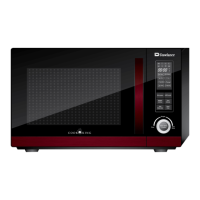
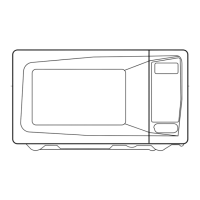
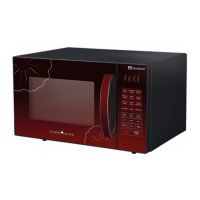
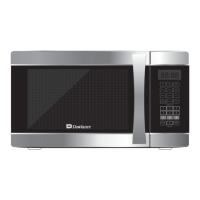
This document is an owner's guide for a Dawlance microwave oven, model DW-162 HZP, with a power output of 1200 watts. It provides comprehensive instructions for safe installation, operation, and maintenance of the appliance.
Function Description
The Dawlance DW-162 HZP is a microwave oven designed primarily for heating and cooking food using microwave energy. It offers various cooking modes and functions to cater to different culinary needs.
Core Cooking Functions:
- Microwave Cook: This is the primary function for cooking food using microwave power. Users can set a specific cooking time (up to 99 minutes and 99 seconds) and adjust the power level from 100% down to 0% (fan only).
- Speedy Cooking: For quick heating, the oven allows instant cooking at 100% power. Users can select cooking times from 1 to 6 minutes by pressing number pads, or add 30-second increments by repeatedly pressing the "START/+30SEC." button. The maximum cooking time in this mode is 99 minutes and 99 seconds.
- Weight Defrost: This function is designed to defrost food based on its weight. Users input the weight of the food (ranging from 100g to 2000g), and the oven automatically calculates the defrosting time.
- Time Defrost: Alternatively, users can manually set a defrosting time (from 00:01 to 99:99) for food. The default microwave power level for this function is set to level 3 and cannot be changed.
- Multi-stage Cooking: The oven supports up to two cooking stages. If one of the stages involves defrosting, it will automatically be set as the first stage. Auto-cooking functions are not available in multi-stage cooking.
Pre-set Cooking Functions (Auto Cook):
The microwave includes several pre-set programs for common food items, simplifying the cooking process:
- Popcorn: Users can select between 50g and 100g popcorn settings. For 100g popcorn, it is recommended to fold down a triangle on each corner of the bag before cooking. If the bag expands and stops rotating, users should adjust its position for even cooking.
- Potato: This function offers settings for 1, 2, or 3 potatoes (approximately 230g, 460g, and 690g, respectively).
- Frozen Vegetable: Pre-set options for frozen vegetables include 150g, 350g, and 500g.
- Beverage: This function provides settings for 1, 2, or 3 cups (each approximately 120ml) of beverage.
- Dinner Plate: Users can select settings for 250g, 350g, or 500g dinner plates.
- Pizza: Pre-set options for pizza include 100g, 200g, and 400g.
Utility Functions:
- Clock Setting: The oven features a 12-hour clock display. Users can set the current time, which will flash on the LED display. If no valid numbers are input or no operation occurs within 1 minute, the clock setting reverts to the previous state.
- Kitchen Timer: This is a standalone timer function, separate from the 12-hour clock system. Users can set a timer for up to 99 minutes and 99 seconds. The buzzer will sound five times when the timer finishes.
- Memory Function: The oven allows users to save up to three custom cooking procedures (memory 1-3). Each memory can consist of one or two stages. Once set, these procedures can be recalled and run. The saved procedures are retained even if the electricity is cut off.
- Inquiring Function: While cooking, users can inquire about the current time by pressing "CLOCK" (displayed for three seconds) or the current microwave power level by pressing "POWER" (displayed for three seconds).
- Lock Function for Children: To prevent unintended operation, the oven can be locked. Pressing "STOP/CANCEL" for three seconds activates the child lock, indicated by a long beep and a specific display. Repeating this action for three seconds releases the lock.
- Cooking End Reminding Function: At the end of a cooking cycle, the oven's buzzer will beep five times to alert the user that the food is ready.
Usage Features
The Dawlance DW-162 HZP is designed for user-friendly operation with a clear control panel and digital display.
Operational Flow:
- Setting Time and Power: For microwave cooking, users typically press "TIME COOK," input the desired cooking time using number keys, then press "POWER" to select a power level (default is 100%, adjustable with number keys), and finally "START/+30SEC." to begin.
- Pre-set Programs: For auto-cook functions like Popcorn, Potato, etc., users repeatedly press the corresponding button until the desired weight or quantity appears on the display, then press "START/+30SEC."
- Adding Time: During microwave cooking or time defrost, additional cooking time can be added by pressing the "START/+30SEC." button.
- Pausing/Canceling: The "STOP/CANCEL" button is used to pause or cancel ongoing operations. If pressed during clock setting or other settings, it will revert to the previous state.
- Buzzer Feedback: The oven provides audible feedback with a single beep for confirmation of settings and five beeps upon completion of cooking or timer functions.
Safety and Utensil Guidelines:
- Utensil Compatibility: Only microwave-safe utensils should be used. The manual provides a detailed list of materials that can be used (e.g., aluminum foil for shielding, browning dishes, dinnerware, glass jars, glassware, oven cooking bags, paper plates/cups, paper towels, parchment paper, plastic, plastic wrap, thermometers, wax paper) and those to be avoided (e.g., aluminum trays, food cartons with metal handles, metal or metal-trimmed utensils, metal twist ties, paper bags, plastic foam, wood).
- Utensil Test: A simple test is provided to determine if a non-metallic utensil is microwave-safe: heat 1 cup of cold water in the utensil for 1 minute at maximum power. If the empty utensil is warm, it is not safe for microwave cooking.
- Container Safety: Liquids and other foods should not be heated in sealed containers as they may explode. Wire twist-ties and metal handles must be removed from paper or plastic containers/bags.
- Food Preparation: Contents of feeding bottles and baby food jars should be stirred or shaken, and their temperature checked before consumption to prevent burns. Microwave heating of beverages can result in delayed eruptive boiling, requiring caution when handling.
- Specific Food Warnings: Eggs in the shell and whole hard-boiled eggs should not be heated in microwave ovens due to explosion risk. Do not overcook food.
- Oven Cavity Storage: The oven cavity should not be used for storage of items like bread or cookies.
Maintenance Features
Proper maintenance is crucial for the longevity and safe operation of the Dawlance DW-162 HZP microwave oven.
Cleaning:
- Regular Cleaning: The oven should be cleaned regularly, and any food deposits should be removed.
- Interior Cleaning: The inside of the oven should be cleaned with a slightly damp cloth after use.
- Accessories Cleaning: Accessories like the glass tray and turntable ring assembly should be cleaned in soapy water.
- Door and Seals: The door frame, door seal, and neighboring parts must be cleaned carefully with a damp cloth when dirty. Failure to maintain cleanliness can degrade surfaces, affect lifespan, and create hazardous situations.
Installation and Placement:
- Level Surface: The oven must be placed on a level surface with adequate open space for intake and outlet vents.
- Clearances: A minimum clearance of 12 inches (30 cm) is required above the oven, and 3.0 inches (7.5 cm) between the oven and adjacent walls. One side must remain open. The legs from the bottom of the oven should not be removed.
- Ventilation: Blocking intake and/or outlet openings can damage the oven.
- Wall Placement: The rear surface of the appliance should be placed against a wall.
- Power Supply: The oven should be plugged into a standard household outlet with the correct voltage and frequency as specified on the rating label.
- Interference: To minimize interference with radios and TVs, the oven should be placed as far away as possible from these devices.
- Heat Sources: Do not install the oven over a range cooktop or other heat-producing appliances, as this can damage the oven and void the warranty.
- Cabinet Installation: The microwave oven should not be placed in a cabinet unless it has been specifically tested for cabinet installation.
- Mica Cover: The light brown Mica cover attached to the oven cavity should not be removed, as it protects the magnetron.
Troubleshooting:
The manual includes a troubleshooting section to address common issues:
- No Power/No Heat: Remedies include checking if the power cord is tightly plugged in, replacing a blown fuse or resetting a circuit breaker (by professional personnel), testing the outlet with other appliances, and ensuring the door is closed properly.
- Interference: Radio and TV interference is considered normal and similar to that caused by other small electrical appliances.
- Dim Light/Steam: A dim oven light during low-power cooking and steam accumulation on the door are also considered normal.
- Turntable Noise: If the glass turntable makes noise, it may be due to a dirty roller rest or oven bottom, requiring cleaning.
- Operation Without Food: It is explicitly stated that running the oven without food inside is dangerous and forbidden.
Disposal:
- WEEE Directive: The appliance should be collected and treated separately according to the Waste of Electrical and Electronic Equipment (WEEE) directive. It should not be disposed of with household waste but sent to designated WEEE collecting points.
General Safety Precautions:
- Competent Personnel: Any service or repair operations involving the removal of covers that protect against microwave energy exposure should only be carried out by competent personnel.
- Damaged Oven: If the door or door seals are damaged, the oven must not be operated until repaired by a competent person.
- Children Supervision: Children should only use the oven under adult supervision, especially in combination modes where high temperatures are generated. Adequate instructions must be given to ensure safe use and understanding of hazards.
- Supply Cord: If the supply cord is damaged, it must be replaced by the manufacturer, its service agent, or similarly qualified persons to avoid hazards.
- Outdoor Use: The appliance should not be stored or used outdoors, near water, in wet basements, or near swimming pools.
- Cord Management: The cord should be kept away from heated surfaces and not allowed to hang over the edge of a table or counter to prevent accidental pulling or tripping.
- Intended Use: The appliance is designed for heating and should not be used for industrial or laboratory purposes, nor with corrosive chemicals or vapors.
- External Timer/Remote Control: The appliance is not intended to be operated by an external timer or separate remote-control system.
- Hot Surfaces: The door or outer surface may become hot during operation.


 To Next Page
 General