Need help?
Do you have a question about the Dawlance DWT 1775 PL and is the answer not in the manual?
Identifies and illustrates the various components of the washing machine.
Lists and describes the included accessories for the washing machine.
Explains the meaning of warning and forbidden symbols used in the manual.
Provides critical safety warnings and precautions for operating the washing machine.
Details the correct installation and usage of the drainpipe for effective water drainage.
Guides on how to properly connect the water inlet hose and tap for water supply.
Instructions on preparing the washing machine and laundry before starting a wash cycle.
Guidelines on how to properly load laundry into the washing machine for optimal results.
Explains how to use detergent, bleach, and washing powder correctly.
Details the functions and indicators of the washing machine's control panel.
Provides a step-by-step guide on how to operate the washing machine.
Outlines routine maintenance tasks for the washing machine after use and for cleaning.
Instructions for cleaning the exterior of the washing machine safely and effectively.
Steps to clean the inlet filter to ensure proper water flow.
Addresses problems related to the washing machine's control panel not displaying anything.
Covers problems with water inlet leaks, no water inlet, and drainage failures.
Details issues related to the spin cycle, including interruptions and intermittency.
Explains normal water flow from the drainpipe upon first use.
Explains various error codes (E0-E5, F1) and their corresponding settlement actions.
Describes how the machine handles and corrects imbalance during spinning.
Details automatic power-off functions for safety and energy saving.
Explains how to activate and deactivate the child lock feature for safety.
Describes the water recycle function and its operation.
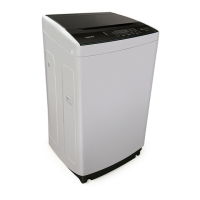
This document is a user manual for a Dawlance Fully Automatic Washing Machine, Model DWT 1775 PL. It provides comprehensive instructions for installation, operation, maintenance, and troubleshooting, ensuring safe and efficient use of the appliance.
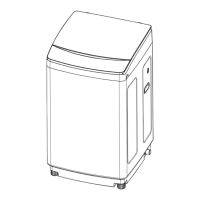
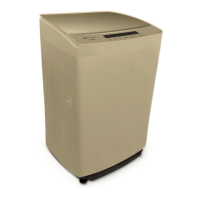
The Dawlance Fully Automatic Washing Machine is designed to automate the laundry process, offering various wash cycles and features to cater to different fabric types and soil levels. It is a top-loading machine, indicated by the "Toplid" and "Inner tub" components. The machine includes a "Pulsator" for agitating clothes during washing and a "Detergent box" for dispensing washing agents. Water is supplied via a "Feed valve" and drained through a "Drainpipe." The control panel allows users to select programs, water levels, and other functions.
The machine supports multiple processes including Soak, Wash, Rinse, and Spin. Users can choose from various programs such as NORMAL, HEAVY, SOFT, STANDARD, FAST, WOOL, CHILD, FOAM CLEAN, TUB CLEAN, and AIR DRY. The "FUZZY" logic function enables the machine to automatically detect the laundry quantity and set the appropriate water level for optimal washing. It also features a "Preset" function for delayed start, allowing users to schedule wash cycles.
Additional functions include "WATER RECYCLE," "LOW NOISE," and "CHILD LOCK." The "WATER RECYCLE" function allows users to reuse water from the last rinse cycle, promoting water conservation. The "LOW NOISE" setting is designed to reduce operational sound. The "CHILD LOCK" feature prevents accidental changes to settings during operation, enhancing safety.
The machine incorporates an imbalance adjustment function during spinning to minimize violent vibrations caused by unevenly distributed laundry. It also has an automatic power cut-off feature for energy saving, activating after 10 minutes of inactivity post-program completion or if the machine is not started within 10 minutes of power-on.
Before operation, users must ensure proper installation, including connecting the inlet hose to a suitable tap, ensuring the drainpipe is correctly positioned, and plugging the machine into an earthed power socket with a rated voltage of 220V A/C. The manual emphasizes checking for water leaks after installation and ensuring the tap is open during operation.
Laundry preparation is crucial for effective washing and machine longevity. Users are advised to read laundry care labels, empty pockets, knot long bands, fasten buttons, and close zippers. Overloading the machine should be avoided, and laundry should be loaded loosely, alternating large items with small ones. Sorting laundry by fabric type, color-fastness, and dirtiness is recommended. Delicate items or those prone to wear and tear should be placed in a washing bag. Special attention is given to washing new colored items separately and treating difficult stains before washing.
Detergent usage instructions specify withdrawing the dispenser box and pouring concentrated synthetic washing powder directly into it. For powder that doesn't dissolve easily, it's recommended to dissolve it in warm water (30°C) before adding it to the tub. Low foam washing powder is suggested. Bleach should be diluted and poured slowly into the tub, avoiding direct application to laundries, especially colored ones.
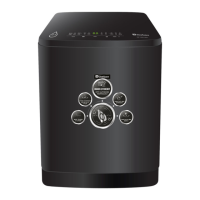
The control panel allows for intuitive program selection. Users can press the "PROGRAM" button to choose a wash program and the "PROCESS" button to select the desired process (Wash, Rinse, Spin, or combinations). The "WATER LEVEL" button adjusts the water level, and the "PRESET" button sets a delayed start time. The "START/PAUSE" button initiates or pauses the wash cycle. The digital timer displays remaining time or preset time.
Safety warnings are highlighted throughout the manual, including not putting hands into the working machine, especially when children are present, avoiding overloading, and not placing hot goods on the machine. It also warns against washing waterproof laundries like raincoats or bike covers, as this can cause abnormal vibrations during spinning.
Regular maintenance is essential for the washing machine's performance and lifespan. After each use, users are advised to unplug the machine, turn off water taps, and drain any remaining water from the tub. The exterior cabinet should be cleaned with a soft cloth, avoiding harsh cleansers or volatile chemicals that could damage plastic parts.
The "Magic filter" requires regular cleaning. This involves pulling out the filter, opening its box, cleaning it, and then reinstalling it. Users should also check if the lint block part is in good condition.
The "Inlet gate" (inlet filter net) can get blocked by dust. To clean it, users must close the tap, turn on the power switch for 5 seconds to allow water into the inlet hose, then cut off the power supply, pull off the inlet hose, remove and clean the inlet valve and net, and reinstall.
In winter, if there's a risk of water freezing in the inner tub, the inlet hose should be removed, and water drained from both the hose and the tub. If water has already frozen, the machine should not be operated. Instead, 40°C hot water should be poured into the tub to submerge the pulsator, and after a few minutes, the pulsator should be gently rotated by hand before operating the machine.
The manual also provides a troubleshooting guide for common issues such as the control panel not displaying, inlet hose leaks, the machine not draining or inletting water, spin stops during the spin program, intermittent spinning, and water flowing from the drainpipe on first use. For persistent faults, users are instructed to contact customer service and avoid self-repair.
 General
| Spin Speed | 700 RPM |
|---|---|
| Delay Start | Yes |
| Child Lock | Yes |
| Type | Top Load |
| Water Level Selection | Yes |

 To Next Page