Need help?
Do you have a question about the DaytonAudio B652-AIR and is the answer not in the manual?
Details on the B652-AIR speaker model including woofer, tweeter, power handling, impedance, response, sensitivity, crossover, terminals, and dimensions.
Warning about potential chemical exposure from the product known to cause cancer or reproductive harm.
Details on the one-year limited warranty for manufacturer defects and contact information for customer support.
Exclusions from warranty coverage, including consequential damage, improper use, and specific types of product failure.
Lists the included components in the B652-AIR speaker package, such as speakers and cables.
Specifies that no tools are required for basic installation, but additional tools may be needed for wall mounting.
Guidance on positioning speakers for optimal audio performance, including off-axis response and room boundary effects.
Instructions for connecting the speakers to an amplifier, emphasizing correct polarity and wire gauge.
Recommendations for cleaning and maintaining the speaker finish and grills to preserve their appearance.
Information on amplifier compatibility and the risks of audible distortion, advising users to operate within design limits.
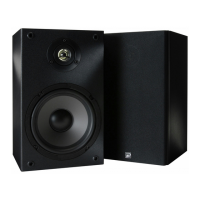
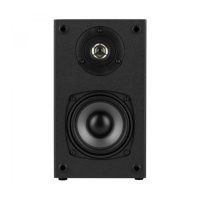
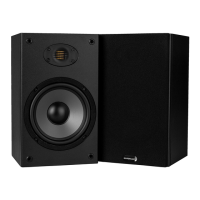
The Dayton Audio B652-AIR is a 6-1/2" 2-Way Bookshelf Speaker Pair featuring an Air Motion Transformer (AMT) tweeter. These speakers are designed to reproduce clear, natural high-frequency sound, aiming to rival more expensive speaker systems. They are intended for use in a home environment to reproduce music and speech at moderate volume levels.
The B652-AIR speakers function as a stereo audio output device, designed to connect to an amplifier to deliver sound. The inclusion of AMT tweeter technology is a key functional aspect, contributing to their ability to produce detailed and natural high frequencies. The 2-way design indicates that the speakers utilize separate drivers for different frequency ranges (woofer for lower frequencies and tweeter for higher frequencies) to achieve a balanced sound reproduction.
The B652-AIR speaker package includes the speaker pair itself and a pair of 2-conductor red/black speaker cables. No special tools are required for the basic installation of the speakers. However, if you plan to wall-mount them, additional tools and hardware may be necessary. The speakers feature a wall hanger on the rear of the enclosure to facilitate secure wall mounting.
The B652-AIR speakers are designed with well-behaved off-axis response and excellent dispersion, making them less critical to position compared to many other loudspeakers. Often, simply placing them where they best fit into your decorating scheme can yield excellent performance.
For more rigorous positioning, it's recommended to start with the speakers directly in front of your primary listening position. Avoid placing them near hard vertical edges within 3 or 4 feet of either side of the cabinet. Position the cabinets about 1-2 feet out from the wall. When evaluating placement, listen to selected recordings, paying close attention to the positions of instruments and vocalists. Move the speakers a few inches at a time, returning to the listening position to assess the results. Optimal placement should result in the vocalist being firmly positioned in front of the instruments, and the instruments appearing to be between or behind the loudspeakers. If possible, position your speakers so that when you are seated in the primary listening position, your ears are 10-12 feet from the tweeter. From your seat, the angle between the speakers should ideally be between 30 to 60 degrees.
Special attention should be paid to bass response, as its relation to room position is critical. Adjust the position of the speakers closer to or further away from room boundaries to ensure that bass levels are in proportion with the rest of the musical spectrum. While time-consuming, careful loudspeaker positioning can significantly enhance the audio experience.
Despite their compact size, the B652-AIR speakers are substantial in weight. When wall-mounting or shelf-mounting, it is crucial to ensure that the wall hanger or shelf is securely anchored to the building's structure, either via a stud or a drywall insert. This prevents the loudspeakers from falling and potentially causing injury or damage.
For connecting the speakers to an amplifier, you can use the supplied speaker wire or other good quality wire. For longer runs, heavier gauge wire is recommended. Proper "phasing" is essential for optimal performance. To ensure correct phasing, connect the red speaker terminals to the red amplifier terminals and the black speaker terminals to the black amplifier terminals. Most two-conductor wires are marked in some way (e.g., a colored stripe, a raised rib, or a different colored conductor) to help identify the "red" connections.
These speakers are designed to be used with stereo equipment rated from 5 to 75 watts and from 4 to 8 ohms. While almost any speaker can be used with almost any amplifier, and vice versa, it's important to note that a speaker can be damaged by an amplifier if the volume level is set above the point of audible distortion. Distortion indicates that the amplifier or loudspeaker is operating beyond its design limits, and damage can occur rapidly. If you hear distortion, immediately reduce the volume to prevent damage. When used within their specified limits, Dayton Audio loudspeakers are designed to provide many years of trouble-free performance.
To clean your speakers, simply wipe them with a damp, lint-free cloth. The finish of the speakers can be maintained and enhanced by periodically using a surface protection product, such as "ArmorAll." The speaker grills can be vacuumed, gently tapped, or brushed to remove any accumulated dust and debris. The grill is removable and made of non-see-through cloth.
 General
| Woofer Size | 6.5 inches |
|---|---|
| Woofer | Polypropylene cone |
| Tweeter Type | AMT (Air Motion Transformer) |
| Sensitivity | 87 dB |
| Impedance | 6 Ohms |
| Power Handling (RMS) | 40 Watts |
| Type | Bookshelf Speaker |
| Frequency Response | 70 Hz - 25 kHz |
| Crossover Frequency | 3 kHz |

 To Next Page