EasyManua.ls Logo

dbx 160X - Page 14

dbx 160X
41 pages
Print Icon
To Next Page IconTo Next Page
To Previous Page IconTo Previous Page
Loading...
1
6
0
X
T
OPERATING
NOTTS
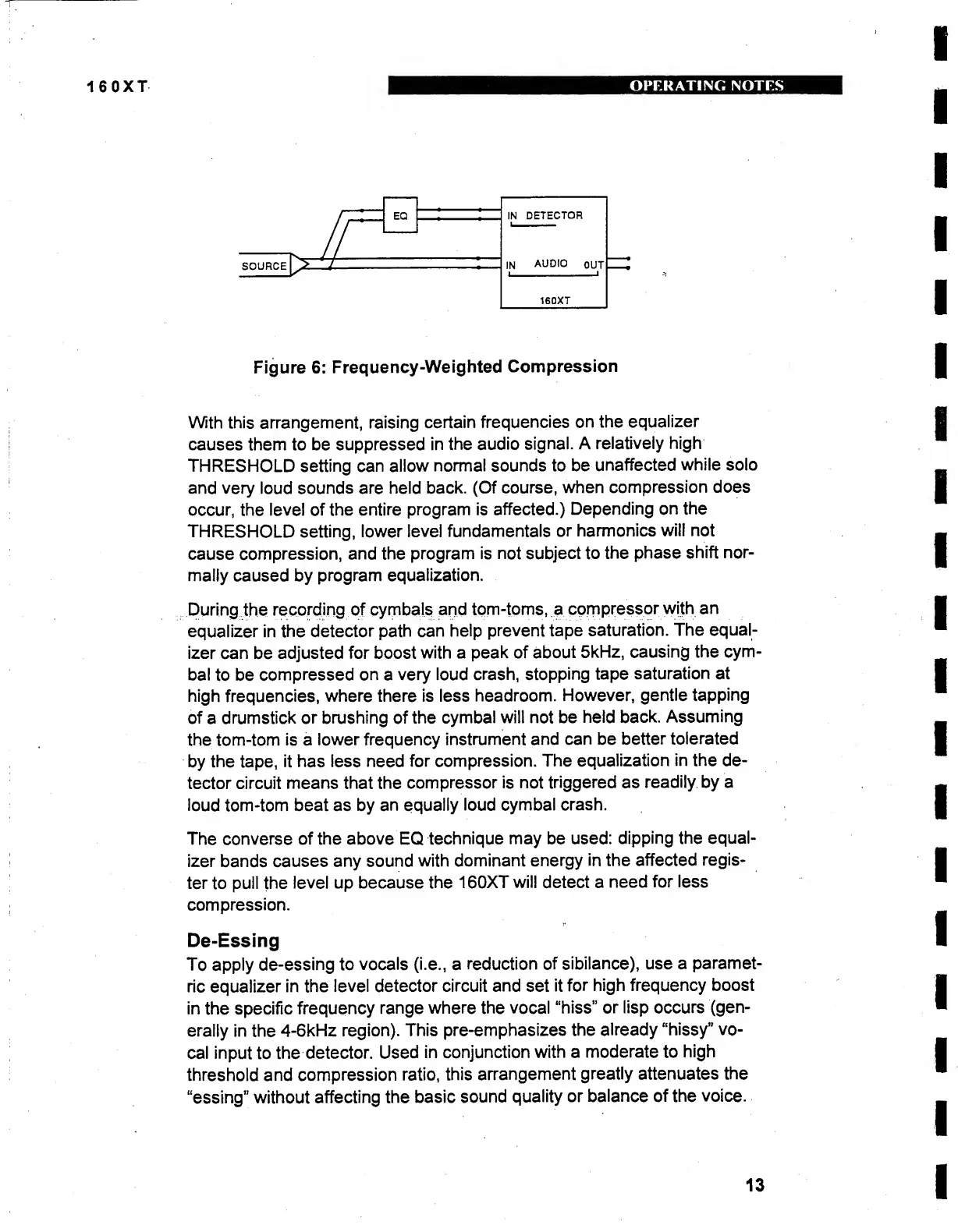
Figure
6:
Frequency-Weighted
Compression
With
this
arrangement,
raising
certain
frequencies
on
the
equalizer
causes
them
to
be
suppressed
in
the
audio
signal.
A
relatively
high
THRESHOLD
setting
can
allow
normal
sounds
to
be
unaffected
while
solo
and
very
loud
sounds
are
held
back.
(Of
course,
when
compression
does
occur,
the
level
of
the
entire
program
is
affected.)
Depending
on
the
THRESHOLD
setting,
lower
level
fundamentals
or
harmonics
will
not
cause
compression,
and
the
program
is
not
subject
to
the
phase
shift
nor¬
mally
caused
by
program
equalization.
During
the
recording
of
cymbals
and
tom-toms,
a
compressor
with
an
equalizer
in
the
detector
path
can
help
prevent
tape
saturation.
The
equal¬
izer
can
be
adjusted
for
boost
with
a
peak
of
about
5kHz,
causing
the
cym¬
bal
to
be
compressed
on
a
very
loud
crash,
stopping
tape
saturation
at
high
frequencies,
where
there
is
less
headroom.
However,
gentle
tapping
of
a
drumstick
or
brushing
of
the
cymbal
will
not
be
held
back.
Assuming
the
tom-tom
is
a
lower
frequency
instrument
and
can
be
better
tolerated
by
the
tape,
it
has
less
need
for
compression.
The
equalization
in
the
de¬
tector
circuit
means
that
the
compressor
is
not
triggered
as
readily
by
a
loud
tom-tom
beat
as
by
an
equally
loud
cymbal
crash.
The
converse
of
the
above
EQ
technique
may
be
used:
dipping
the
equal¬
izer
bands
causes
any
sound
with
dominant
energy
in
the
affected
regis¬
ter
to
pull
the
level
up
because
the
160XT
will
detect
a
need
for
less
compression.
De-Essing
To
apply
de-essing
to
vocals
(i.e.,
a
reduction
of
sibilance),
use
a
paramet¬
ric
equalizer
in
the
level
detector
circuit
and
set
it
for
high
frequency
boost
in
the
specific
frequency
range
where
the
vocal
“hiss”
or
lisp
occurs
(gen¬
erally
in
the
4-6kHz
region).
This
pre-emphasizes
the
already
“hissy”
vo¬
cal
input
to
the
detector.
Used
in
conjunction
with
a
moderate
to
high
threshold
and
compression
ratio,
this
arrangement
greatly
attenuates
the
“essing”
without
affecting
the
basic
sound
quality
or
balance
of
the
voice.
13

Other manuals for dbx 160X

Related product manuals