Need help?
Do you have a question about the Defiant 49808 and is the answer not in the manual?
Lists key features of the digital timer, including automatic sunrise/sunset times and multiple outlets.
Details the electrical ratings and motor capacity of the digital timer.
Provides essential safety warnings regarding electrical shock and fire risks when using the timer.
Guides users on how to find and watch an instructional video for programming the digital timer.
Step-by-step guide to set the clock, date, and day for the digital timer.
Selects geographical region to ensure accurate sunrise and sunset times for automatic programming.
Explains how to assign specific ON/OFF times to different days or day combinations for the timer.
Details how to set custom, sunrise, or sunset times for turning devices on and off.
Instructions on how to view previously configured ON/OFF programs on the timer display.
Procedure for removing or clearing existing ON/OFF programs from the digital timer.
Enables a random feature that simulates occupancy by varying ON/OFF times by +/- 30 minutes.
How to manually turn devices ON or OFF, bypassing the programmed schedule.
Provides important regulatory compliance information regarding FCC and Industry Canada standards.
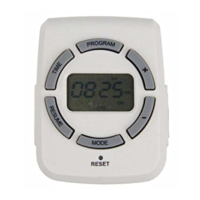
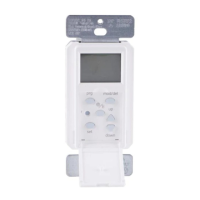
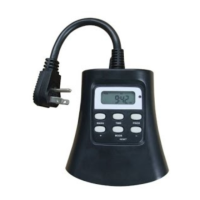
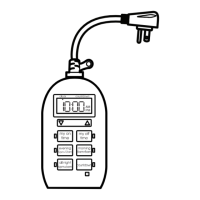
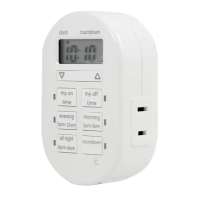
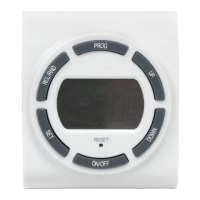
This document describes a Daylight Adjusting Indoor Digital Timer, designed to automate the control of indoor lighting and appliances.
The primary function of this device is to automatically turn lights and appliances ON and OFF at pre-programmed times. A key feature is its daylight adjusting capability, which automatically adjusts sunrise and sunset times throughout the year based on your geographical location. This ensures that your lighting schedule remains consistent with natural daylight cycles without requiring manual adjustments for seasonal changes. The timer can store up to seven individual programs, allowing for flexible scheduling options such as daily cycles, weekday-weekend cycles, or specific days of the week.
To begin using the timer, an initial setup process is required. First, if the screen is blank, the timer needs to be plugged in for two hours to charge its internal battery. Once charged, a toothpick or sharp pencil is used to push the RESET button, which clears all settings and displays 12:00 AM. The user then presses and holds the SET button for five seconds to enter the clock setting mode. From there, the hour, minute, year, month, and day can be adjusted using the UP/DOWN buttons and confirmed with the SET button. During hour adjustment, it's important to note the AM/PM indicator. The timer also includes a Daylight Savings Time (DST) feature, which can be set to ON or OFF. If set to ON, the timer automatically adjusts for DST changes, typically on the second Sunday of March and the first Sunday of November.
After setting the clock, the user must define their Dawn/Dusk region. This step is crucial for the timer's automatic daylight adjusting feature to function accurately. The manual provides a map with regions (North, Central, South, Hawaii, Alaska). The user selects the region that best fits their location using the UP/DOWN buttons and confirms with SET. The timer then displays a pre-set SUNUP time, which should be close to the actual sunrise time in the user's area. This time can be revised if necessary by adjusting the hour and minutes using the UP/DOWN buttons. The process is then repeated for the SUNSET time.
The timer can store up to seven programmable ON/OFF times (PROG 1 - PROG 7). To program, the user presses and holds the PROG button for five seconds. A blank PROG 1 screen indicates readiness for programming. The SET button is pressed, and the days of the week begin to flash. The user can select individual days (Monday, Tuesday, etc.) or day combinations (Monday-Friday, Saturday-Sunday, etc.) using the UP/DOWN buttons, confirming with SET.
Next, the user chooses an ON time from three options:
For enhanced security, the timer includes a Random (RND) feature. When activated, this feature turns lights ON and OFF using the programmed times but with a random variation of +/- 30 minutes. This creates a more "lived-in" appearance, deterring potential intruders when the user is away. To activate this feature, the user presses the RCL/RND button while the timer is in Clock mode. "RND" will appear in the top right corner of the screen. Pressing RCL/RND again deactivates the feature.
The timer also offers a manual override option. If the user wishes to manually control the connected devices at any time, they can press the ON/OFF button. Pressing ON/OFF until "ON" is displayed will keep the lamps/devices continuously ON. Pressing ON/OFF until "OFF" is displayed will keep them continuously OFF. To disable the manual override and re-enable the programmed schedule, the user presses ON/OFF until "AUTO" is displayed.
Users can review their programmed ON/OFF settings by pressing and holding the PROG button for five seconds, then using the UP/DOWN buttons to scroll through the configured programs. If an additional program needs to be added, the user can scroll to a blank program (displayed as "--:--") and follow the programming steps.
To delete an ON/OFF setting, the user presses PROG for five seconds, then scrolls with UP until the desired ON/OFF time is reached. Pressing RCL/RND removes the ON time (displaying "--:--"). The user then presses UP to reach the OFF screen and presses RCL/RND again to remove the OFF time. This process can be repeated for any other programs to be deleted.
In case of issues or to clear all settings, a RESET button is provided. This button should be pressed and held with a toothpick or sharp pencil. This action will clear all settings and return the timer to its initial blank screen, ready for a fresh setup.
The timer contains an internal battery that needs to be charged for initial setup or if the screen is blank. Plugging the timer into an electrical outlet for two hours will charge this battery, allowing the user to proceed with programming.
If no buttons are pressed for one minute during any setup or programming procedure, the timer will automatically return to clock mode. If this happens, the user can press and hold the SET button for five seconds and then continue pressing SET to scroll through the settings to return to where they left off in the setup process.
 General
| Programmable | Yes |
|---|---|
| Number of Outlets | 1 |
| Amperage | 15 A |
| Wattage | 1875 W |
| Use | Indoor |
| Max Load | 15 Amps |
| Voltage | 125V |
| Display | LCD |

 To Next Page