3
Signage
Because of the explosive gas mixtures generated while
charging batteries, anything that could ignite the gas, such
as sparks, open flames, an electrical arc, smoking, etc., must
be prohibited in the charging areas. To serve as a prominent
reminder, “NO SMOKING” signs should be posted in all battery
room areas.
Eye Wash Facilities
Emergency eye wash and acid neutralization facilities should
be located in the immediate work area for easy access. The
three most popular types of eye wash and acid neutralizing
equipment are the chemical burn station, deluge shower, and
eye wash fountain.
Consult all applicable Local, State, and Federal codes to ensure
compliance.
BATTERY OPERATION
There are several factors that affect the operation of the battery
concerning its ability to deliver capacity and life expectancy.
Storage
IEEE recommends:
Batteries should be stored indoors in a clean, cool, dry, level,
well-ventilated area away from direct sunlight. Typical storage tem-
perature range is 32°F (0°C) to 86°F (30°C).
Storage time should be limited to 3 – 6 months. It is recom-
mended the battery be fully charged and the electrolyte is at the
proper level, prior to storing. If the battery must be stored for sev-
eral months, a freshening charge should be given whenever the
voltage falls below 12.40V (12V)/6.20V (6V). If the average storage
temperature is below 77°F (25°C), check the voltage at least once
every two months. If the temperature is above 77°F (25°C), check
it every month.
Batteries should be covered with a non-conductive
material to protect them from dirt, moisture, etc. A flat sheet of
rigid plastic or plywood is not recommended. Do not drape flexi-
ble plastic sheeting over batteries because it may trap explosive
gases underneath.
Note: If batteries are to be stored for more than 6 months,
consult with nearest authorized East Penn representative.
Temperature
Many chemical reactions are effected by temperature, and this is
true of the reaction that occurs in a storage battery.
The chemical reaction of a lead-acid battery is slowed down by a
lowering of the electrolyte temperature that results in less capacity.
A battery that will deliver 100% of rated capacity at 77° F will only
deliver 65% of rated capacity at 32°F.
Excessive heat will increase the natural corrosion factors of a
lead acid battery. This increase corrosion of the positive plates
contributes greatly to reducing the overall life of the battery.
Depth of Discharge (DoD)
Depth of discharge is a function of design. The deeper the dis-
charge per cycle the shorter the life of the battery. A cycle is a
discharge and its subsequent recharge regardless of depth of
discharge.
System should be designed for shallow discharges. The result
of shallower discharges is typically a larger capacity battery at
prolonged battery life.
Charging
Majority of battery issues can be traced to improper charging.
Improper charging settings will lead to overcharging or under-
charging condition. Each condition will result in reduced capacity
and/ or battery life.
To ensure proper charging the inverter / charge controller
should be set to the recommended battery voltage settings. If
battery is located in an uncontrolled temperature environment,
temperature compensation should be used.
Maintenance
IEEE 450 suggests batteries be checked on a monthly,
quarterly and yearly basis. Each time period requires different
checks. Maintenance log should be initiated at time of installa-
tion. Typical checks consists of voltage & specific gravity read-
ings and well as visual inspections. Periodic verification of proper
gravity readings and electrolyte levels will ensure battery being
fully charged and operating properly. If any conditions are found
that are out of specifications, corrections should be made.
A good battery maintenance program is necessary to protect
life expectancy and capacity of the battery.
BATTERY INSTALLATION
Receiving a Battery
After receiving a battery, examine the crate and pallet for
signs of damage. If you see any wet spots, the battery may have
been tipped or damaged during transit. Be careful when handling
a crate or packing material that’s contaminated with spilled
electrolyte. Chemical burns can result if skin or clothing comes in
contact with the spillage.
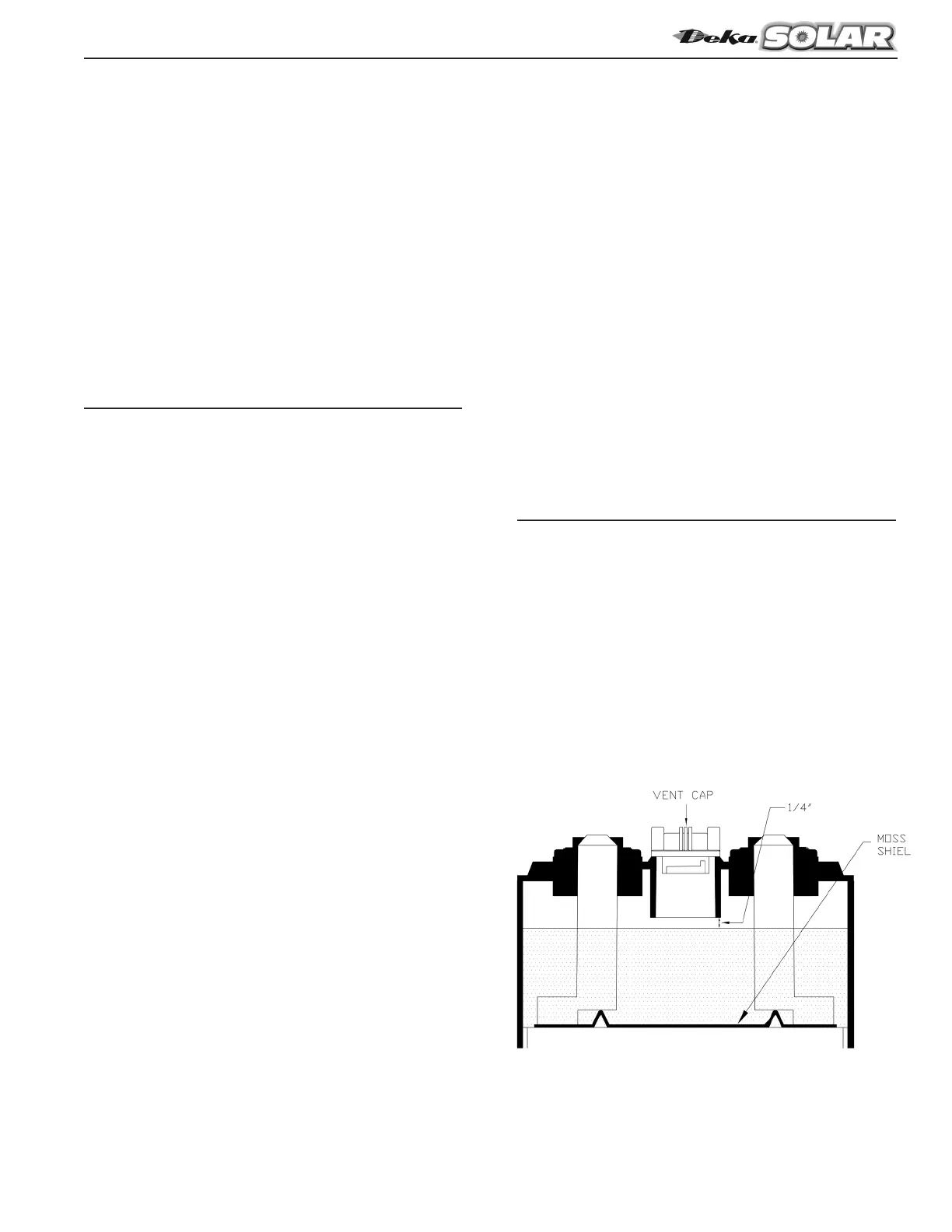
Every cell should be inspected to be sure that the electrolyte
level is above the moss shield. If the electrolyte level is slightly
below the moss shield in any cell, it can be raised by transferring
a small amount of acid from higher level cells within the battery
by using a syringe or hydrometer. Do not fill with water to bring
levels to above the moss shield.
If a large amount of liquid is required to raise the level, the
battery may be damaged. Inspect the packing material under
the tray for signs of leakage. All damaged components should be
inspected by your East Penn agent or representative.



 To Next Page