4
Receiving a Battery cont.
Call your East Penn representative immediately. In the mean-
time, keep the damaged cell’s vent cap tightly in place and pro-
tect the floor from acid leakage. Do not attempt to discharge
or charge the battery.
Lifting Batteries
Always use the proper lifting equipment to reduce the risk of
tray damage, shorting and possible injury.
Chain hoists used to handle batteries should be equipped with
a non-metallic container or bucket to prevent the chains from
dangling and possibly causing a short by coming in contact with
exposed intercell connectors on the battery top. If no protection
is available, cover the battery with a non-conducting insulating
material such as plywood or heavy plastic.
Installing Batteries
There should be some type of barrier/racking between the floor
and the batteries. Battery rack(s) should be installed per rack
manufactures instructions. Battery rack should be securely
anchored to the floor. Floor anchoring and its design are the
responsibility of the owner and should meet all local, state and/
or federal codes.
Caution should be observed when installing battery on
racking system. Consult battery layout to ensure batteries are
installed in the correct polarity order. Batteries are shipped as-
sembled, charged and filled with electrolyte to just below the
bottom of the vent well. If the electrolyte level is above the low
end of the vent well after the battery has been on a long open
circuit stand, care must be taken to avoid flooding during the
initial charge. Electrolyte may be removed to the bottom of the
vent well to prevent overflowing.
Battery terminals should be cleaned of all oils, greases or
corrosion prior to installing cables. The surface of the battery
terminals may be cleaned using a stiff-bristle nonmetallic brush/
pad until a clean bright surface is accomplished
Ensure all inter-battery connections and battery cables are
properly connected and polarity is correct. All inter-battery
cables should be of the same length and wire gauge. Cables
should be at minimum length to reduce voltage drop. Use a
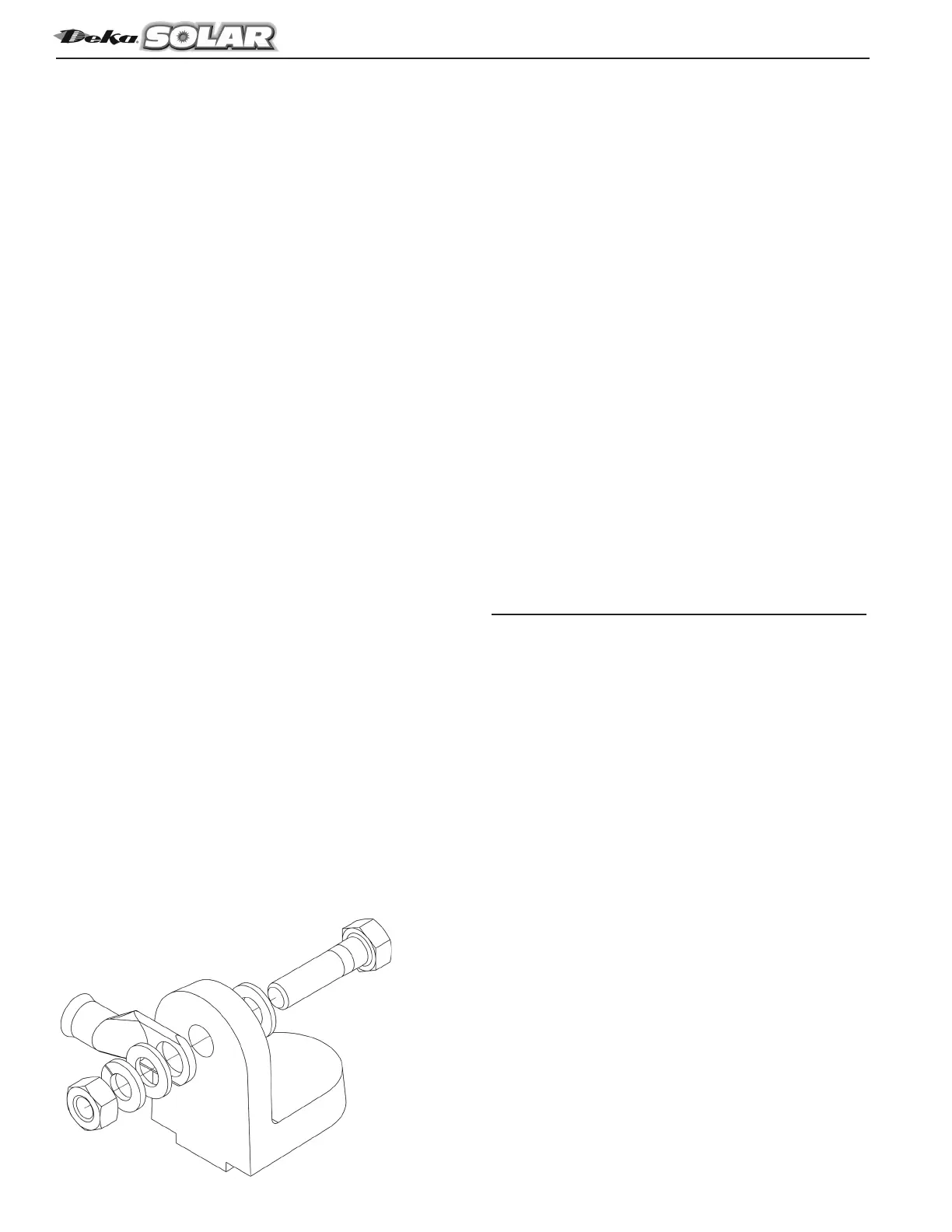
voltmeter to confirm correct polarity. Lug bolt hole should be
5/16” in dia. Hardware supplied with battery should be used. All
battery connections should be torque to 100-120 in lb.
All Parallel Connections should be of the same length and
wire gauge and be terminated at a common bus. This will en-
sure all parallel battery strings are being discharged & changed
at the same voltage and current.
Charging Safety
There are several important safety precautions that should be
taken when charging a battery:
• Do not use open flames when checking the electrolyte
levels in storage batteries.
• Keep all open flames, sparks and matches away
from the charging area. DO NOT SMOKE around the
charging area.
• Only properly trained personnel understanding all
safety measures, charging parameters and required
maintenance prior to charging should charge batteries.
• Follow charger manufacturers recommendations for
charger connection / disconnection sequence.
• All mechanical connections on the battery and charger
should be tight. Torque all connections to specification.
Loose connections can overheat and cause arcing that
could cause a gassing cell to explode, or cables to
become hot to the touch.
• Vent plugs should be kept firmly in place at all times to
minimize electrolyte spray when the battery gasses.
Connecting/Disconnecting Charger
Always turn the charger OFF before connecting or disconnecting
a battery. Live leads can cause arcing and sparking, which could
cause an explosion if battery gases are present. In addition, the
contact surfaces of the plugs or connectors will become pitted
over time.
BATTERY OPERATION
There are several factors that affect the operation of the battery
concerning its ability to deliver capacity and life expectancy.
Many chemical reactions are affected by temperature, and
this is true of the reaction that occurs in a storage battery. The
chemical reaction of a lead-acid battery is slowed down by a
lowering of the electrolyte temperature that result in less capac-
ity. A battery that will deliver 100% of rated capacity at 77° F
(25°C) will only deliver 65% of rated capacity at 32°F (0°C).



 To Next Page