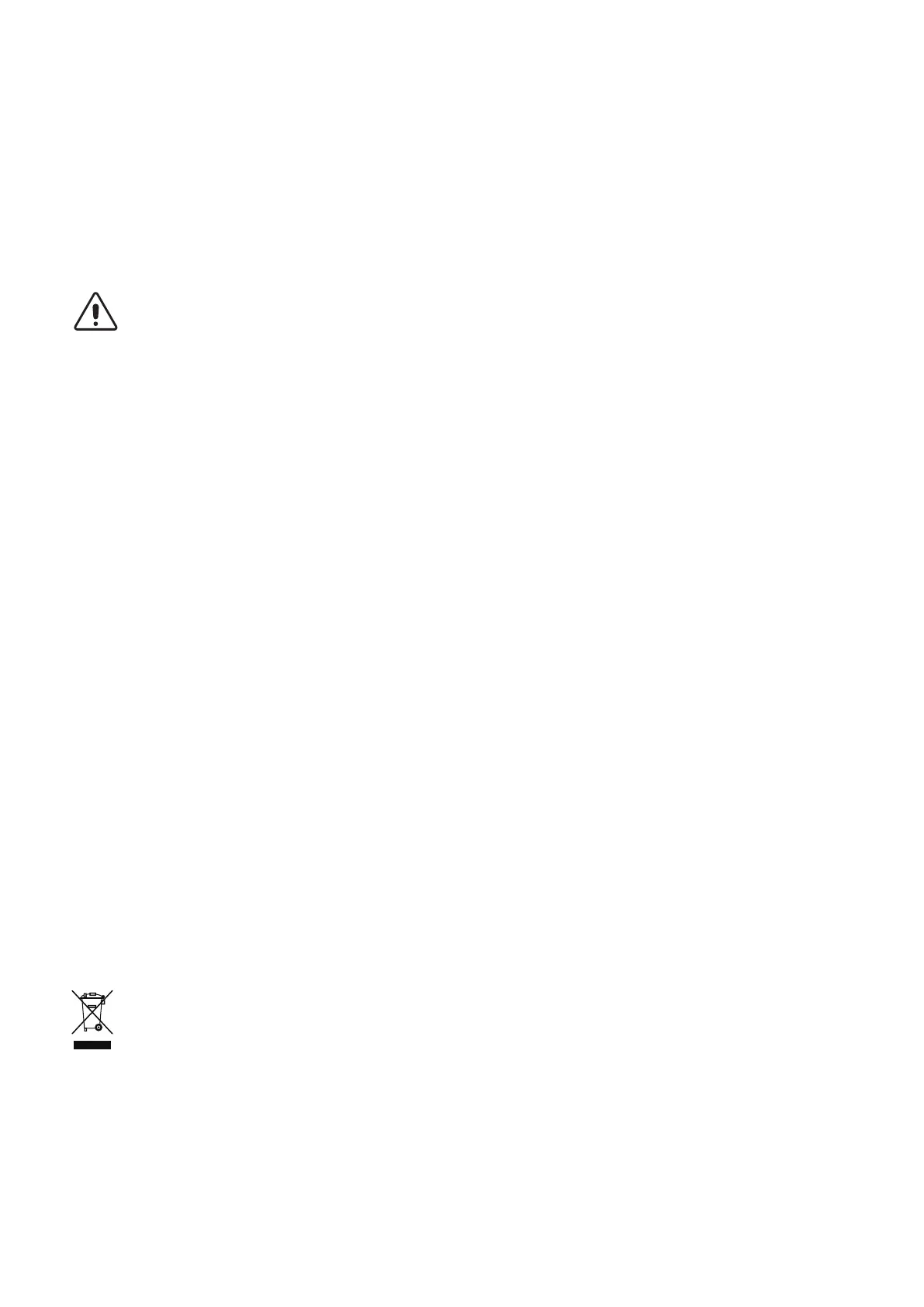
Always expect the stall. Grip the drill firmly to control the twisting action and avoid injury.
5. IF DRILL STALLS, it is usually because it is being overloaded or improperly used. RELEASE
TRIGGER IMMEDIATELY, remove drill bit from work, and determine cause of stalling. DO NOT
DEPRESS TRIGGER ON AND OFF IN AN ATTEMPT TO START A STALLED DRILL — THIS CAN
DAMAGE THE DRILL.
6. To minimize stalling or breaking through the material, reduce pressure on drill and ease the bit
through the last fractional part of the hole.
7. Keep the motor running when pulling the bit back out of a drilled hole. This will help prevent jam-
ming.
Residual risks
Even when the tool is used as prescribed it is not possible to eliminate all residual risk factors.
The following hazards may arise in connection with the tool’s construction and design:
1, Damage to lungs if an effective dust mask is not worn.
2, Damage to hearing if effective hearing protection is not worn.
3, Health defects resulting from vibration emission if the power tool is being used over longer
period of time or not adequately managed and properly maintained.
Maintenance and Cleaning
Before any work on the machine (e.g., maintenance, tool change, etc.) as well as during transport
and storage, set the rotational direction switch to the center position.Unintentional actuation of
the On/Off switch can lead to injuries.
For safe and proper working, always keep the machine and ventilation slots clean.
To ensure product SAFETY and RELIABILITY, repairs and any other maintenance or adjustment
should be performed by a qualified repair person, always using DEKO replacement parts.
10
Transport
The contained lithium-ion batteries are subject to the Dangerous Goods Legislation requirements.
The user can transport the batteries by road without further requirements. Dispatch batteries only
when the housing is undamaged. When being transported by third parties (e.g.: air transport or
forwarding agency), special requirements on packaging and la belling must be observed. For
preparation of the item being shipped, please observe possibly more detailed national regulations
and consult an expert for hazardous material.
Disposal
The machine, rechargeable batteries, accessories, and packaging should be sorted for envi-
ronmental-friendly recycling. Do not dispose of power tools and batteries/rechargeable
batteries into household waste! Please recycle them at collection points provided for the
purpose. Ask your local authority for information about recycling.


 To Next Page