37 Owner’s Manual
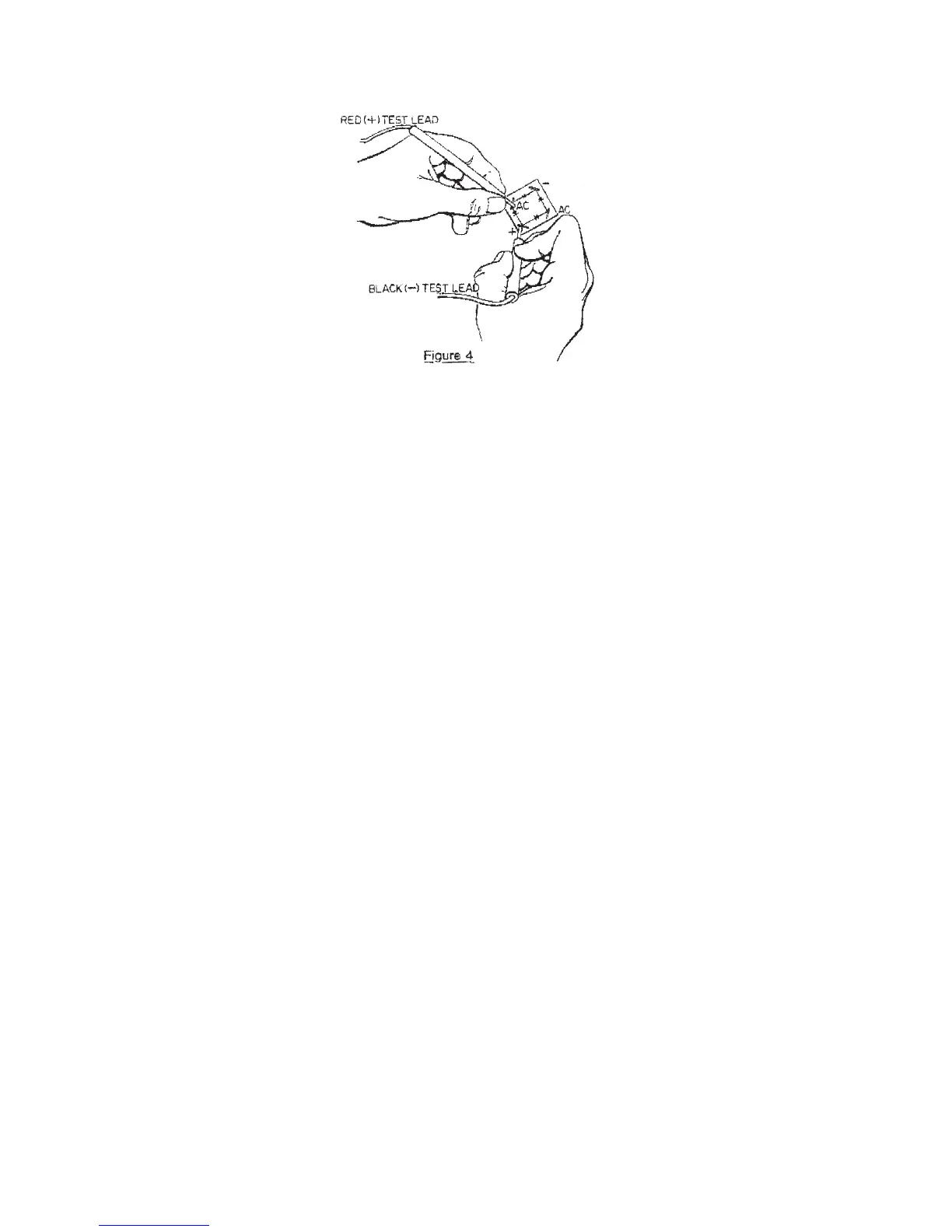
4. TESTING RECTIFIERS (Fig. 4):
The field excitation is supplied through a half-wave bridge rectifier. This type of rectifier has 3 terminals - 2
AC and a DC positive. A rectifier may be tested in the following manner:
A. Disconnect all leads from rectifier.
B. Connect the red ohmmeter lead to the positive DC (+) terminal.
C. Connect the black lead to each of the AC terminals in turn. Either a high or low resistance reading will
be obtained.
D. Reverse the meter leads, (black lead to the DC positive (+), and red to the AC terminals, each in turn.
An opposite reading should be observed.
E. Check each terminal to the case. An open circuit (very high resistance) reading should be observed.
A battery powered test light is used. Follow the same procedures described above. A good diode
element will allow current to pass to the light in the test lamp when leads are connected in the for-
ward direction.
F. If rectifier fails any of the above tests, it should be considered defective and be replaced.
3. CONDENSER TESTING:
A. Condensers are built into the generator circuit to minimize radio interference during operation. If a
condenser shorts out, it will also short out the generator output. To determine whether a condenser is
shorted, stop the generator and disconnect the condenser lead wire from the brush holder.
B. Using a multimeter on the R x 100 scale, check the resistance of the condenser. Normal response is
a sharp swing of the meter towards low resistance and then a steady rise towards high resistance
(open circuit). If the capacitor is shorted, it will show as a constant low resistance.
C. Otherwise, restart the generator without the capacitor connected to re-check the generator for out-
put. If the generator then provides power, the condenser was at fault and should be replaced. If the
generator did not provide power after the problem was not caused by that condenser, reconnect the
lead wire.
D. If these tests have not located the trouble, remove the armature and have it tested for opens, shorts,
and grounds on a growler.



 To Next Page