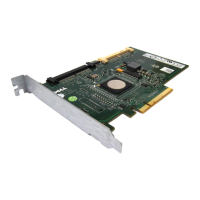
Need help?
Do you have a question about the Dell H710 and is the answer not in the manual?
Lists operating systems compatible with PERC H310, H710, H710P, and H810 cards.
Provides contact information, related documentation links, and feedback channels for support.
Explains the power saving feature for physical disks, allowing spin-down based on configuration and I/O.
Details how to set the time delay before spinning down disks, with default and maximum values.
Describes background, full, and fast initialization methods for virtual disks.
Explains the process of verifying and correcting redundancy data in virtual disks.
Describes moving physical disks between slots on the same controller when the system is off.
Details a feature for improving application performance by delivering high I/O per second.
Explains eligibility criteria and configuration for FastPath on virtual disks.
Covers migrating virtual disks between controllers without taking the target offline.
Explains Write-Back and Write-Through cache policies and their implications.
Details scenarios where Write-Back caching is utilized, including battery presence.
Describes different read policies like Always Read Ahead, No Read Ahead, and Adaptive.
Explains Online Capacity Expansion (OCE) and RAID Level Migration (RLM).
Lists features like SMART, Patrol Read, and hot spares that provide fault tolerance.
Describes how SMART monitors disks for predictable failures and degradation.
Explains the automatic process of replacing a disk reporting a predicted failure.
Details the feature for ensuring physical disk health and data integrity through scans.
Explains how to set up redundant SAS paths for the PERC H810 adapter.
How the system detects and handles physical disk failures, including automatic rebuilds.
Configuring dedicated slots as persistent hot spares for automatic replacement.
Procedures for replacing physical disks while the PERC controller is online.
How the controller preserves cache data during power outages or shutdowns using a BBU.
Explains NVC's role in transferring cache data to flash storage for indefinite preservation.
Steps to recover cache data after a system power loss or improper shutdown.
Periodic operation that calibrates and gauges the battery's charge capacity.
Step-by-step guide for safely removing the PERC controller from the system's PCIe slot.
Instructions for installing the PERC controller into the appropriate slot and connecting cables.
How drives are managed with multiple independent PERC H710P cards in dual-bay systems.
Configuring hardware for redundant SAS paths for the PERC H810 for increased reliability.
Method for including drivers during a new OS installation using installation media.
Process for updating PERC drivers on an already installed operating system.
Prerequisites for installing Windows drivers, including BIOS/firmware updates.
Methods for creating installation media (diskette, USB, CD, DVD) for Windows drivers.
Steps to download drivers from the Dell support website by system tag or product listing.
Installing drivers during the Windows Server 2008/2008 R2 setup process.
Installing drivers for a new RAID controller on an existing Windows system.
Procedure to update PERC drivers on existing Windows Server 2008/2008 R2 installations.
Instructions for updating PERC drivers on Linux systems, including downloading from Dell support.
Installing RPM drivers with DKMS support for specific Linux distributions like RHEL and SUSE.
Installing RPM drivers with KMOD support for specific Linux distributions like RHEL.
Installing RPM drivers with KMP support for specific Linux distributions like SUSE.
Overview of the Dell OpenManage application for configuring and managing RAID systems.
Details the <Ctrl><R> utility for configuring RAID disk groups and virtual disks.
Steps to access the BIOS Configuration Utility (<Ctrl><R>) during system boot.
Procedures for safely exiting the BIOS Configuration Utility.
Explains the keyboard controls for navigating menus and options within the BIOS utility.
Guide to creating disk groups and virtual disks, including parameter selection and hot spares.
Detailed steps to create new virtual disks, selecting RAID levels and physical disks.
How to choose parameters like RAID level, stripe size, and read/write policies for virtual disks.
Process to make physical disks RAID capable on the PERC H310 controller.
Process to convert physical disks to Non-RAID mode on the PERC H310 controller.
Explains fast and full initialization methods for virtual disks and their implications.
How to verify redundancy data integrity in virtual disks using consistency checks.
Step-by-step guide to perform a data consistency check on virtual disks.
Managing foreign configurations via the VD Mgmt menu for importing or clearing.
Managing foreign configurations via the Foreign Configuration View screen for import or clear operations.
Operation to split RAID1 arrays for disk imaging or testing purposes.
Performing the break mirror operation within the BIOS Configuration Utility.
Handling cache data preservation when virtual disks become offline or are deleted.
Creating or deleting hot spares dedicated to specific virtual disks.
Steps to delete virtual disks and free up disk space for new configurations.
Procedures for deleting disk groups and all associated virtual disks.
How to delete all virtual disks and configurations from the RAID controller.
Overview of the menus and options available in the BIOS Configuration Utility.
Details the VD Mgmt screen, its panels, and information displayed for virtual disk management.
Describes various actions that can be performed on virtual disks.
Overview of the PD Mgmt screen for viewing and managing physical disk information.
Lists actions performable on physical disks, such as rebuild and replace member.
Process for rebuilding failed physical disks to restore redundancy.
Details the Ctrl Mgmt screen for managing controller and BIOS settings.
Lists actions performable from the Controller Management screen.
How to view foreign configurations present on the adapter before importing or clearing.
General section covering physical disk management tasks and LED indicators.
How to start or stop physical disk LED blinking to indicate activity.
Steps to create global hot spares that can replace any failed physical disk.
Procedures for removing hot spares from the system.
Manually replacing a physical disk within a virtual disk using the Replace Member functionality.
Outlines restrictions and limitations that apply to the Replace Member operation.
How to stop ongoing background initialization (BGI) processes on virtual disks.
Steps to manually rebuild a single failed physical disk.
Enabling BIOS boot support for the controller to allow system booting.
Enabling boot support for a controller that has its BIOS enabled.
Configuring BIOS to stop the system boot process if any BIOS errors are detected.
Automatically importing foreign configurations during boot without manual intervention.
Disabling the automatic import of foreign configurations during system boot.
Restoring controller and BIOS settings to their factory default values.
Introduction to the UEFI utility for configuring RAID arrays, integrated into system BIOS.
Steps to access the UEFI RAID Configuration Utility during system setup.
Procedures for safely exiting the UEFI RAID Configuration Utility.
Overview of the four main configuration menus available in the UEFI utility.
Details the controller-level functions like properties, foreign configurations, and battery management.
Functions for creating and managing virtual disks within the UEFI utility.
Functions for viewing and managing physical disks through the UEFI utility.
Viewing enclosure firmware and attached physical disks within the UEFI utility.
Properties and limitations of CacheCade virtual disks, including SSD usage and cache size.
How to create and manage CacheCade virtual disks using management applications.
CacheCade-related actions available within the Virtual Disk Management menu.
Step-by-step guide to creating CacheCade virtual disks using SSDs.
Procedures for deleting CacheCade virtual disks from the controller.
Methods for resizing CacheCade virtual disks by adding or removing SSDs.
How Self-Encrypting Disks (SEDs) are protected using encryption keys managed by the controller.
Managing security keys and creating secured virtual disks via the BIOS Configuration Utility.
Using LKM to generate keys, secure disks, and manage secured foreign configurations.
Steps to create a security key for the PERC controller to enable disk encryption.
Procedure for changing an existing security key on the PERC controller.
Steps to delete the security key from the controller, which also securely erases SEDs.
Creating virtual disks with security enabled, requiring a prior security key setup.
Securing previously created unsecured virtual disks if conditions are met.
Migrating or clearing foreign configurations for secured virtual disks between controllers.
Permanently erasing data and resetting security attributes on SEDs, often for lost passphrases.
Common errors related to security key management, import, and configuration.
Lists and explains BIOS error messages encountered by the PERC controller during system boot.
Error related to the discovery process failing to complete within the allotted time.
Error when more than the maximum allowed enclosures are connected to a single SAS connector.
Message indicating cache data loss due to power issues, battery failure, or ECC errors.
Error indicating missing disks in a virtual disk configuration, leading to offline status.
Error when previous disk configurations are cleared or missing, indicating a configuration mismatch.
Error indicating that virtual disks are missing from the current configuration.
Error when cache contains dirty data but virtual disks are missing or offline, risking data loss.
Warning when BIOS ROM option is disabled, preventing the controller from handling logical drives.
Message indicating drive configuration changes have occurred during utility use.
Error when virtual drives with preserved cache are offline or missing, requiring import or discard.
Error indicating that virtual disks have entered an offline state, potentially due to disk issues.
Error indicating that virtual disks are in a degraded state, usually due to disk failures.
Error indicating virtual disks are partially degraded, often due to single disk failure in RAID 6/60.
Error indicating memory or battery issues detected, potentially causing cache data loss.
Error indicating the controller firmware has entered a fault state, requiring technical support.
Message indicating foreign configurations are found on the adapter, requiring import or clearing.
Message indicating no foreign configurations are present despite a POST warning.
Error when previous disk configurations are cleared or missing, indicating a mismatch.
Error indicating an invalid SAS topology, usually due to improper cable connections.
Error specific to PERC H710 regarding multibit ECC errors affecting memory and cache.
Error when configured disks are removed or become inaccessible, possibly due to cable issues.
Error indicating the controller battery is discharged or disconnected, affecting cache protection.
Explains the degraded state of virtual disks when one or more physical disks fail or are inaccessible.
Explains how memory errors affect cached data and controller operation, distinguishing single-bit from multi-bit errors.
How preserved cache is managed when virtual disks become offline or are deleted due to missing disks.
Troubleshooting step when a PERC card shows a yellow bang (warning) in Device Manager.
Troubleshooting step when a PERC card is not detected in Device Manager, suggesting reseating.
Error during Windows Server 2003 installation indicating no drives are found, often due to driver or configuration issues.
Handling physical disks that have entered a failed state, recommending firmware updates.
Troubleshooting issues when rebuilding a fault-tolerant virtual disk, potentially due to disk compatibility.
Handling fatal errors or data corruption reports, usually requiring technical support.
Troubleshooting when physical disks are displayed as blocked and cannot be configured, recommending firmware updates.
Recovering virtual disks after multiple disks become simultaneously inaccessible, often due to cabling issues.
Procedures for manually rebuilding a single failed physical disk, especially when hot spares are unavailable.
Scenario where a virtual disk fails during rebuild with a global hot spare, resulting in a failed state.
Scenario where a virtual disk fails during rebuild with a dedicated hot spare, resulting in a failed state.
When a physical disk fails during reconstruction on a redundant virtual disk with a hot spare.
A virtual disk failing rebuild with a dedicated hot spare, leading to a failed state.
Troubleshooting when a physical disk rebuild takes an excessive amount of time, possibly due to high system stress.
General information on SMART errors and how they are detected to predict physical disk failures.
Handling SMART errors detected on a physical disk within a redundant virtual disk, including backup and replacement.
Handling SMART errors detected on a physical disk within a non-redundant virtual disk, including backup and replacement.
Troubleshooting issues related to the Replace Member operation, including source or target disk failures.
What happens when the source disk fails during a Replace Member operation.
What happens when the target disk fails during a Replace Member operation, aborting the process.
Handling general disk failures and the Replace Member operation when source data is available.
Troubleshooting Linux-specific OS errors related to the PERC controller, like driver issues.
Issue where PERC drivers fail to auto-build into a new Linux kernel after system updates.
Error when unable to register SCSI devices, potentially due to kernel interactions with the controller.
Overview and comparison of different RAID levels (0, 1, 5, 6, 10, 50, 60) supported by PERC cards.
Definitions of common RAID terms used in storage systems.
Explanation of how data is striped across physical disks to enhance performance.
Explanation of RAID 1, providing data redundancy through simultaneous writes to two disks.
How RAID 10, 50, and 60 are constructed by combining multiple basic RAID levels with striping.
Explanation of parity data used in RAID levels for fault tolerance against disk failures.
 General
| Supported RAID Levels | 0, 1, 5, 6, 10, 50, 60 |
|---|---|
| Interface | PCIe 2.0 x8 |
| Compatibility | Dell PowerEdge servers |
| Drive Interface | SAS 6Gb/s |
| Data Transfer Rate | 6Gbps |
| Processor | LSI SAS2208 |
| Max Devices Supported | 32 |
| Connectors | SFF-8087 |
| Operating Temperature | 0°C to 55°C (32°F to 131°F) |
| Storage Temperature | -40°C to 70°C (-40°F to 158°F) |
| Cache Memory | 512MB |
| Ports | 2 internal mini-SAS (SFF-8087) |


 To Next Page