Need help?
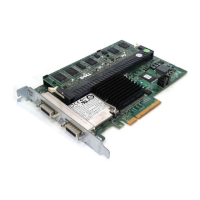
Do you have a question about the Dell H710P and is the answer not in the manual?
Lists operating systems supported by the PERC H310, H710, H710P, and H810 cards.
Provides information on obtaining assistance and contacting Dell for support and service.
Lists other relevant Dell documentation and instructions for providing feedback on the guide.
Manages disk power saving modes and spin-down delay for energy efficiency.
Covers different initialization methods (background, full, fast) and consistency checks for virtual disks.
Explains disk roaming and the FastPath feature for improving I/O performance.
Covers migration, cache policies, reconfiguration, and fault tolerance features.
Details how the controller preserves cache data during power outages using battery backup and learn cycles.
Step-by-step instructions for removing and installing the PERC controller hardware.
Information on managing multiple controllers and setting up redundant path support on the H810.
Covers prerequisites, media creation, downloading, and installing/updating drivers for Windows.
Details driver updates for Linux, including RPM packages and kernel upgrades.
Comprehensive application for managing RAID systems, controllers, and enclosures.
Covers accessing, navigating, and performing core tasks like virtual disk setup, physical disk management, and configuration clearing.
System BIOS integrated utility for RAID configuration, independent of the operating system.
Guides on creating virtual disks, selecting parameters, and configuring hot spares.
Covers viewing physical disk properties and performing actions like rebuilds or hot spare management.
Managing controller BIOS, boot options, auto-import settings, and restoring factory defaults.
Details features of CacheCade virtual disks, including SSD requirements and size limits.
Covers creating, deleting, reconfiguring, and resizing CacheCade virtual disks using management tools.
Covers implementing, creating, changing, deleting, and managing security keys and secured virtual disks.
Procedures for securing pre-existing disks and migrating secured foreign configurations.
Details instant secure erase functionality and troubleshooting common security key errors.
Covers BIOS errors, discovery, enclosure, cache loss, controller faults, and SAS topology issues.
Addresses missing disks, degraded states, offline virtual disks, physical disk failures, and rebuild issues.
Covers Device Manager issues, Linux errors, driver build problems, and SCSI device registration errors.
Details SMART error detection, Replace Member errors, and disk failure during operations.
Explains the meaning of activity and status LEDs on disk carriers.
Overview of supported RAID levels (0, 1, 5, 6, 10, 50, 60) and their characteristics.
Explains the concept of disk striping used in RAID 0 for performance.
Describes disk mirroring for redundancy, used in RAID 1.
Explains how RAID 10, 50, and 60 are constructed using multiple basic RAID levels.
Details the role of parity data in fault tolerance for RAID levels 5, 6, 50, and 60.
 General
| Interface | PCIe 2.0 x8 |
|---|---|
| Supported RAID Levels | 0, 1, 5, 6, 10, 50, 60 |
| Supported Drives | SAS, SATA |
| Max number of drives supported | 32 |
| Storage Temperature | -40°C to 70°C |
| Connector Type | Mini-SAS |
| Data Transfer Rate | 6Gbps |
| Connectors | 2 x Mini-SAS (SFF-8087) |
| Processor | LSI SAS2208 |
| Operating Temperature | 0°C to 55°C |
| Humidity | 5% to 95% (non-condensing) |
| Cache Memory | 1GB |
| Cache Protection | Yes (with BBU or FBWC) |


 To Next Page