Need help?
Do you have a question about the Dell H310 and is the answer not in the manual?
Lists operating systems compatible with the PERC H310, H710, H710P, and H810 cards.
Provides guidance on how to obtain technical assistance and support.
Details methods for contacting Dell support for sales and service issues.
Lists other Dell documents and resources relevant to PERC controllers and systems.
Instructions for providing feedback on the user's guide.
Explains the power saving feature that spins down disks based on configuration and I/O activity.
Details how to set the waiting time before spinning down disks for power saving.
Describes background, full, and fast initialization methods for virtual disks.
Explains consistency checks for verifying and correcting mirror/parity data in fault-tolerant virtual disks.
Describes moving physical disks between slots on the same controller without losing configuration.
Explains FastPath feature for improving application performance by delivering high I/O per second.
Details the process of migrating virtual disks between different PERC controllers.
Covers online capacity expansion (OCE) and RAID level migration (RLM) for virtual disks.
Lists features that provide fault tolerance to prevent data loss, such as SMART and Patrol Read.
Explains the SMART feature for monitoring disk health and predicting failures.
Describes automatic replacement of failed disks based on SMART predictive failure reports.
Explains Patrol Read as a preventative measure for ensuring physical disk health and data integrity.
Details redundant path support for the PERC H810, enabling path redundancy for enclosures.
How failed physical disks are detected and how automatic rebuilds occur.
Configuration of dedicated hot spare slots for automatic replacement of failed disks.
Procedures for manually replacing disks while the PERC cards are online.
Managing hot spares, including reverting them to a usable state after disk replacement.
How the controller preserves cache data during power outages using a Battery Backup Unit (BBU).
Explains how NVC allows controller cache data to be stored indefinitely.
Steps to recover cache data after a system power loss or shutdown.
Describes the periodic battery calibration cycle and its purpose.
Information on the expected time frame for the Transparent Learn Cycle.
Criteria indicating when the PERC battery needs replacement.
Step-by-step instructions for safely removing a PERC controller from the system.
Detailed procedures for installing a PERC controller into the system.
Information on how PowerEdge systems manage multiple independent PERC H710P cards.
Guide to configuring redundant paths for disk enclosures with the PERC H810.
Steps to disable redundant path support and revert to single path configuration.
Method for including drivers during a new operating system installation.
Procedure for updating PERC drivers on an already installed operating system.
Essential steps and checks before installing Windows drivers for PERC cards.
Instructions for creating bootable media containing PERC drivers for Windows.
How to obtain drivers from Dell diagnostic tools media.
Guide to downloading the latest PERC drivers from the Dell support website.
Specific steps to load PERC drivers during Windows Server installation.
How to install PERC drivers for a new controller in an existing Windows installation.
Detailed steps to update PERC drivers using Device Manager in Windows Server.
Procedures for updating PERC drivers on Linux systems.
Installing RPM driver packages with DKMS support for Red Hat/SUSE Linux.
Installing RPM driver packages with KMOD support for Red Hat Enterprise Linux.
Installing RPM driver packages with KMP support for SUSE Linux.
Comprehensive application for configuring RAID systems, creating disk groups, and monitoring.
Step-by-step instructions to access the BIOS Configuration Utility during system boot.
Procedures for safely exiting the BIOS Configuration Utility and returning to the OS.
Explanation of keyboard shortcuts and navigation keys within the BIOS Configuration Utility.
Guide to creating virtual disks and selecting RAID levels, stripe sizes, and policies.
Detailed actions for creating, managing, and deleting virtual disks and their properties.
Overview of managing physical disks, including viewing properties and performing actions.
Options for managing controller properties, BIOS settings, and default configurations.
Viewing and managing foreign configurations, including import and clear operations.
Describes the characteristics and limitations of CacheCade virtual disks.
Instructions for creating, configuring, and managing CacheCade virtual disks.
Step-by-step guide to creating CacheCade virtual disks using SSDs.
Procedures for deleting CacheCade virtual disks.
How to automatically or manually reconfigure CacheCade virtual disks.
Overview of Self-Encrypting Disk (SED) support and security key management.
Managing security keys and creating secured virtual disks via BIOS utility.
Using LKM to generate keys, secure disks, and manage foreign configurations.
Step-by-step guide to creating a security key for the controller.
Procedure for changing the existing security key on the controller.
Steps to delete the security key when no secured disks are present.
Guide to creating virtual disks that are secured with a security key.
Steps to secure previously created unsecured virtual disks.
Migrating secured virtual disks between controllers and handling foreign configurations.
Permanently erasing data and resetting security attributes on encryption-capable disks.
Explains BIOS-related error messages and their causes and corrective actions.
Explains cache data loss errors, their causes, and potential recovery steps.
Addresses missing disks in virtual disks and how to troubleshoot.
Addresses virtual disks in a degraded state and how to make them optimal.
Deals with memory or battery problems leading to cache loss.
Handles foreign configuration detection messages and import options.
Troubleshoots invalid SAS topology detection and cabling issues.
Handles errors when configured disks are removed or become inaccessible.
Addresses physical disks found in a failed state and firmware updates.
Steps to recover virtual disks when multiple disks become simultaneously inaccessible.
Overview of SMART monitoring for detecting predictable physical disk failures.
Troubleshoots drivers not auto-building into new Linux kernels after updates.
Details supported RAID levels, their characteristics, and use cases.
Defines key terms related to RAID technology, such as disk striping.
Explains the concept of disk striping, how it works, and its benefits.
Describes disk mirroring (RAID 1), its redundancy benefits, and cost implications.
Explains RAID levels like 10, 50, and 60 which combine multiple basic RAID levels.
Details how parity data provides fault tolerance in RAID levels 5, 6, 50, and 60.
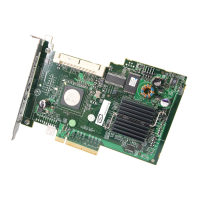
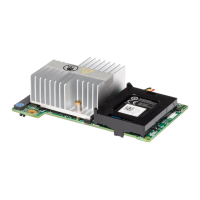
 General
| Data Transfer Rate | 6Gbps |
|---|---|
| Form Factor | Low profile |
| Interface | PCIe 2.0 x8 |
| Supported Drives | SAS and SATA |
| RAID Levels | 0, 1, 5, 10, 50 |
| Connectors | 2 x SFF-8087 Mini-SAS internal connectors |
| Operating System Support | Windows, Linux, VMware |
| Connector Type | Mini-SAS |

 To Next Page