
 Need help?
Do you have a question about the Dell S3100 Series and is the answer not in the manual?
Lists related documentation for S3100 series software configuration and support.
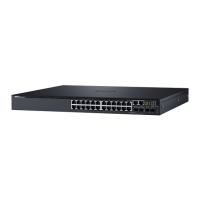
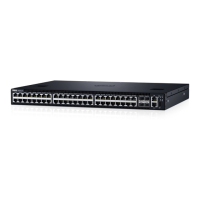
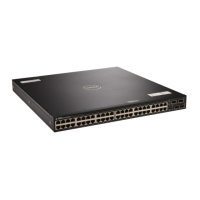
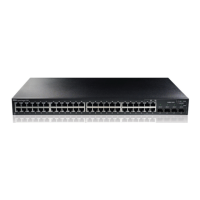
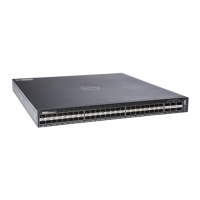
Describes the S3100 series as a low-cost switch/router for copper connections with PoE+.
Details common features across all S3100 series platforms, including stacking and modularity.
Explains PoE+ support for specific S3124P and S3148P platforms and its configuration aspects.
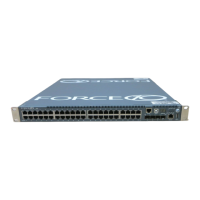
Describes the I/O side of the S3124 platform, including ports and indicators.
Details the PSU side of the S3124 platform, including power supplies, fan tray, and stacking ports.
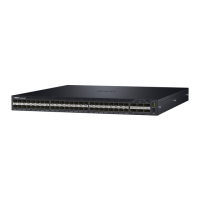
Describes the I/O side of the S3124F platform, including fiber ports and indicators.
Details the PSU side of the S3124F platform, including power supplies, fan tray, and stacking ports.
Describes the I/O side of the S3148 platform, including copper ports and indicators.
Details the PSU side of the S3148 platform, including power supplies, fan tray, and stacking ports.
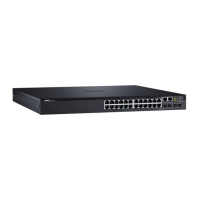
Describes the I/O side of the S3124P platform, including PoE+ copper ports and indicators.
Details the PSU side of the S3124P platform, including power supplies, fan tray, and stacking ports.
Describes the I/O side of the S3148P platform, including PoE+ copper ports and indicators.
Details the PSU side of the S3148P platform, including power supplies, fan tray, and stacking ports.
Explains how to perform a hard reset on the switch using the reset button.
Details the hot-swappable power supply units (PSUs) and their options for different platforms.
Describes the fan tray and internal fans providing system cooling.
Covers the SFP+ and 10GBase-T plug-in modules for expansion slots.
Explains how to interpret LED status indicators on the I/O and PSU sides of the chassis.
Lists components available for order, such as PSUs, modules, and cables.
Provides guidelines for choosing a suitable location based on safety and environmental requirements.
Specifies requirements for installing the switch in indoor cabinets for controlled environments.
Details rack grounding requirements and stability considerations for equipment mounting.
Step-by-step instructions for safely unpacking the switch and checking included items.
Guidelines for properly storing the system and its components before installation.
Instructions for installing a power supply unit (PSU) into the switch chassis.
Procedures for removing a failed PSU and installing a replacement.
Steps for installing a new fan tray into the switch.
Procedures for removing a faulty fan tray and installing a replacement.
Instructions for installing SFP+ or 10GBase-T modules into expansion slots.
Overview of options for mounting the switch in a rack or cabinet using EIA-310-E standards.
Guidance on installing the ReadyRails system for rack mounting the switch.
Steps for mounting the switch in a two-post rack configuration using a flush-mount method.
Steps for mounting the switch in a two-post rack configuration using a center-mount method.
Steps for mounting the switch in a four-post rack configuration using threaded mounting.
Instructions for installing the switch in 1U two-post rack configurations (flush and center).
Procedures for attaching switch rails for a 1U front-rack configuration.
Instructions for connecting multiple switches to form a stack using mini-SAS ports.
Steps to connect the system to a power source and power it on.
Guide on connecting to the switch's console port for initial configuration.
Lists the IEEE standards that the S3100 series system complies with.
Covers general compliance statements, including ESD warnings.
Details FCC compliance for Class A digital devices and potential interference.
Outlines conformity with EU directives on electromagnetic compatibility.
States conformity with relevant Indian telecommunications essential requirements.
Explains Japan's VCCI compliance for Class A information technology equipment.
Information regarding Korean certification standards for electronic equipment.
Lists various safety standards and agency certifications the product adheres to.
Details emissions and immunity standards for electromagnetic compatibility.
Provides information on responsible recycling and disposal of the IT equipment.
Describes the pull-out tag on the PSU side containing system information like Service Tag.
 General
| Layer 3 Features | Static Routing, RIP, OSPF, VRRP |
|---|---|
| Product Series | S3100 |
| Ports | 24 or 48 10/100/1000BASE-T ports |
| MAC Address Table Size | 16K |
| Jumbo Frame Support | Yes |
| Layer 2 Features | VLAN |
| Management | Web, CLI, SNMP |
| Operating Temperature | 32°F to 113°F (0°C to 45°C) |
| Storage Temperature | -40°F to 158°F (-40°C to 70°C) |
| Humidity | non-condensing |
| Power Supply | Internal |
| Uplink Ports | SFP+ |



 To Next Page
