CAIRplus Commissioning and Maintenance
PR-2009-0096-GB • Subject to modifications • R8-10/2015 71
8.5.7 Maintenance of other filters
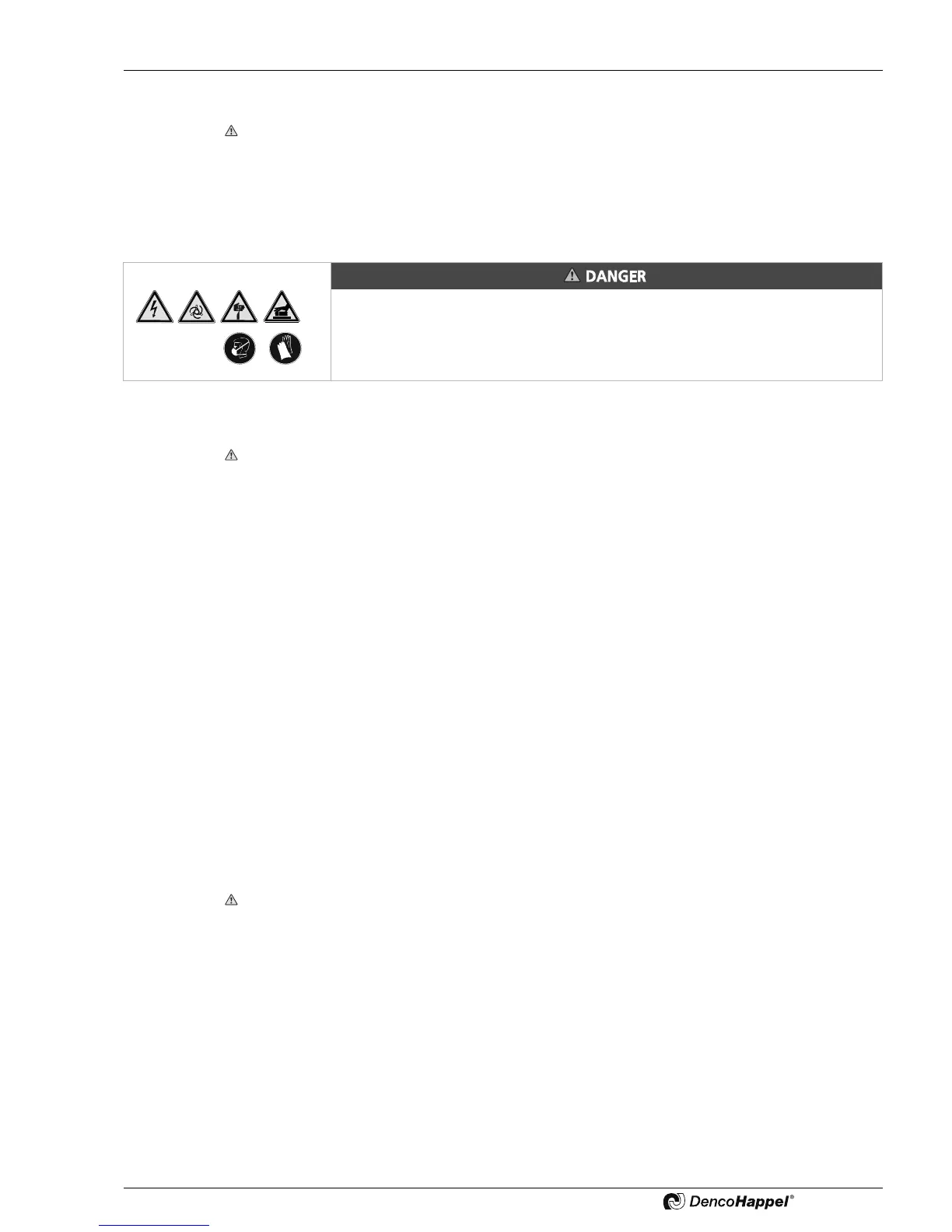
DANGER!
• Please consider the safety instructions on page 5 and page 55ff when performing
all the described activities!
Refer to the relevant maintenance instructions specified in the supplied documenta-
tion.
8.6 Heater assembly
8.6.1 Commissioning of heater assembly (pumped warm water)
DANGER!
• Please consider the safety instructions on page 5 and page 55ff when performing
all the described activities!
Complete the following commissioning steps:
Requirement:
• Check supply and return lines for proper connection.
• Counterflow mechanism and water inlet on air-discharge side.
• Check shut-off devices and other fixtures for proper installation.
Commissioning:
• Open provided air vent, if automatic air-venting is not installed.
• Charge the coil at the lowest point to prevent air cushions and water hammer.
• Slowly open air vent and wait until the coil is flushed with water.
• Open air vent completely.
• Close air vent; if the levels are different - close air vent gradually until water
displaces air and starts to run out.
• Activate primary and secondary pump, check rotation direction and put the coil into
service for ample time.
• Set the control valves in reverse position (three-way valves).
• Perform a subsequent check by repeated opening of air vent.
• Check for leak-free condition.
• Operate frost protection in a regulated mode to prevent over-conditioning.
8.6.2 Maintenance of heater assembly (pumped warm water)
DANGER!
• Please consider the safety instructions on page 5 and page 55ff when performing
all the described activities!
Carry out the following maintenance steps:
• Check for leak-free condition and possible dirt on the air side.
• To ensure frost protection, periodically check the safety devices and take proper
precautions such as draining the equipment or adding antifreeze agents.
• Ensure that pipework connections and mountings are securely fixed.
• If necessary clean the coil on the air side (blow out with compressed air or low-
pressure water).
• Air vent.
Electrical hazard and danger of rotating unit parts with sharp edges!
• OBSERVE PERSONAL PROTECTION MEASURES
• Please consider the safety instructions on page 5 and page 55ff when
performing all the described activities!



 To Next Page