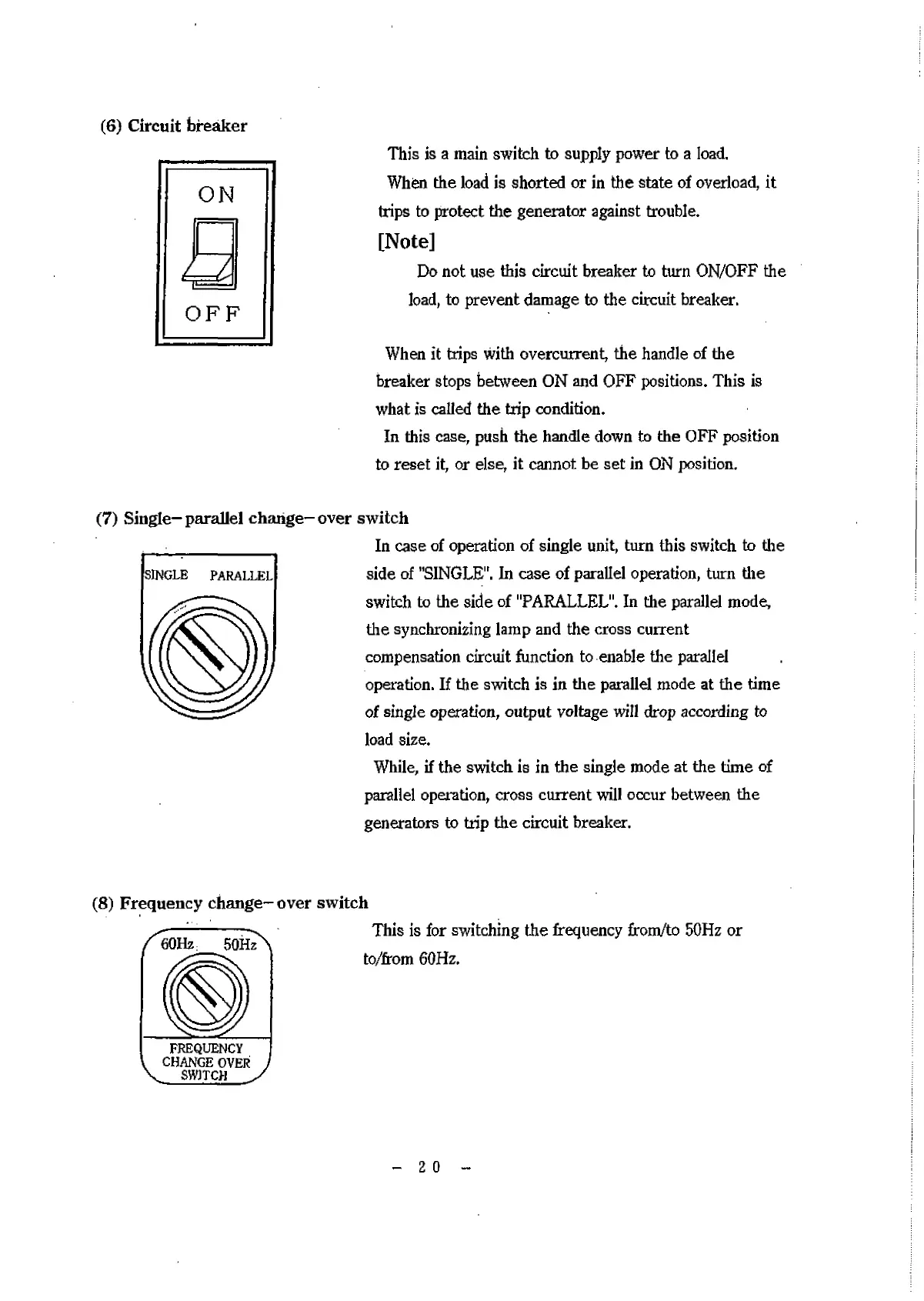
(6) Circuit breaker
This is a main switch to supply power to a load.
When the load is shorted or in the state of overload, it
trips to protect the generator against trouble.
[Note]
Do not use this circuit breaker to turn ON/OFF the
load, to prevent damage to the circuit breaker.
When it trips with overcurrent, the handle of the
breaker stops between ON and OFF positions. This is
what is called the trip condition.
In this case, push the handle down to the OFF position
to reset it, or else, it cannot be set in ON position.
(7) Single—parallel change-over switch
In case of operation of single unit, turn this switch to the
side of "SINGLE1'. In case of parallel operation, turn the
switch to the side of "PARALLEL". In the parallel mode,
the synchronizing lamp and the cross current
compensation circuit function to enable the parallel
operation. If the switch is in the parallel mode at the time
of single operation, output voltage will drop according to
load size.
While, if the switch is in the single mode at the time of
parallel operation, cross current will occur between the
generators to trip the circuit breaker.
(8) Frequency change- over switch
-----
—
--------
—x This is for switching the frequency from/to 50Hz or
f 60Hz; 50Hz\
" to/from 60Hz,
FREQUENCY
CHANGE OVER
SWJTCH ^
-20-


 To Next Page