8
LT-2044
TROUBLESHOOTING
TROUBLESHOOTING
System Operation
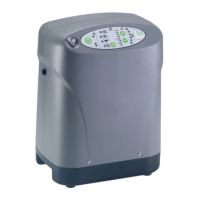
The DeVilbiss iGo Portable Oxygen System uses a pressure-swing
adsorption system. Air is drawn through lters into a double-head,
pressure-vacuum compressor. The pressure and vacuum created
in the compressor are cycled through a 4-way valve that directs the
pressure to one sieve bed while directing vacuum to the other. A
pressure transducer monitors the accumulator tank and triggers the
valve to direct the pressure/vacuum to the alternate sieve beds
when the tank reaches the specied shift pressure.
The sieve beds contain a synthetically-produced silicate molecular
sieve material with the unique ability to selectively adsorb nitrogen
from the air. As one bed pressurizes and adsorbs nitrogen, the
other bed vacuums forcing the previously adsorbed nitrogen to
exhaust through the valve and an exhaust mufer. During each
pressure-vacuum cycle, a small amount of oxygen from the
pressurizing bed travels to the vacuuming bed through a purge
valve helping to release the nitrogen from the sieve material. The
beds continue to alternately pressurize and vacuum as the unit
operates.
Oxygen leaving each sieve bed travels through a check valve into
the accumulator tank. A pressure regulator on the tank controls the
pressure of the oxygen as it leaves the tank and enters the OSD
®
oxygen sensing device where it is checked for purity. From the
OSD, the oxygen travels to a proportional valve, which adjusts the
ow rate of the oxygen so that the level prescribed by the physician
is delivered accurately. Oxygen leaves the proportional valve and
passes through the nal bacteria lter and the oxygen outlet port to
the patient.
The iGo incorporates power efciency routines. The PC board
adjusts cycle shift pressures and compressor speeds, as needed,
to consume the least amount of power, while maintaining oxygen
delivery with higher than 90% purity levels.
The PC board also activates the electronic alert system. See Alert
System under Maintenance in this manual.
Normal Operating Sequence
When the concentrator is turned ON @ 3 LPM, the following
cycling sequence can be observed by attaching pressure gauges
to the sieve bed test points.
1. The PC board cycles the 4-way valve quickly several times, to
relieve residual bed pressure and prevent a static condition in
the compressor, and opens the proportional valve to relieve
any residual pressure elsewhere in the system. During this
time the PC board conducts a test of the control panel and
audible alerts.
2. The PC board powers the compressor and sets the
proportional valve to the desired ow rate.
3. The PC board removes voltage from the 4-way and purge
valves. The right bed, as viewed from the front of the unit,
pressurizes while the left bed evacuates to approximately 17
in-Hg.
4. When the accumulator tank reaches the shift pressure, the PC
board applies voltage to the purge valve for 0.8 seconds
sending a small amount of oxygen to the left bed to help
release the nitrogen from the sieve material.
5. The PC board applies voltage to the 4-way valve and removes
voltage from the purge valve causing the left bed to pressurize
while the right bed evacuates.
6. When the accumulator tank reaches the shift pressure the PC
board applies voltage to the purge valve for 0.8 seconds
sending a small amount of oxygen to the right bed to help
release the nitrogen from the sieve material.
7. The cycle repeats beginning with step 3.


 To Next Page