SB-4-391-N Page 3
INSTALLATION
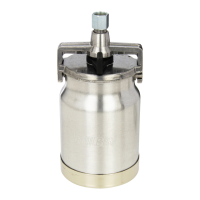
1. Position yoke at right angle to gun body with vent hole in lid
towardrearandleverofcam(3)towardfrontofgun.
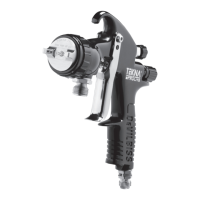
2. Fastencuplidassemblytogunbyattachingnut(2),seeFig.4,
touidinletnippleongun.Tightennutwithwrenchonlyuntil
snug.
3. Strain material to be sprayed through a 60-90 mesh screen before
pouring into cup.
4. Engage pins on cup into yoke and tighten yoke by moving lever
of cam clockwise.
MAINTENANCE
Lid Repair/Replacement:
1. Toreplaceadamagedpart,usea5/16"Allenwrenchtoloosen
andremoveadapter(1),nut(2),yoke&cam(3).Lidandtube
assembly are now loose for replacement.
2. Replace damaged parts on the lid and tube assembly. The cam
levershouldbelocatedonoppositesideoflidfromvalve(4).
3. Applysealant(Loctite#262)tothersttwofullthreadsofadapter
(1).Insertthreadedendofadapterintoopenendofnut(2).
4. Installadapter(1)andnut(2)intopoflidandtubeassembly.
Usea5/16"Allenwrenchtotightenrmly(10-12footpounds).
Valve and Lid Gasket Replacement:
1. Toremoveadamagedvalve(4)orlidgasket(5),pressontopof
valve until it breaks free. The valve pushes the lid gasket from the
seat. The lid gasket may now be removed from the lid. Continue
pressing hard on the valve to remove it from the lid.
2. Installreplacementvalve(4)throughbottomoflidsothatthe
valve tab is toward center of lid. Snap in place. If necessary, use
a plastic mallet or screwdriver handle to tap the valve in place.
Press the lid gasket firmly in the lid using the end of a crescent
wrench. Insert the side with the black marks first.
CLEANING
Note
Alwayscleanthecamlever(3)surfaceswithcleansolventand
a brush. This will keep the cam lever functioning properly. Do
not lubricate the cam.
General: For routine cleaning, it is not necessary to remove the lid
gasket. It is not necessary or desirable to remove the valve for any
cleaning procedure. The valve can be depressed from the outside
to assist in removal of the gasket for gasket replacement or when
cleaning dried paint from the channel. The valve should not be forced
past the shoulder which retains it in the lid except for replacement.
Air Pressure: Alwayscleanwithreducedairpressure.Anairpressure
no greater than 15 to 20 psi will allow quick and thorough cleaning
of the cup and gun and at the same time will:
1. Minimize the amount of solvent atomized into the air.
2. Prevent possibility of damage to cup from excessive back pres-
sure.
3. Reduce the force with which solvent is expelled from the vent.
Cleaning Procedures:
1. Empty paint from cup and add small amount of clean solvent. The
amount required will vary with different coatings and solvents.
2. Shake cup to wash down inside surfaces. Then spray solvent at
lowairpressure(15-20psi)toushoutuidpassages.
3. Pour out solvent and add same amount of clean solvent.
4a. Again,shakecup.Loosenaircap.Holdafoldedclothoverfront
of gun and invert cup over solvent receptacle. Trigger with short
burststobackushventchannel.WithvalveinD/F position,
solvent will be expelled with force from the channel vent hole
in lid.
Alternative to Step 4a.
4b. Shut off air to gun. With valve in D/F position, invert cup over
solventreceptable.Triggergun.Allowsolventtodripoutchan-
nel vent hole in lid for several seconds, or until clean solvent is
seen.
• Donotprobethroughthechannelventholeatanytime.Do
not probe through the valve slot hole while the valve is in
the D/F position. These holes are sealed by gasket (5) and
gasket damage could occur.
• Donotuseabrasivessuchasawirebrushorsteelwoolto
clean the inside of the Teflon
®
cup (7). Damage to the Teflon
®
surface could result.
IMMERSION
Since all materials in the cup are highly solvent resistant, the cup
assembly may be immersed for cleaning. Immersion should not
exceed 24 hours. The use of paint strippers should be avoided be-
cause strippers will affect the aluminum as well as other non-metallic
components. If the lid gasket has become swollen from prolonged
exposure to solvents, it will return to its original size without loss of
properties when allowed to dry.



 To Next Page