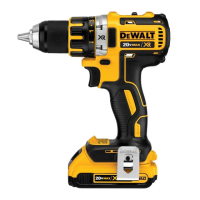
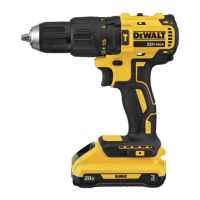
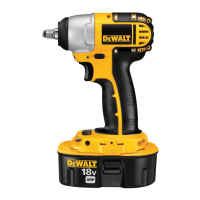
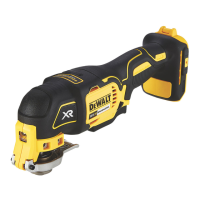
10
ENGLISH
DO NOT use under wet conditions or in the presence of
flammable liquids orgases.
These drills/drivers/hammerdrills are professional powertools.
DO NOT let children come into contact with the tool.
Supervision is required when inexperienced operators use
thistool.
• Young children and the infirm. This appliance is not
intended for use by young children or infirm persons
withoutsupervision.
• This product is not intended for use by persons (including
children) suffering from diminished physical, sensory or
mental abilities; lack of experience, knowledge or skills
unless they are supervised by a person responsible for their
safety. Children should never be left alone with thisproduct.
ASSEMBLY AND ADJUSTMENTS
WARNING: To reduce the risk of serious personal
injury, turn tool off and disconnect battery pack
before making any adjustments or removing/
installing attachments or accessories. An accidental
start‑up can causeinjury.
WARNING: Use only DeWALT battery packs andchargers.
Inserting and Removing the Battery Pack
from the Tool (Fig.B)
NOTE: Make sure your battery pack
11
is fullycharged.
To Install the Battery Pack into the Tool Handle
1. Align the battery pack
11
with the rails inside the tool’s
handle (Fig. B).
2. Slide it into the handle until the battery pack is firmly seated
in the tool and ensure that you hear the lock snap intoplace.
To Remove the Battery Pack from the Tool
1. Press the battery release button
12
and firmly pull the
battery pack out of the toolhandle.
2. Insert battery pack into the charger as described in the
charger section of thismanual.
Fuel Gauge Battery Packs (Fig.B)
Some DeWALT battery packs include a fuel gauge which
consists of three green LED lights that indicate the level of
charge remaining in the batterypack.
To actuate the fuel gauge, press and hold the fuel gauge
button
15
. A combination of the three green LED lights will
illuminate designating the level of charge left. When the level
of charge in the battery is below the usable limit, the fuel gauge
will not illuminate and the battery will need to berecharged.
NOTE: The fuel gauge is only an indication of the charge left on
the battery pack. It does not indicate tool functionality and is
subject to variation based on product components, temperature
and end‑userapplication.
Belt Hook and Magnetic Bit Holder (Fig.A)
Optional Accessories
WARNING: To reduce the risk of serious personal
injury, ONLY use the tool's belt hook to hang the
tool from a work belt. DO NOT use the belt hook for
tethering or securing the tool to a person or object during
use. DO NOT suspend tool overhead or suspend objects
from the belthook.
WARNING: To reduce the risk of serious personal
injury, ensure the screw holding the belt hook issecure.
CAUTION: To reduce the risk of personal injury or
damage, DO NOT use the belt hook to hang the drill
while using as aspotlight.
IMPORTANT: When attaching or replacing the belt hook
8
or
magnetic bit holder
10
, use only the mounting screw
9
that is
provided. Be sure to securely tighten thescrew.
The belt hook and magnetic bit holder can be be attached
to either side of the tool using only the screw provided, to
accommodate left‑ or right‑ handed users. If the hook or
magnetic bit holder is not desired at all, it can be removed from
thetool.
To move belt hook or bit clip, remove the screw that holds it in
place then reassemble on the opposite side. Be sure to securely
tighten thescrew.
Variable Speed Trigger Switch (Fig.A)
To turn the tool on, squeeze the variable speed
triggerswitch
1
. To turn the tool off, release the trigger switch.
Your tool is equipped with a brake. The chuck will stop as soon
as the trigger switch is fullyreleased.
NOTE: Continuous use in variable speed range is not
recommended. It may damage the switch and should
beavoided.
Forward/Reverse Control Button (Fig.A)
A forward/reverse control button
2
determines the direction of
the tool and also serves as a lock‑offbutton.
To select forward rotation, release the trigger switch and
depress the for ward/re verse control button on the right side of
thetool.
To select reverse, release the trigger switch and depress the
forward/reverse control button on the left side of thetool.
The centre position of the control button locks the tool in the off
position. When changing the position of the control button, be
sure the trigger isreleased.
NOTE: The first time the tool is run after changing the direction
of rotation, you may hear a click on start up. This is normal and
does not indicate aproblem.
Torque Adjustment Collar (Fig.A)
Your tool has an adjustable torque screwdriver mechanism for
driving and removing a wide array of fastener shapes and sizes
and in some models, a hammer mechanism for drilling into
masonry. Circling the torque adjustment collar
3
are numbers,
a drill bit symbol, and on some models, a hammer symbol.
These numbers are used to set the clutch to deliver a torque


 To Next Page
 Loading...