Need help?
Do you have a question about the DeWalt DCF503E and is the answer not in the manual?
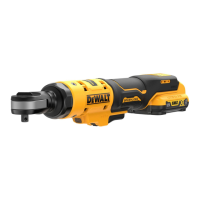
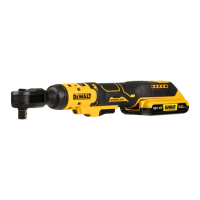
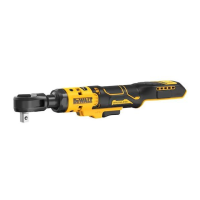
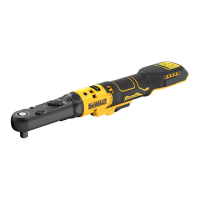
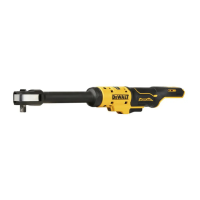
This document describes the DEWALT 12V Ratchets, models DCF503, DCF503E, and DCF504, which are professional power tools designed for light-duty fastening applications. These ratchets are not torque wrenches and should not be used for tightening fasteners to specified torques; an independent calibrated torque measurement device is recommended for such applications. They are not intended for use under wet conditions or in the presence of flammable liquids or gases.
The ratchets operate on 12 VDC. All three models (DCF503, DCF503E, DCF504) have a type 1 classification and a no-load speed of 0–250 RPM.
Noise and Vibration Values (triax vector sum) according to EN62841-2-2:
The declared noise and vibration emission levels are measured according to EN62841 and can be used for tool comparison and preliminary exposure assessment. However, actual emission levels may vary based on application, accessories, and maintenance. Operators should implement additional safety measures like maintaining the tool, keeping hands warm, and organizing work patterns to mitigate exposure.
Battery Pack: The tools operate with 12V DEWALT battery packs (DCB122, DCB124, DCB124G, DCB125, DCB126, DCB126G, DCB127). Battery packs are inserted into the tool handle by aligning them with the rails and sliding until they snap into place. To remove, press the battery release button (4) and pull the pack out. Some battery packs include a fuel gauge (10) with three green LED lights to indicate the remaining charge. The tool features an Electronic Protection System that automatically shuts off the tool if the battery pack is overloaded, overheated, or deeply discharged.
Anvil: The DCF503 ships with a 1/2" square anvil (2), while the DCF504 ships with a 3/8" square anvil (2). Accessories are installed by aligning and pressing them onto the anvil.
Variable Speed Trigger (1): The tool is turned on and off by pulling and releasing the trigger. The speed increases with greater trigger depression. The anvil stops immediately when the trigger is fully released. Avoid repeatedly pressing the trigger to start a stalled ratchet, as this can damage the tool.
Forward/Reverse Dial (3): This dial determines the rotational direction. For forward (clockwise) rotation, release the trigger and rotate the dial counterclockwise. For reverse (counterclockwise) rotation, release the trigger and rotate the dial clockwise. A click may be heard when changing direction, which is normal.
Lock-off Button (8): To lock the tool, slide this button to the locked position, preventing the trigger switch (1) from being pulled.
Worklight (6): A worklight (7) is located at the foot of the tool. It activates when the trigger switch is depressed and remains illuminated for up to 20 seconds after release, providing light to the immediate work surface. It is not intended as a flashlight.
Hand Position: Always maintain a proper hand position, with one hand on the main handle (7), to control the twisting action of the ratchet, especially since the ratchet may stall if overloaded, causing a sudden twist.
The ratchets are designed for long-term operation with minimal maintenance. Continuous satisfactory operation relies on proper tool care and regular cleaning.
Chargers: DEWALT chargers are designed for ease of use and require no adjustment. They are double-insulated and do not require an earth wire. Chargers are designed for standard 230V household electrical power (except vehicular chargers).
Battery Packs: Only DEWALT chargers should be used for charging. Do not charge or use batteries in explosive atmospheres. Avoid storing or using batteries where temperatures may fall below 4 °C (39.2 °F) or exceed 40 °C (104 °F). Do not incinerate damaged or worn-out battery packs. If battery contents contact skin, wash with soap and water; if in eyes, rinse with water for 15 minutes and seek medical help.
Lubrication: The power tool does not require additional lubrication.
Cleaning: Blow dirt and dust out of the main housing with dry air regularly, especially around air vents. Wear approved eye protection and a dust mask. Do not use solvents or harsh chemicals on non-metallic parts; use a damp cloth with water and mild soap. Never allow liquid inside the tool or immerse it.
Accessories: Only DEWALT recommended accessories should be used to reduce the risk of injury.
Environmental Protection: Products and batteries marked with the crossed-out wheeled bin symbol must not be disposed of with normal household waste. They contain recyclable materials and should be recycled according to local provisions. For more information, visit www.2helpU.com. Rechargeable battery packs should be fully discharged before removal from the tool and taken to a dealer or recycling station.
 General
| Brand | DeWalt |
|---|---|
| Model | DCF503E |
| Category | Power Tool |
| Language | English |

 To Next Page