
 Need help?
Do you have a question about the Digilent Analog Discovery 2 and is the answer not in the manual?
Install "Waveforms" software, connect AD2 via USB, and ensure driver installation.
Connect Signal 1 (W1) to CH1 and Signal 2 (W2) to CH2 using BNC cables.
Open the "Waveforms" software by double-clicking the application icon.
Set Channel 1 to 1kHz sine (2V amplitude) and Channel 2 to 1kHz triangle (2V amplitude).
Synchronize signal generation and start by clicking "Run all."
Select "Scope" from the menu and configure Time, CH1, and CH2 settings.
Set trigger mode, source, condition, and level for stable signal acquisition.
Click the "Run" button to view the acquired signals on the oscilloscope screen.
Add a "Custom" math channel and configure it for signal product calculation.
Use the signal calculator to input "C1*C2" and apply it to the math channel.
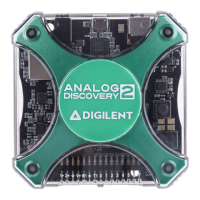
The Digilent Analog Discovery 2 (AD2) is a versatile, multi-function USB instrument designed for mixed-signal analysis and generation. It serves as a compact, all-in-one solution for engineers, educators, and students working with electronics, offering a range of capabilities typically found in separate benchtop instruments.
The primary functions of the AD2, as highlighted in this document, revolve around its signal generator and oscilloscope features.
Signal Generator (Wavegen): The AD2 can generate various waveforms, including sine and triangular waves, on two independent channels (W1 and W2). Users can configure parameters such as frequency, amplitude, and offset for each channel. This allows for the creation of custom test signals needed for circuit analysis, testing, and debugging. The ability to synchronize the two channels ensures that generated signals start simultaneously, which is crucial for phase-sensitive measurements or when analyzing the interaction between two signals.
Oscilloscope (Scope): The AD2 functions as a dual-channel oscilloscope, capable of displaying and analyzing electrical signals over time. It allows users to visualize waveforms generated by the AD2 itself or from external circuits. Key features include adjustable time base (e.g., 200 us/div), voltage range (e.g., 1 V/div), and offset for each channel (CH1 and CH2). The oscilloscope also incorporates triggering capabilities, enabling stable display of repetitive signals by setting conditions like source (e.g., Channel 1), condition (e.g., Rising edge), and level (e.g., 0 V). This ensures that the waveform display starts at a consistent point, making it easier to analyze signal characteristics.
Math Utility: A powerful feature of the AD2's oscilloscope is its integrated math utility. This allows users to perform mathematical operations on the acquired signals. For instance, it can compute and display the product of two input signals (e.g., C1*C2), which is demonstrated in the provided material. This capability extends beyond simple arithmetic, potentially including functions like addition, subtraction, division, integration, differentiation, and more, enabling deeper analysis of signal relationships and derived quantities.
Other Integrated Instruments: While not extensively detailed in the provided text, the AD2 is a comprehensive device that typically includes other instruments such as a logic analyzer, spectrum analyzer, network analyzer, power supplies, and a voltmeter. These additional functions contribute to its utility as a complete portable lab solution for mixed-signal design and testing.
The AD2 is designed for ease of use, leveraging its accompanying "Waveforms" software and a straightforward hardware setup.
Software-Driven Interface: The core of the AD2's operation is its "Waveforms" software. This software provides a graphical user interface (GUI) that mimics traditional benchtop instruments, making it intuitive for users familiar with such equipment. The software allows for easy configuration of all instrument settings, display of waveforms, and analysis of data. The "Workspace" menu within the software enables users to manage different configurations and projects.
USB Connectivity: The AD2 connects to a computer via a standard USB connector. This provides both power to the device and a data interface for communication with the "Waveforms" software. The USB connection also facilitates the installation of necessary drivers upon initial connection.
BNC Adaptor Board: For robust and standard connections, the AD2 can be equipped with a BNC Adaptor Board. This board provides BNC connectors for both the signal generators (W1, W2) and the oscilloscope channels (CH1, CH2). BNC connectors are widely used in test and measurement due to their secure locking mechanism and good impedance matching properties, ensuring reliable signal integrity.
Intuitive Configuration: The software guides users through the setup process. For signal generation, users can select the waveform type, frequency, and amplitude with simple dropdowns and input fields. For the oscilloscope, settings like time base, voltage range, and triggering conditions are easily accessible and adjustable. The ability to "Synchronize" generated signals and "Run all" instruments with a single click streamlines the testing process.
Visual Feedback: The "Waveforms" software provides real-time visual feedback of generated and acquired signals. Waveforms are displayed graphically, allowing for immediate observation of changes and analysis of signal characteristics. The math utility also integrates its results directly into the waveform display, providing a comprehensive view of the analyzed data.
Portability: As a USB-powered device, the AD2 is highly portable. It eliminates the need for multiple bulky benchtop instruments, making it ideal for use in various settings, including classrooms, home labs, and field applications where space and power outlets might be limited.
While the document does not explicitly detail maintenance features, the nature of the AD2 as a software-driven USB instrument implies certain aspects:
Software Updates: The "Waveforms" software is a critical component of the AD2. Digilent typically provides regular software updates to introduce new features, improve performance, and address any bugs. Users can maintain their AD2's functionality by ensuring they have the latest version of the "Waveforms" software, which is freely downloadable.
Driver Management: The AD2 relies on specific drivers to communicate with the host computer. These drivers are usually installed automatically upon the first connection of the AD2 to a computer with the "Waveforms" software already installed. Keeping the operating system and "Waveforms" software updated generally ensures driver compatibility and proper device recognition.
Physical Connections: The BNC Adaptor Board and the USB connector are the primary physical interfaces. Regular inspection of these connectors for any signs of wear or damage is good practice to ensure reliable operation. Using high-quality BNC cables and ensuring secure connections helps maintain signal integrity and prevents damage to the connectors.
Environmental Considerations: Like most electronic devices, the AD2 should be operated within specified environmental conditions (temperature, humidity) to ensure its longevity and accurate performance. Keeping the device clean and free from dust and moisture is also generally recommended.
In summary, the Digilent Analog Discovery 2, with its BNC Adaptor Board and "Waveforms" software, offers a powerful and user-friendly platform for signal generation, acquisition, and analysis. Its integrated approach, intuitive interface, and portability make it an invaluable tool for a wide range of electronic applications.
 General
| Oscilloscope Bandwidth | 30 MHz |
|---|---|
| Oscilloscope Channels | 2 |
| Oscilloscope Sample Rate | 100 MS/s |
| Waveform Generator Channels | 2 |
| Logic Analyzer Channels | 16 |
| Logic Analyzer Sample Rate | 100 MS/s |
| Digital I/O | 16 |
| Voltmeter (DC) | Yes |
| Connectivity | USB 2.0 |
| Analog Input Resolution | 14 bits |
| Analog Input Range | ±25V |
| Analog Output Resolution | 14 bits |
| Analog Output Range | ±5V |
| Power Supply | USB Powered |
| Software | WaveForms |
| Digital I/O Logic Levels | 3.3V |
| Protocols | SPI, I2C, UART |
| Operating System Compatibility | Windows, Linux |
| Programmable Power Supplies Current | 700mA (single), 500mA (dual) |

 To Next Page