53
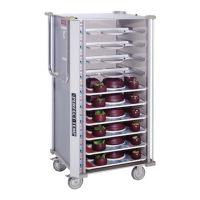
1. Trays assembled in the central facility are loaded onto stacking carts and placed
under refrigeration until delivery.
2. Trays are secured on stacking carts with adjustable belts.
3. Stacking carts are then loaded onto a refrigerated truck for delivery.
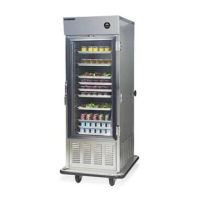
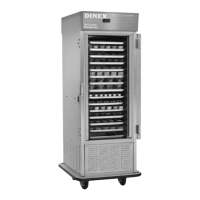
4. At the satellite unit, trays are unloaded and placed into Perfect•Temp carts. At
this time, switches are set by the employee loading trays. (A system should be
devised for indicating the switch position on each menu using an easily readable
symbol, such as red = up, blue = middle, and orange = down.)
5. Perfect•Temp carts are now ready for placement in the central rethermalization
refrigerator or roll-in refrigerators.
6. The truck driver picks up trays, covers and other dishware used from previous
meals at this time and returns them to the central kitchen.
Areas of Consideration
1. Delivery schedule and trayline assembly schedule. These must be considered
together so that assembled trays can be delivered to satellites with enough time to be
unloaded, set in Perfect•Temp carts, and held under refrigeration for at least 45 minutes
before rethermalization.
2. Tray, cover and ware washing. Decisions need to be made on the use of reusable
dishware at satellite units and where these will be washed. In any case, the tray and cover
washing location needs to be established. Both of the above considerations will affect the
number of complements of trays, covers and dishware that will need to be purchased at the
outset and the schedules for dishwashing at back unit. (In addition, dish machine capacities
need to be evaluated carefully.)
3. Transporting assembled trays and soiled trays at one time. In the event that all
trays, covers, etc. are washed at a central facility, some thought should be given to the
transporting of soiled and assembled trays so that cross-contamination does not occur. You
may need to contact your local health department to see if this is a concern.
Suggestions:
• Thermal covers for assembled tray carts
• Partitioning of cargo area of truck


 To Next Page