Need help?
Do you have a question about the DLE DLE40 Twin and is the answer not in the manual?
Adjust the low speed needle for a smooth idle and reliable transition to high throttle.
Set the high speed needle for maximum RPM and adjust for altitude and performance.
Use non-Ethanol 92/95 octane fuel with 30:1 oil ratio for break-in, 40:1 for run-in engines.
Start, adjust idle, warm up, then use short bursts of high RPM for two hours.
One year parts/labor warranty for factory instructions; exclusions include improper use and cooling.
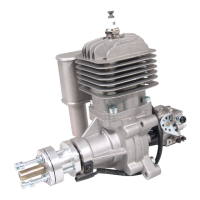
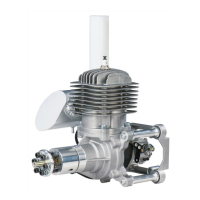
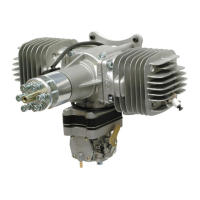
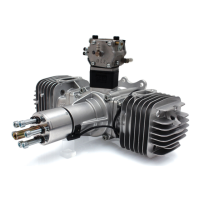
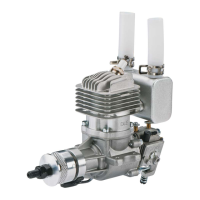
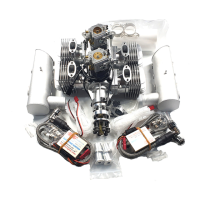
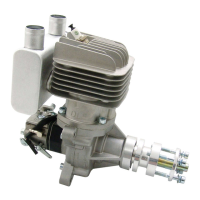
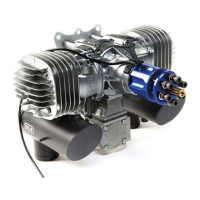
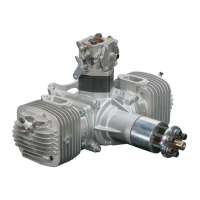
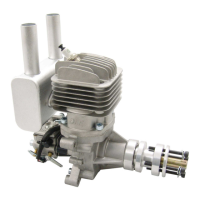
The DLE40 Twin is a gas-powered engine designed for model aircraft. It is not a toy and requires careful handling and adherence to safety guidelines. The manual emphasizes that children under 18 should not operate the engine without supervision, and the user is responsible for its safe operation.
Before each use, it is crucial to inspect the engine assembly, propeller, and airframe for any loose screws or nuts. The manual strongly recommends using Loctite 242 Blue (or similar) on all screws to prevent loosening due to vibration. When starting or running the engine, always stand clear of and behind the propeller. No one, including the operator, should be in front of or to the sides of the propeller. Anyone near the engine must wear protective eyewear, and loose clothing should never be worn near the engine or propeller to avoid entanglement.
During the break-in process, the engine must be installed in an environment that can absorb vibrations, such as in the model aircraft itself or with a soft mount if bench running. Hard mounting to a bench without adequate vibration damping can cause damage to internal parts and shorten the engine's lifespan. Mounting the engine in the model is considered the best method for break-in.
The engine comes with average mixture settings, which should allow it to start and run in most locations. However, due to variations in altitude and barometric pressure, carburetor mixture settings may need adjustment for optimal performance.
The carburetor features the following adjustment points:
A general starting point for mixture screws is 1.25 turns out for the low speed needle (4) and 1.5 turns out for the high speed needle (5).
Running an overly rich mixture can lead to poor engine performance (stopping or sputtering during acceleration/deceleration), premature carbon buildup, a fouled spark plug, and excessive exhaust residue. Conversely, a lean mixture will damage the cylinder and piston, and engines damaged by a lean run are not covered under warranty. During break-in and after a few full-throttle runs, checking the spark plug is recommended; a slight yellow color indicates proper mixture settings.
The engine requires non-Ethanol 92 or 95 Octane fuel. For general use, a 30:1 oil ratio is recommended. A 40:1 ratio may be used after the engine has been run in, provided a high-quality, fully synthetic oil is used. It is crucial not to mix different types or brands of engine oil, as this can cause carburetor fouling. For break-in, a 30:1 full synthetic oil ratio is recommended. After 2 to 3 hours of run time, the oil ratio can be decreased to 40:1 with full synthetic oil. For prolonged engine life, a 30:1 ratio is still recommended.
Start the engine and adjust the idle mixture if necessary. Allow the engine to warm up at idle, then slowly increase the RPM. Avoid running at full throttle for the first tank of fuel. Instead, run in short bursts of 1 or 2 seconds up to 4500 RPM, then return to mid-throttle and idle. Continue this process for 2 hours, gradually increasing the upper RPM and duration of high RPM. If the engine sags in RPM at high throttle, immediately throttle back. Stop the engine and adjust the high speed mixture screw 1/8 of a turn out, then restart and retest.
Avoid running the engine at low speed for excessive periods, as this can lead to carbon buildup on the spark plug.
All DLE engines come with a one-year parts and labor warranty, provided they are operated according to factory instructions, use specified propellers, and correct lubricants and lubricant ratios. The engine's serial number and purchase date will be recorded for warranty purposes, and retaining the purchase invoice is essential for warranty proof.
BOOMA RC P.O Box 1 Oak Flats NSW 2529 Telephone: 02 42 955 287 Website: www.boomarc.com

 To Next Page
 General