EasyManua.ls Logo

DMP Electronics 734 - User Manual

DMP Electronics 734
2 pages
Print Icon
To Next Page IconTo Next Page
Loading...
Step 1: Mount the 734
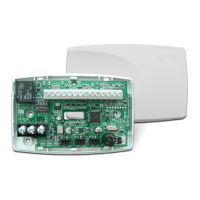
The back and ends of the 734 housing have wire entrances. The back also contains multiple mounting holes that allow
you to mount the module on a single‑gang switch box. DMP recommends mounting the 734 near the protected door.
1. Remove the PCB from the plastic housing by loosening the clips on
one side and gently lifting it out of the housing base.
2. Insert the included screws in the desired mounting hole locations
and tighten them to secure the housing to the surface.
3. Reinstall the PCB in the housing base.
734 Access Control Module
Quick Start Guide
Full Installation and Programming Guide
To view the full 734 Access Control Module Installation and Programming Guide, scan this QR code
or visit DMP.com.
This quick start guide walks you through installing the access control module.
RED
PROG
RED
KYPD OUT
DATA
XMT LED
WIEGAND
READ LED
RELAY
ON
NC
C
NO
GRN
YEL
RED
+ –
Piezo
1
2
3
4 5 6 7
8
10
11 12 13 14
9
LC ASREDWHTGRN BLK Z1 Z2 Z3 Z4+ Z4–RA GND GND
KYPD IN
RED
ON
1 2 3 4
Reader
Inputs
Status
Indicator
Outputs
Zones
To Panel
Keypad Bus
or AX-Bus
Piezo
Address DIP
Switches
Door Relay
Terminal
Indicator
LEDs
Keypad
Programming
Header
To Other
Keypad Bus
or AX-Bus
Step 2: Wire the Access Control Lock
The Form C relay draws up to 35 mA of current and contacts are rated for
10 Amps (resistive) at 12/24 VDC. When connecting multiple locks to the
Form C relay, the total current for all locks cannot exceed 10 Amps. The
three relay terminals marked NO C NC allow you to connect the device
wiring to the relay for module control. Use an additional power supply to
power magnetic locks and door strikes.
Model 333
Suppressor
+
12/24 VDC
Power Supply
Normally Closed
Magnetic Door
Lock
Mag lock positive
to Terminal NC
Power supply positive
to Terminal C
Mag lock negative to
power supply negative
Figure 1: Typical Magnetic Lock Wiring
Model 333
Suppressor
+
12/24 VDC
Power Supply
Normally Open
Door strike positive
to Terminal NO
Power supply positive
to Terminal C
Door strike negative to
power supply negative
DC Door Strike
Figure 2: Typical Door Strike Wiring
Step 3: Wire the 734
KYPD IN (Keypad In): Receives and transmits data to the panel Keypad bus/AX‑Bus.
KYPD OUT (Keypad Out): Receives and transmits data out to other keypad(s) or module(s). Install a dual‑connector
harness to allow connection to other devices up to the maximum number of devices supported.
Caution: When the 734 is powered from 24 VDC, do not connect devices to KYPD OUT header.

Other manuals for DMP Electronics 734

Question and Answer IconNeed help?

Do you have a question about the DMP Electronics 734 and is the answer not in the manual?

Summary

Mounting the 734 Access Control Module

Wiring the Access Control Lock

Wiring the 734 Module

KYPD IN (Keypad In)

Receives and transmits data to the panel Keypad bus/AX-Bus.

KYPD OUT (Keypad Out)

Receives and transmits data out to other keypad(s) or module(s).

Isolation Relay and Suppressor Installation

Isolation Relay (Optional)

Used for devices drawing more than 10 Amps or exceeding relay limits.

Install the 333 Suppressor

Suppresses surges caused by energizing magnetic locks or door strikes.

Zone and Card Reader Connections

Wire the Zone Terminals

Connects zones 1-3 and zone 4 for various device inputs.

Wiegand Card Reader

Wiring for Wiegand readers: Data Zero, Data One, 12/24 VDC, and ground.

OSDP Card Reader

Wiring for OSDP readers: A (485), B (485+), DC+, and DC- connections.

Final Configuration and Power

Set the 734 Address

Configure module address using DIP switches on the PCB.

Connect the Power Supply

Connects 12 or 24 VDC power supply to the module.

Program the Panel and 734

Instructions for programming the access control system.

Summary

Mounting the 734 Access Control Module

Wiring the Access Control Lock

Wiring the 734 Module

KYPD IN (Keypad In)

Receives and transmits data to the panel Keypad bus/AX-Bus.

KYPD OUT (Keypad Out)

Receives and transmits data out to other keypad(s) or module(s).

Isolation Relay and Suppressor Installation

Isolation Relay (Optional)

Used for devices drawing more than 10 Amps or exceeding relay limits.

Install the 333 Suppressor

Suppresses surges caused by energizing magnetic locks or door strikes.

Zone and Card Reader Connections

Wire the Zone Terminals

Connects zones 1-3 and zone 4 for various device inputs.

Wiegand Card Reader

Wiring for Wiegand readers: Data Zero, Data One, 12/24 VDC, and ground.

OSDP Card Reader

Wiring for OSDP readers: A (485), B (485+), DC+, and DC- connections.

Final Configuration and Power

Set the 734 Address

Configure module address using DIP switches on the PCB.

Connect the Power Supply

Connects 12 or 24 VDC power supply to the module.

Program the Panel and 734

Instructions for programming the access control system.

Overview

The 734 Access Control Module is a device designed to integrate access control functionalities into a security system, allowing for the management of doors, card readers, and various zones. It serves as an interface between the main control panel and the access control components, facilitating communication and control.

Function Description

The module's primary function is to provide access control capabilities, including the control of door locks (magnetic locks or door strikes), the integration of card readers (Wiegand and OSDP), and the monitoring of security zones. It receives data from the main panel via a Keypad bus or AX-Bus and transmits data to other keypads or modules. The module features a Form C relay for controlling door locking mechanisms, status indicator outputs, and multiple zone inputs for monitoring. It also includes a keypad programming header for configuration and a piezo for audible indications.

Important Technical Specifications

  • Relay Specifications: The Form C relay can draw up to 35 mA of current. Its contacts are rated for 10 Amps (resistive) at 12/24 VDC. When multiple locks are connected to the Form C relay, their total current must not exceed 10 Amps. For devices exceeding 10 Amps, an isolation relay is required.
  • Power Supply: The 734 can be powered by either a 12 VDC or 24 VDC power supply. The 12 VDC power can be sourced from the panel keypad bus or a separate power supply. The 24 VDC power supply can be connected directly to the relay terminal block (J1).
  • Output Current Limit: The total output current for zones connected to the module must not exceed 750 mA to prevent equipment damage.
  • Zone Inputs: The module includes multiple zone inputs:
    • Zones 1-3 (Terminals 8-12): These are grounded zones and cannot be used for fire-initiating devices. Zones 2 and 3 offer specific access control functionalities, with Zone 2 providing a bypass feature and Zone 3 offering request-to-exit functionality.
    • Zone 4 (Terminals 13-14): This is a non-powered Class B ungrounded zone suitable for connecting fire devices such as heat detectors or pull stations.
  • Card Reader Output: The 734 provides direct 12/24 VDC output to the reader via the RED terminal connection.
  • Wiegand Card Reader Connections:
    • Data Zero (DO): Green wire
    • Data One (D1): White wire
    • 12/24 VDC: Red wire
    • Ground: Black wire
  • OSDP Card Reader Connections:
    • Data Transmission (A 485-): GRN terminal
    • Data Transmission (B 485+): WHT terminal
    • Reader Power (DC+): RED terminal
    • Reader Power (DC-): BLK terminal
  • Suppressor: A 333 suppressor is included to mitigate surges caused by energizing magnetic locks or door strikes. It should be installed across the module's C (common) and NO (normally open) or NC (normally closed) terminals, depending on the relay connection.
  • End-of-Line (EOL) Resistors: Supplied 311 1k Ohm EOL resistors are used on each zone.
  • KYPD OUT Header: When the 734 is powered from 24 VDC, no devices should be connected to the KYPD OUT header.

Usage Features

  • Flexible Mounting: The module's housing has wire entrances at the back and ends, and multiple mounting holes allow for installation on a single-gang switch box. It is recommended to mount the 734 near the protected door for optimal performance.
  • Door Lock Control: The Form C relay allows for direct control of magnetic locks or door strikes. Wiring diagrams are provided for both normally closed (magnetic lock) and normally open (door strike) configurations, emphasizing the need for an additional power supply for these devices and the use of a suppressor.
  • Card Reader Integration: Supports both Wiegand and OSDP card readers, with clear wiring instructions for each type, including data and power connections.
  • Zone Monitoring: Provides multiple zone inputs for various security applications. Zones 2 and 3 are specifically designed for access control features like bypass and request-to-exit, while Zone 4 is suitable for fire devices.
  • Address Setting: The module's address is set using DIP switches on the PCB, allowing for unique identification within the system.
  • Panel and Module Programming: The device requires programming of both the panel and the 734 module itself, with instructions available via a QR code or the panel's programming guide.
  • Daisy-Chaining: The KYPD OUT header allows for connection to other keypads or modules, supporting a maximum number of devices. A dual-connector harness is required for this feature.
  • Reset Functionality: While the panel can perform a Sensor Reset, it does not drop power to the Keypad Bus or AX-Bus. For four-wire smoke detectors or other latching devices on Zone 4, a mechanical means of resetting is required.

Maintenance Features

  • PCB Removal: The PCB can be easily removed from the plastic housing by loosening clips, facilitating installation and maintenance.
  • Suppressor Installation: The included 333 suppressor helps protect the module from power surges, contributing to the longevity and reliability of the device.
  • EOL Resistors: The use of EOL resistors on each zone is a standard practice for maintaining circuit integrity and simplifying troubleshooting.
  • Clear Wiring Diagrams: The manual provides detailed wiring diagrams for various components, aiding in correct installation and future maintenance.
  • Troubleshooting Guidance: The note regarding the mechanical reset for Zone 4 devices and the caution about the KYPD OUT header when using 24 VDC power provide important considerations for preventing issues and ensuring proper operation.

DMP Electronics 734 Specifications

General IconGeneral
BrandDMP Electronics
Model734
CategoryControl Unit
LanguageEnglish

Related product manuals