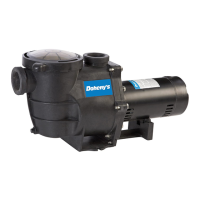
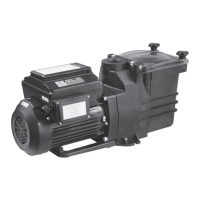
6950 51st Street Kenosha WI 53144|Orders and Customer Care: 1-800-574-7665|Fax: 1-800-323-5932|Doheny.com
C. Motor Hums, But Does NOT Start – Check For:
1. Impeller jammed with debris.
Solution:Haveaqualiedrepairprofessionalopen
the pump and remove the debris.
D. Pump Won’t Prime, Check For:
1.
Empty pump/strainer housing.
Solution:Makesurepump/strainerhousingislled
with water and cover O-Ring is clean. Ensure O-Ring
is properly seated in the cover O-Ring groove.
Ensure O-ring is lubricated and that strainer cover
is locked rmly in position. Lubricant will help to
create a tighter seal.
2. Loose connections on suction side.
Solution: Tighten pipe/union connections. NOTE:
Any self-priming pump will not prime if there are
suction air leaks. Leaks will result in bubbles
emanatingfromreturnttingsonpoolwall.
3. Leaking O-ring or packing glands on valves.
Solution: Tighten, repair, or replace valves.
4. Strainer basket or skimmer basket loaded with
debris.
Solution: Remove strainer housing cover or
skimmer cover, clean basket, and rell strainer
housing with water. Tighten cover.
5. Suction side clogged.
Solution: Contact a qualied repair professional.
Block off to determine if pump will develop a
vacuum. You should have 5 in. to 6 in. of vacuum
at the strainer cover (Only your pool dealer can
conrm this with a vacuum gauge). You may be
able to check by removing the skimmer basket and
holding your hand over the bottom port with
skimmer full and pump running. If no suction is felt,
check for line blockage.
a. If pump develops a vacuum, check for blocked
suction line or dirty strainer basket. An air leak
in the suction piping may be the cause.
b. If pump does not develop a vacuum and pump
hassufcient“primingwater”:
i. Re-check strainer housing cover and all
threaded connections for suction leaks.
Check if all system hose clamps are tight.
ii. Check voltage to ensure that the motor is
rotating at full RPM’s.
iii. Open housing cover and check for clogging
or obstruction in suction. Check impeller for
debris.
iv. Remove and replace shaft seal only if it is
leaking.
E. Low Flow – Generally, Check For:
1. Clogged or restricted strainer or suction line.
Solution:Contactaqualiedrepairprofessional.
2. Undersized pool piping.
Solution: Correct piping size.
3. Pluggedorrestricteddischargelineoflter,valve
partially closed (high gauge reading).
Solution: Sand Filters: backwash as per
manufacturer’s instructions; D.E. Filters: backwash
as per manufacturer’s instructions; Cartridge Flters:
clean or replace cartridge.
4. Air leak in suction (bubbles issuing from return
ttings).
Solution: Re-tighten suction and discharge
connections using Teon tape. Inspect other
plumbingconnectionsandtightenasrequired.
5. Plugged, restricted, or damaged impeller.
Solution: Replace including new seal assembly.
F. Noisy Pump – Check For:
1. Air leak in suction piping, cavitations caused by
restricted or undersized suction line or leak at any
joint, low water level in pool, and unrestricted
discharge return lines.
Solution: Correct suction condition or throttle
return lines, if practical. Holding hand over return
ttingwillsometimesprovethispointorputtingina
smallereyeballtting.
2. Vibration due to improper mounting.
Solution: Mount the pump on a level surface and
securethepumptotheequipmentpad.
3. Foreign matter in pump housing. Loose stones/
debris hitting impeller could be cause.
Solution: Clean the pump housing.
4. Motor bearings noisy from normal wear, rust,
overheating, or concentration of chemicals causing
seal damage which will allow chlorinated water
to seep into bearings, wiping out the grease and
causing bearing to whine.
Solution: All seal leaks should be replaced at once.
CHAPTER 8: TECHNICAL DATA
Pump performance table
ITEM# HP VOLT AMPS MAX MAX
(GPM) HEAD (ft)
2601 3/4 115 7.3 62 30
6578 1 115 9 75 38
6579 1.5 115 12 83 40
2716 1 115/230 11.5/5.7 83 15
6589 1.5 115/230 14.2/7.1 97 20
4657 1 115 11.5 82 50
5014 1.5 115 15 95 68


 To Next Page
 Loading...