19-10 DELTA/DELTA XL/KAPPA VF8
19
ETCO2 (END-TIDAL CO2) MONITORING
Capnograms
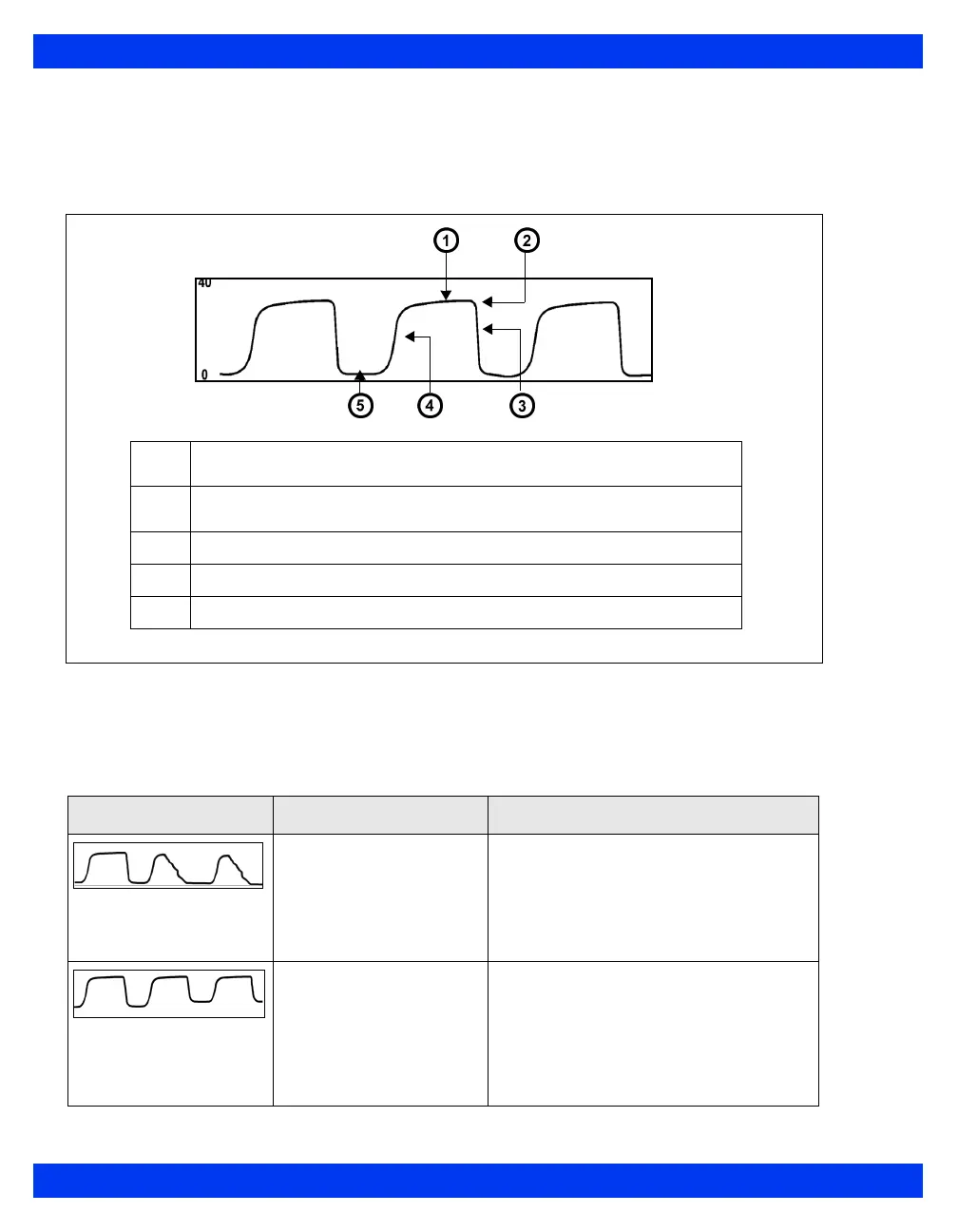
The monitor also displays an instantaneous CO
2
reading as a waveform or capnogram.
A typical capnogram is shown below:
You can use capnograms to troubleshoot problems with equipment or monitor
configuration as well as to monitor a patient’s clinical status. The following table
shows some of the more common problems identifiable through capnogram analysis:
Capnogram Description Immediate and possible causes
Alveolar plateau shows
downward slope that
merges with descending
limb
Inadequate Seal Around Endotracheal
Tube
• Leaky or deflated endotracheal or
tracheostomy cuff
• Artificial airway that is too small for the
patient
Elevated waveform
baseline with
corresponding increase in
etCO
2
level
Rebreathing
• Insufficient expiratory time
• Faulty expiratory valve
• Inadequate inspiratory flow
• Malfunction of a CO
2
absorber system
• Partial rebreathing circuits
1
Expiratory plateau (level of CO2 in lungs ceases to increase
significantly)
2
End-tidal concentration point (end of expiration phase, where etCO2 is
measured)
3
Onset of inspiration phase
4
Expiration phase
5
Baseline during inspiration



 To Next Page