Introduction
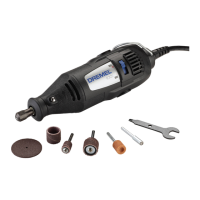
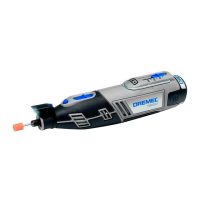
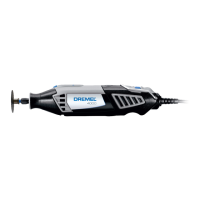
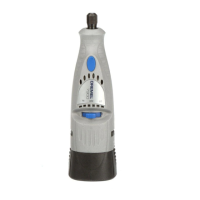
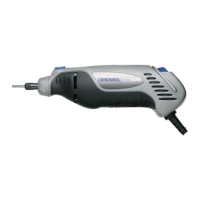
The Moto-Tool is a handful of high-speed
power. It serves as a carver, a grinder,
polisher, sander, cutter, power brush, drill and
more.
The Moto-Tool has a small, powerful electric
motor, is comfortable in the hand, and is
made to accept a large variety of accessories
including abrasive wheels, drillbits, wire brushes,
polishers, engraving cutters, router bits, and
cutting wheels. Accessories come in a variety
of shapes and permit you to do a number of dIf-
ferent jobs. As you become familiar with the
range of accessories and their uses, you will
learn just how versatile the Moto-Tool is. You'll
see dozens of uses you hadn't thought of before
now.
The real secret of the Moto-Tool is its speed. To
understand the advantages of its high speed,
you have to know that the standard portable
electric drill runs at speeds up to 2,800 rev-
oJutlons per minute. The Moto- Tool operates at
speeds up to 30,000 revolutions per minute.
The typical electric drill is a low-speed, high tor-
que tool; the Moto- Tool Is just the opposite - a
high-speed, low torque tool. The chief dif-
ference to the user Is that in the high speed
tools, the speed combined with the accessory
mounted In the chuck does the work. You don't
apply pressure to the tool, but simply hold and
guide it. In the low speed tools, you not only
guide the tool, but also apply pressure to it, as
you do, for example, when drilling a hole.
It is this high speed, along with its compact size
and wide variety of special accessories, that
makes the Moto- Tooldifferent from other power
tools. The speed enables it to do jobs low-
speed tools cannot do, such as cutting har-
dened steel, engraving glass, etc.
Getting the most out of your Moto- Tool Is a mat-
ter of learning how to let this speed work for
you.
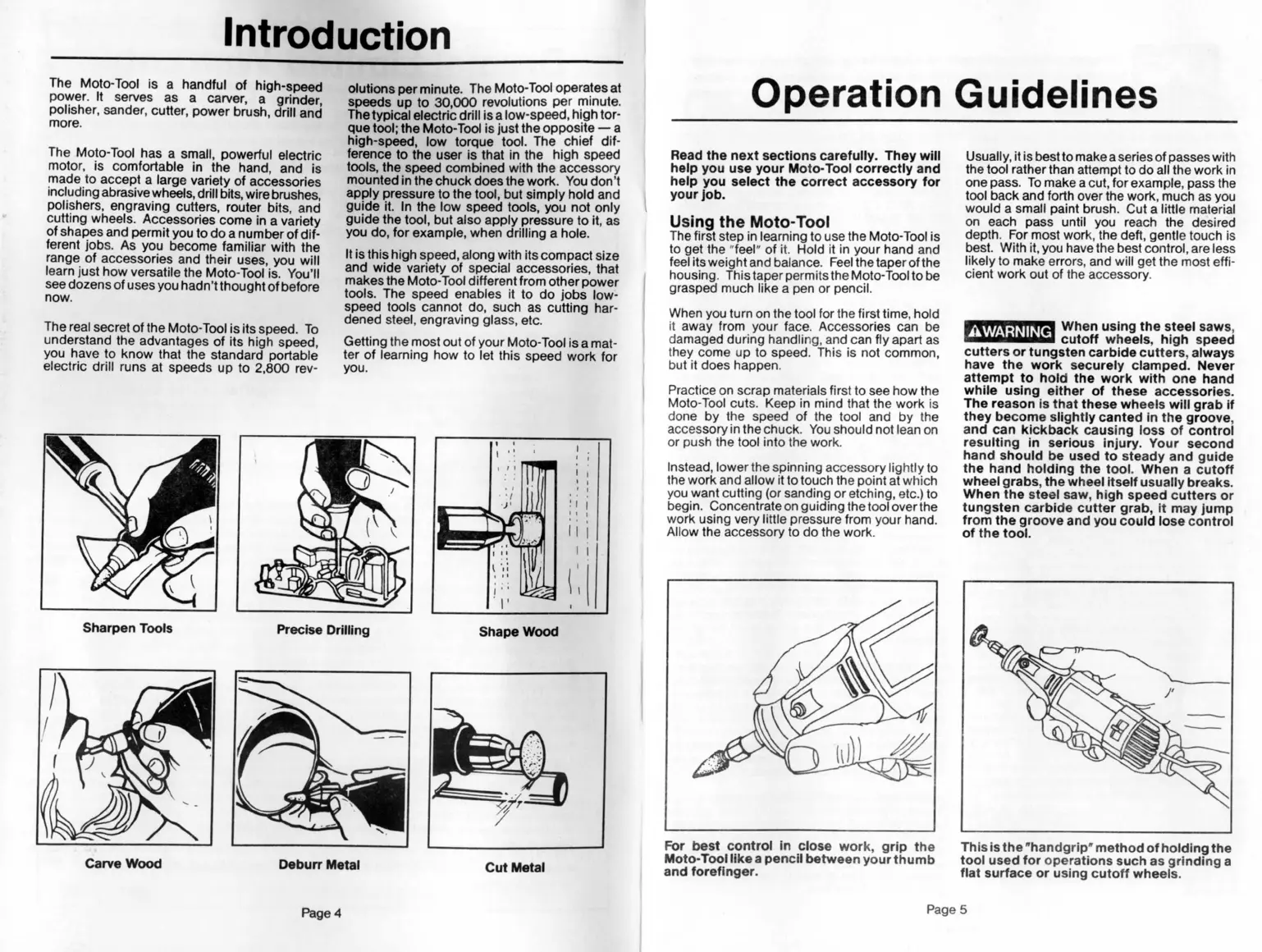
Sharpen Tools
Precise Drilling
. I
I .
~
"
I I
I I
I I
I
I
:,
I
II I
'.
I
II I
I I
,.,
'I'
(,(
I
Shape Wood
Carve Wood
Deburr Metal
Page 4
Cut Metal
Operation Guidelines
Read the next sections carefully. They will
help you use your Moto-Tool correctly and
help you select the correct accessory for
your job.
Using the Moto- Tool
The first step in learning to use the Moto- Tool is
to get the "feel" of it. Hold it in your hand and
feel its weight and balance. Feel the taper of the
housing. This taper permits the Moto- Tool to be
grasped much like a pen or pencil.
When you turn on the tool for the first time, hold
it away from your face. Accessories can be
damaged during handling, and can fly apart as
they come up to speed. This is not common,
but it does happen.
Practice on scrap materials first to see how the
Moto. Tool cuts. Keep in mind that the work is
done by the speed of the tool and by the
accessory in the chuck. You should not lean on
or push the tool into the work.
Instead, lower the spinning accessory lightly to
the work and allow it to touch the point at which
you want cutting (or sanding or etching, etc.) to
begin. Concentrate on guiding the tool over the
work using very little pressure from your hand.
Allow the accessory to do the work.
For best control In close work, grip the
Mota-Tool like a pencil between your thumb
and forefinger.
Usually, it is best to make a series of passes with
the tool rather than attempt to do all the work in
one pass. To make a cut, for example, pass the
tool back and forth over the work, much as you
would a small paint brush. Cut a little material
on each pass until you reach the desired
depth. For most work, the deft, gentle touch is
best. With it, you have the best control, are less
likely to make errors, and will get the most effi-
cient work out of the accessory.
~ When using the steel saws,
~ cutoff wheels, high speed
cutters or tungsten carbide cutters, always
have the work securely clamped. Never
attempt to hold the work with one hand
while using either of these accessories.
The reason Is that these wheels will grab If
they become slightly canted In the groove,
and can kickback causing loss of control
resulting In serious Injury. Your second
hand should be used to steady and guide
the hand holding the tool. When a cutoff
wheel grabs, the wheel Itself usually breaks.
When the steel saw, high speed cutters or
tungsten carbide cutter grab, It may jump
from the groove and you could lose control
of the tool.
This Is the "handgrlp" method of holding the
tool used for operations such as grinding a
flat surface or using cutoff wheels.
Page 5



 To Next Page
 Loading...