Need help?
Do you have a question about the DSC WT4911 and is the answer not in the manual?
Technical specifications including humidity, operating temperature, frequency, battery life, and weight.
Steps for initial battery activation and depassivation of the WT4911 siren.
Procedure to re-initiate the siren's battery depassivation process if it stops.
Instructions for enrolling the siren with the security panel via Quick Enrollment or Serial Number.
Guide for testing signal strength at the desired mounting location for the siren.
Steps for mounting the outdoor siren securely to a flat surface.
Procedure for replacing the siren's battery, including safety and activation steps.
How to configure siren options and perform tests using the security panel keypad.
Guidance for the end-user regarding safety, operation, and product care.
Details the warranty period, exclusions, and limitations for Digital Security Controls products.
Terms and conditions for using DSC software, including grant of license, usage restrictions, and copyright.
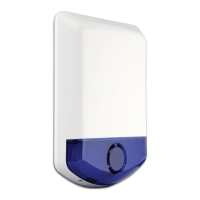
The WT4911/WT8911 is a two-way wireless outdoor siren designed for use with compatible DSC security panels, such as the PC9155 series. This device serves as an external annunciator for alarm conditions, providing both audible siren sounds and visual strobe light activation. Its primary function is to enhance the security system's ability to alert occupants and neighbors to potential threats.
The siren operates on DSC wireless protocol, enabling two-way communication with the security panel. This means it not only receives commands to activate alarms but also transmits information back to the panel, such as its status and the local outdoor temperature. Up to four WT4911/WT8911 units can be enrolled and supervised on a single security panel, allowing for comprehensive coverage around a property.
When an alarm condition is detected by the security panel, the WT4911/WT8911 receives a command to activate. It is capable of sounding different alarm cadences tailored to the type of event. For instance, it can produce continuous tones for burglary alarms, pulsating tones for fire alarms (temporal three fire), and distinct cadences for carbon monoxide alarms. Additionally, it can generate "bell squawks" to confirm system arming/disarming or other specific events. The integrated strobe light provides a visual deterrent and indicator during an alarm, flashing in conjunction with the audible siren.
Beyond alarm annunciation, the WT4911/WT8911 continuously monitors its own operational status. It tracks the state of its case and wall tamper switches, which are designed to detect unauthorized attempts to open or remove the siren from its mounting location. In the event of a tamper activation, the siren immediately transmits a signal to the security panel. It also monitors its internal battery status and reports a low battery condition to the panel when necessary. If configured, the siren can provide local audible and visual indications for these events, such as a low battery or tamper. A unique feature is its ability to transmit the local outdoor temperature to the security panel, which can then be displayed on compatible wireless keypads.
The WT4911/WT8911 is designed for straightforward enrollment and configuration. It can be added to the security system either through a quick enrollment process, where the siren sends a request to the panel upon activation, or via serial number programming using the keypad. This flexibility allows installers to choose the most convenient method.
Before final installation, a placement test is recommended to ensure optimal signal strength between the siren and the security panel. This test helps identify the best mounting location for reliable communication. During the placement test, the siren provides clear feedback: one strobe flash and one beep indicate a "Good" location, while three strobe flashes and three beeps signify a "Bad" location, prompting the installer to relocate the unit.
Physical installation involves mounting the siren's backplate onto a flat surface, typically the exterior of a building. The design ensures that the wall tamper switch remains closed once the siren is properly mounted. The front cover hinges onto the backplate and is secured with screws, providing a robust and weather-resistant enclosure.
The siren's operational settings, such as whether alarm sounds, bell squawks, and the strobe light are enabled, can be configured through the security panel's keypad interface. Options also include whether the strobe follows the Bell Time Out (BTO) or the alarm condition in the armed state, and how tamper events are annunciated. The maximum siren activation time can also be set, with a default of 10 minutes, though for UL/ULC residential burglary applications, it must be set to 5 minutes.
The WT4911/WT8911 is powered by a D-size Lithium Thionyl Chloride battery, designed for a typical lifespan of three years under normal operating conditions. The battery includes a "passivation" feature to preserve its shelf life during storage. Before initial use or after a battery replacement, the siren requires a depassivation sequence. This involves holding the tamper switch closed while plugging in the battery and continuing to hold it for 10 seconds. The siren will then flash its strobe in various patterns, indicating it is in depassivation mode, which can take up to 30 minutes to complete. Once depassivation is finished, the strobe lights turn off, and the siren begins to beep every 5 seconds, signaling it is ready for enrollment. If the battery is unplugged during depassivation and reconnected within one minute, the sequence will resume. If depassivation takes longer than 30 minutes, the siren will stop trying to depassivate, and the process needs to be restarted by holding the tamper or replacing the battery.
The security panel will indicate when the siren's battery is low, prompting replacement. Battery replacement should only be performed by a trained service person using the manufacturer-recommended battery type. To identify which siren has a low battery, the front cover can be opened, the battery disconnected for 30 seconds, and then reconnected. If the strobe light flashes, the battery is good; if it doesn't flash, the battery is low and needs replacement. It is crucial to follow the depassivation instructions after replacing the battery. Used batteries must be disposed of according to local waste recovery and recycling regulations, as they pose a risk of fire or explosion if mishandled.
Regular inspection and cleaning are important to ensure optimal performance, especially in outdoor environments. Ice and snow can potentially block the siren openings, affecting audibility, so periodic checks and cleaning are recommended. The equipment is designed for fixed, wall-mount installation and should only be serviced by qualified personnel. Users are advised not to attempt servicing the product themselves, as opening or removing covers may expose them to dangerous voltages.
 General
| Type | Wireless Transmitter |
|---|---|
| Frequency | 433 MHz |
| Battery Life | Up to 5 years |
| Supervision | Yes |
| Tamper Protection | Yes |
| Battery | CR123A Lithium Battery |
| Compatibility | Compatible with DSC PowerSeries |
| Inputs | 1 input (normally open or normally closed) |

 To Next Page