EasyManua.ls Logo

Dual HS130 - Cue Control Operation; Pitch Control Adjustment

Dual HS130
34 pages
Print Icon
To Next Page IconTo Next Page
To Previous Page IconTo Previous Page
Loading...
2
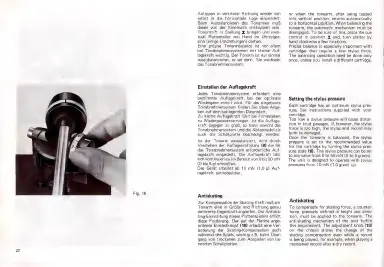
Fig.
16
Antippen
in
vertikaler
Richtung
wieder
von
selbst
in
die
horizontale
Lage
einpendelt.
Beim
Ausbalancieren
des
Tonarmes
muß
dieser
von
der
Kinematik
entkoppelt
sein.
Tonarmlift
in
Stellung
Y
bringen
und
even-
tuell
Plattenteller
von
Hand
im
Uhrzeiger-
sinn
(einige
Umdrehungen)
drehen.
Eine
präzise
Tonarmbalance
ist
vor
allem
bei
Tonabnehmersystemen
mit
kleiner
Auf-
lagekraft
wichtig.
Der
Tonarm
ist
nur
einmal
auszubalancieren,
es
sei
denn,
Sie
wechseln
das
Tonabnehmersystem.
Einstellen
der
Auflagekraft
Jedes
Tonabnehmersystem
erfordert
eine
bestimmte
Auflagekraft,
bei
der
optimale
Wiedergabe
erzielt
wird.
Für
das
eingebaute
Tonabnehmersystem
finden
Sie
diese
Anga-
ben
auf
dem
beiliegenden
Datenblatt.
Zu
kleine
Auflagekraft
führt
bei
Fortestellen
zu
Wiedergabeverzerrungen.
Ist
die
Auflage-
kraft
dagegen
zu
groß,
so
kann
sowohl
das
Tonabnehmersystem
und
die
Abtastnadel
als
auch
die
Schallplatte
beschädigt
werden.
Ist
der
Tonarm
ausbalanciert,
wird
durch
Verdrehen
der
Auflagekraftskala
(8)
die
für
das
Tonabnehmersystem
erforderliche
Auf-
lagekraft
eingestellt.
Die
Auflagekraft
läßt
sich
kontinuierlicr
im
Bereich
von
O
bis
50
mN
(0
bis
5
p)
erstellen,
Das
Gerät
arbeitet
ab
10
mN
(1,0
p)
Auf-
lagekraft
betriebssicher.
Antiskating
Zur
Kompensation
der
Skating-Kraft
muß
am
Tonarm
eine
in
Größe
und
Richtung
genau
definierte
Gegenkraft
angreifen.
Die
Antiska-
ting-Einrichtung
dieses
Plattenspielers
erfüllt
diese
Forderung.
Der
auf
der
Platine
ange-
ordnete
Einstellknopf
(10)
erlaubt
eine
Ver-
änderung
der
Skating-Kompensation
auch
während
des
Spiels,
wichtig
z.B.
beim
Über-
gang
von
trockenen
zum
Abspielen
von
be-
netzten
Schallplatten.
or
when
the
tonearm,
after
being
tapped
into
vertical
position,
returns
automatically
to
a
horizontal
position.
When
balancing
the
tonearm,
the
automatic
mechanism
must
be
disengaged.
To
be
sure
of
this,
place
the
cue
control
in
position
Y
and,
turn
platter
by
hand
clockwise
a
few
rotations.
Precise
balance
is
especially
important
with
cartridges
that
require
a
low
stylus
force,
The
balancing
operation
need
be
done
only
once,
unless
you
install
a
different
cartridge.
Setting
the
stylus
pressure
Each
cartridge
has
an
optimum
stylus
pres-
sure.
See
instructions
supplied
with
your
cartridge.
Too
low
a
stylus
pressure
will
cause
distor-
tion
in
loud
passages,
If,
however,
the
stylus
force
is
too
high,
the
stylus
and
record
may
both
be
damaged.
Once
the
tonearm
is
balanced,
the
stylus
pressure
is
set
to
the
recommended
value
for
the
cartridge
by
turning
the
stylus
pres-
sure
scale
(8).
The
stylus
pressure
can
be
set
to
any
value
from
O
to
50
mN
(0
to
5
grams).
The
unit
is
designed
to
operate
with
stylus
pressures
from
10
mN
(1.0
gram)
up.
Antiskating
To
compensate
for
skating
force,
a
counter-
force,
precisely
defined
in
height
and
direc-
tion,
must
be
applied
to
the
tonearm.
The
anti-skating
mechanism
of
the
unit
fulfills
this
requirement.
The
adjustment
knob
(10)
on
the
chassis
allows
the
change
of
the
skating
compensation
even
while
a
record
is
being
played,
for
example,
when
playing
a
moistened
record
after
a
dry
record.

Related product manuals