47
• Start the engine and let it run until any remaining petrol has
been used up.
• Open battery cap and remove battery.
• Change the oil at the end of every season. To do so, remove
the used engine oil from a warm engine and refill with fresh
oil.
• Remove the spark plug from the cylinder head.
• Fill the cylinder with approx. 20ml of oil from an oil can.
• Slowly pull back the starter handle, which will bathe in the cy-
linder wall with oil.
• Screw the spark plug back in.
• Clean the cooling fins of the cylinder and the housing.
• Be sure to clean the entire machine to protect the paint.
• Store the machine in a well-ventilated place.
Battery Pack and Charger
When not in use, disconnect charger and store in a cool, dry
area. Wet, damp areas can cause corrosion of terminals and
electrical contacts. If stored for long periods in high tempera-
tures (120° F / 50° C), perma-nent damage to the battery pack
can result. Check electrical terminals and contacts on battery
packs and charger. Wipe with clean cloth or blow clean with
compressed air.
After storage, a normal charge may be required. To check
available charge, press the Battery Fuel Gauge button
and charge if required. See the Battery Fuel Gauge sec-
tion.
Incorrect storage can damage the battery and is excluded
from the guarantee.
Transport
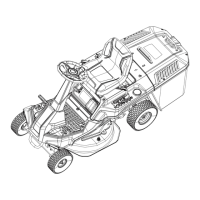
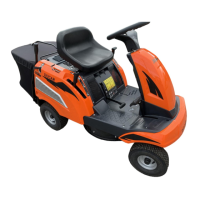
Transporting the ride-on mower
On account of its own weight, the ride-on mower can cause
severe crush injuries. Particular care must be taken when loa-
ding or unloading the ride-on mower onto/from a vehicle or trai-
ler for transport purposes.
This ride-on mower must not be towed. For transport-ing on
public roads, a suitable vehicle or a suitable trailer must be
used.
Secure the ride-on mower on a loading area during transport.
Always engage the parking brake.
Prior to transporting or storage, disengage the drive to the mo-
wing blade or attachments.
When transporting the machine, always observe re-gional le-
gislation, especially regarding load security and the transport
of objects on load loors.
Allow the machine, in particular the engine and muf-ler, to cool
down completely after loading and before further transport. The
load loor and the area around the mu ler and engine must be
kept free of combusti-ble materials such as straw, leaves or dry
grass resi-dues.
Always remove the ignition key.
23. Disposal and recycling
The equipment is supplied in packaging to prevent it from being
damaged in transit. The raw materials in this packaging can be
reused or recycled. The equip-ment and its accessories are
made of various types of material, such as metal and plastic.
Defective components must be disposed of as special waste.
Ask your dealer or your local council.
Old devices must not be disposed of with house-hold
waste!
This symbol indicates that this product must not be dis-
posed of together with domestic waste in compliance
with the Directive (2012/19/EU)
pertaining to waste electrical and electronic
equipment (WEEE). This product must be disposed of at a de-
signated collection point. This can occur, for example, by han-
ding it in at an author-ised collecting point for the recycling of
waste elec-trical and electronic equipment. Improper handling
of waste equipment may have negative consequences for the
environment and human health due to potentially hazardous
substances that are often contained in electrical and electronic
equipment. By properly disposing of this product, you are also
con-tributing to the e ective use of natural resources. You can
obtain information on collection points for waste equipment from
your municipal administration, public waste disposal authority,
an authorised body for the disposal of waste electrical and elec-
tronic equipment or your waste disposal company.
Batteries and rechargeable batteries do not be-long in the
household waste!
As the consumer you are required by law to bring all
batteries and rechargeable batteries, regardless whet-
her they contain harmful sub-stances* or not, to a
collection point run by the local authority or to a retailer, so
that they can be disposed of in an environmentally friendly
manner.
*labelled with: Cd = cadmium, Hg = mercury, Pb = lead
• Remove the batteries from the laser before disposing of the
machine and the batteries.
24. Troubleshooting
Troubleshooting
The table shows potential failures, their possible cause and re-
moval options. However, if you are un-able to remove the prob-
lem, contact a professional to assist you. m CAUTION!
Always switch off the engine and pull the ignition cable before
starting any inspection or adjustment work. m CAUTION!
If, after making an adjustment or repair to the engine, you let it
run for a few minutes, remember that the ex-haust and other
parts will get hot. Thus, do not touch parts that emanate heat,
as these may burn you.


 To Next Page
 Loading...