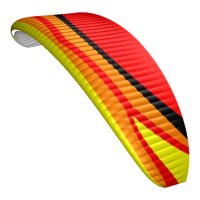
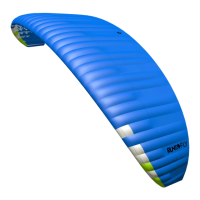
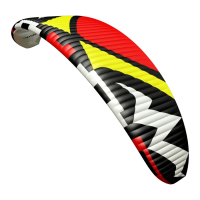
When flying in slow configuration turns can be much tightened and more
effective by means of differential brake operation. Slight use of the outer
brake (with considerable amount of the inner one) will diminish the loss of lift
in turn. Turns can be much improved by additional use of throttle, speed-
system etc.
Once with growing experience you will master these techniques, you will be
able to execute fully coordinated and effective turns, bringing to mind the
aeroplane handling.
REMEMBER:
=
Trimmer setting is another part of the pre-start check list!
=
If it will be asymmetric, the wing will be turning all the time. And if you
will inadvertently set them off, the reflex profile of the Universal will
keep the wing level, so after opening the throttle you'll start to descend
with increased speed instead of climbing.
3.3.3 LANDING
In PPG flying there are two kinds of landing: with and without power.
Power off landing
At an altitude of 50 metres switch the engine off and glide as you would on a
conventional paraglider. It reduces the chances of damaging the propeller on
landing, but on the other hand there is only one attempt possible - so it has
to be done right! With or without power Universal better copes with
turbulence on partly open trimmers (i.e. some 6 cm, position ‘6’). So, if the
conditions are rough, better make an approach with greater speed, plan a lot
of free space (as for a hangglider) and wear that speed off before touching
down. Universal preserves the energy well, so there is a long float
necessary, exchanging the abundant speed for lift with your brakes.
If the landing field is not big enough and you have to land on the spot, we
advise you to set the trimmers in slower settings. It will increase lift
coefficient of the wing, effectively decreasing its sink rate and speed. Such
an action is especially important when flying with high surface loading.
Powered landing
Make a flat approach with the engine idling, then level out and lose the
speed before final flare. Immediately after touchdown switch off the engine.
The main advantage of this procedure is of course the possibility of a
repeated approach if anything goes wrong. Still, if you forget to switch off the
ignition before the wing falls down, there is a considerable risk of damaging
propeller, catching lines in it or even suffering injuries connected with falling
on your running engine.
Remember:
=
Whenever possible, get to know the landing field before taking off.
22


 To Next Page